
📌 한국어로 읽고 싶어요? 👉 [한국어 블로그]
Hello, everyone. 😊
In August, what is the most special day in your country?
Maybe one day comes to mind. Some countries celebrate their independence on August 15. Others celebrate a few days before or after. It’s interesting — many of these special days happen in the middle of August, all around the world.
But even at the same time of year, these days have slightly different faces. For some countries, it is “the day we won the war.” For others, it is “the day we got back what was taken from us.” Korea’s August 15 is closer to the second one.
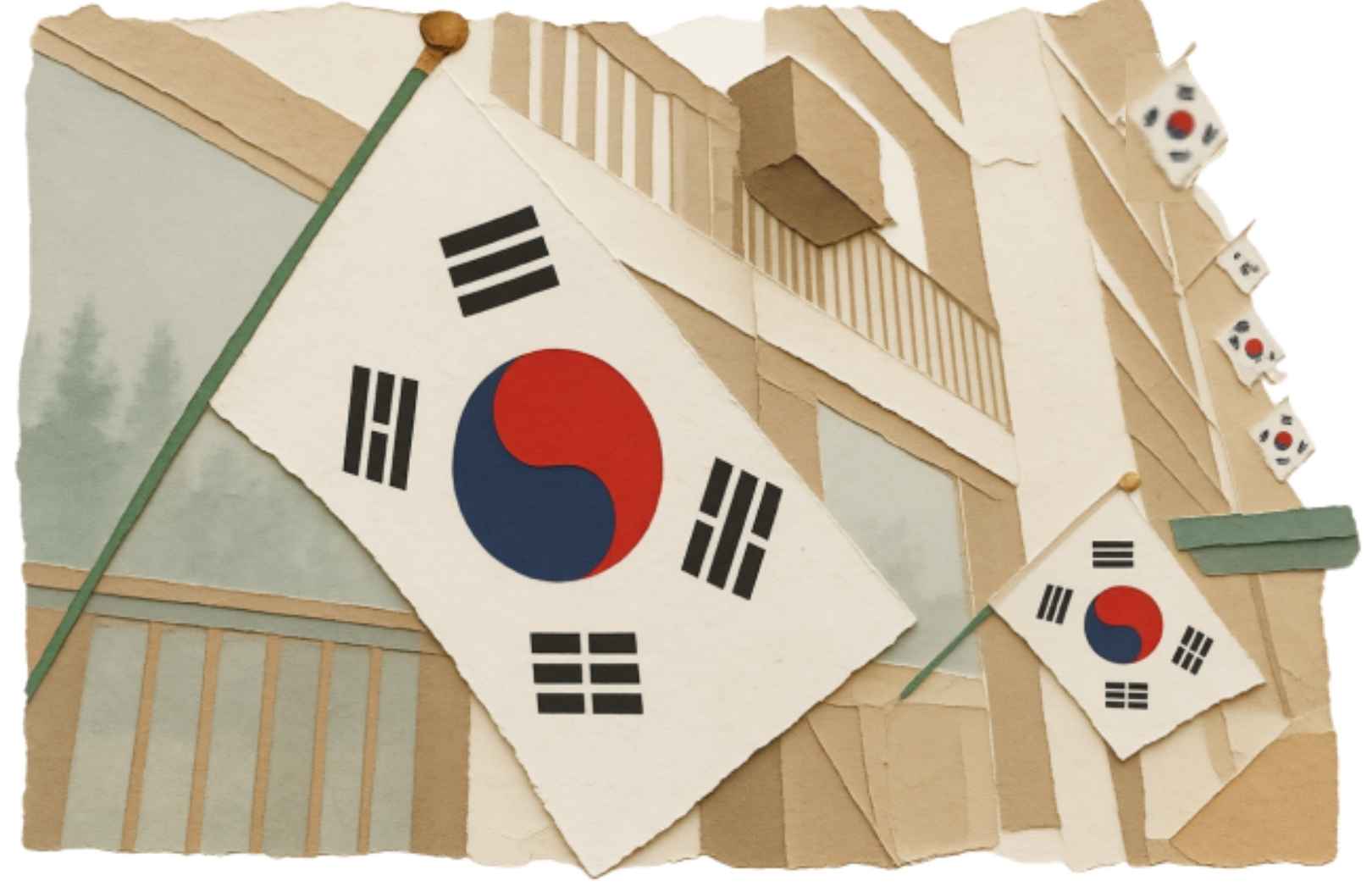
So on this day, you can see the Korean flag (Taegeukgi) a little more often on the streets. On apartment windows, in front of government buildings, and sometimes even on passing cars, you can see a small Korean flag.
This day is Gwangbokjeol (광복절).
“Gwangbok (光復)” comes from two Chinese characters: light (光) and return (復). So it means “getting the light back.” It is the day Korea became free from Japanese rule, on August 15, 1945. This year, 2026, is the 81st anniversary.
But why do people say Korea “got its light back”? Getting the light back means there was a time when the light was lost. Let’s start with that story.
The time when Korea lost its light
In 1910, Japan forced Korea to become part of Japan. This is called annexation (joining two countries into one — here, joined by force). To rule Korea, Japan built the Joseon Government-General (조선총독부), the top office in charge of colonial rule.
From this time until 1945, Korea lived under Japanese occupation for 35 years. During this time, Korean people had many things taken away. They had no political freedom. If they asked for independence, they were arrested.
From the late 1930s, when Japan was fighting a big war, its policy became even stronger. Japan tried to turn Korean people into Japanese people. This kind of policy is called assimilation (trying to change one people into another). Here are some real examples:
- Koreans were forced to bow to Japanese gods. This is called Sinsa-chambae (신사참배) — being forced to bow at Japanese shrines.
- Koreans were forced to change their names into Japanese-style names. This is called Changssi-gaemyeong (창씨개명).
- Koreans were not allowed to use or teach the Korean language at school or in daily life. Near the end of the war, Japan tried to ban Korean completely.
People were taken away, too. Men were forced to become soldiers or workers — this is called forced mobilization (강제동원) — and were sent to battlefields, coal mines, and factories. Women and young girls were also taken away. Many of these women suffered terrible sexual violence under the Japanese military “comfort women” system. The fact that the Japanese military was involved was later admitted by the Japanese government in the 1993 Kono Statement.
So for Korean people, this time is not simply “a time long ago when another country ruled us.” It is remembered as a time of loss — a time when not only their country, but also their names, their language, and even people’s dignity were threatened by force.
But people did not stay quiet
On March 1, 1919, people all over the country came out to the streets holding the Korean flag.
“Long live Korean independence!”
Students, religious leaders, merchants, and farmers shouted it together. This big event is called the March 1st Movement (3·1운동). Because of this movement, in the same year, the Provisional Government of Korea (대한민국 임시정부) was set up far away in Shanghai, China — a temporary government made overseas until Korea could be free again.
The independence movement did not have just one shape. Some people fought with weapons. Some asked other countries for help. Some built schools. Some made newspapers.
And some people thought that protecting the Korean language was also a way to protect the country. The very language you are learning right now — they believed that protecting it was protecting the nation.
Protecting the language was also protecting the country
Even when Japan was pushing the Korean language down, scholars kept studying and teaching it. In 1921, a group of scholars who studied Korean was created. Later, this became the Korean Language Society (조선어학회). They worked to make Korean spelling rules the same everywhere, to organize the standard language, and to start making a Korean dictionary.
But in 1942, Japan arrested these scholars. The materials and dictionary drafts they had worked so hard to gather were taken away. Two scholars, Yi Yun-jae and Han Jing, died in prison. Several others were sent to jail — just because they tried to protect their language.
Even so, the Korean language did not disappear. The language you are learning today survived and came all the way here.
🎬 If you enjoy watching Korean movies or K-dramas,
“Malmoi” (말모이, 2019) is a must-watch film that shows the true history behind the language.
“Malmoi” means “gathering words.” In the time when the Korean language was banned, it is a story about ordinary people — not famous heroes — who gathered words from all over the country, one by one, to make a dictionary. If you are learning Korean, a dictionary may feel a little different after watching it.
As a person who teaches Korean, every Gwangbokjeol I feel thankful that the Korean language was protected. Protecting a country was not only something done with guns. Using your own language, teaching it, and passing it to the next generation — that was also a way to protect a nation.
And then, August 15, 1945
As World War II was ending, on August 15, 1945, Japan announced its surrender. At last, Korea became free.
Of course, freedom did not come for only one reason. Japan losing the war was a big part of it. At the same time, there was also the independence movement that Korean people never gave up, through all those long years.
So on Gwangbokjeol, people remember not only the result — “we got it back” — but also the long time it took to get there. There are names all Koreans know, like Yu Gwan-sun, Kim Gu, Yun Bong-gil, and Lee Bong-chang. But there were also many, many people who were sacrificed, whose names we don’t even know.
Hanging the Korean flag on Gwangbokjeol is one way to remember all of them.
This is the story of “Gwangbokjeol — Getting the Light Back.”
But the story of Gwangbokjeol does not end in 1945. Some of the wounds from that time have not healed yet. That is why the way Koreans feel about Japan today is a little complicated.
In Part 2, I’ll continue with “Gwangbokjeol — Today’s Story”: the problems that are still not solved, the films that try to remember them, and even the strange, strong feelings that come out during a Korea–Japan soccer match.
See you in Part 2~ 🥰
📢 Want to learn more about Korean culture? 👉 [ Korean Culture ]
📖 Key words in this story
| Word | Meaning |
|---|---|
| Gwangbok (광복) | Getting the light back. Winning back a lost country. |
| Gwangbokjeol (광복절) | The day that celebrates Gwangbok. August 15. |
| Byeonghap (병합) | Joining two countries into one. Here, Japan joining Korea by force in 1910. |
| Joseon Government-General (조선총독부) | The top Japanese office in charge of colonial rule. |
| Sinsa-chambae (신사참배) | Being forced to bow at Japanese shrines. |
| Changssi-gaemyeong (창씨개명) | Being forced to change Korean names into Japanese-style names. |
| Gangje-dongwon (강제동원) | Forced mobilization — being taken against your will to work. |
| Samil Undong (3·1운동) | The nationwide independence movement of March 1, 1919. |
| Joseoneo Hakhoe (조선어학회) | The society of scholars who studied and protected the Korean language. |