
Have you ever visited a traditional Korean market? When you walk through the market(전통시장), you will see many pretty clothes and delicious foods everywhere!
But have you ever struggled to explain exactly what you want to buy?
For example, instead of just saying “I want to buy a bag (가방을 사고 싶어요),” wouldn’t it be much better if you could say, “I want to buy a cheap bag (싼 가방을 사고 싶어요)” or “I am looking for a small bag (작은 가방을 찾고 있어요)”?
After reading this blog post, you will be able to describe the characteristics of any object or person beautifully and accurately, just like a native speaker! Are you ready to find out how this grammar works? Let’s explore together!
1. Meaning & Function Korean adjective modifier
In English, when you want to describe a noun, you simply place the adjective before it (e.g., pretty clothes, cheap bag). In Korean, however, you cannot put a basic adjective form (like 예쁘다 or 싸다) directly in front of a noun.
To make an adjective describe a noun, you must drop the dictionary ending -다 and attach -ㄴ or -은 to the adjective stem. This form is called the determiner form (관형사형).
- 예쁘다 (to be pretty) + 옷 (clothes) → 예쁜 옷 (pretty clothes)
- 싸다 (to be cheap) + 가방 (bag) → 싼 가방 (a cheap bag)
Using this grammar allows you to vividly explain the unique features of objects, places, or people around you!
2. Conjugation Rules & Table of Korean adjective modifier
The form changes depending on whether the adjective stem ends in a vowel or a final consonant (받침). Let’s look at the three simple rules.
Rule 1: No Final Consonant (Ends in a Vowel) ➡️ Add ‘-ㄴ’
If the adjective stem does not have a final consonant, simply attach -ㄴ to the bottom of the stem.
| Dictionary Form | Stem | Change | Final Form | Example Sentence |
| 싸다 (to be cheap) | 싸- | + ㄴ | 싼 | 시장에서 싼 옷을 많이 사요. (I buy a lot of cheap clothes at the market.) |
| 크다 (to be big) | 크- | + ㄴ | 큰 | 큰 가방을 사고 싶어요. (I want to buy a big bag.) |
| 예쁘다 (to be pretty) | 예쁘- | + ㄴ | 예쁜 | 저기 예쁜 모자가 있어요. (There is a pretty hat over there.) |
| 편하다 (to be comfortable) | 편하- | + ㄴ | 편한 | 저는 편한 신발을 찾고 있어요. (I am looking for comfortable shoes.) |
Rule 2: Has a Final Consonant (받침) ➡️ Add ‘-은’
If the adjective stem ends in a final consonant, add -은 right after the stem.
| Dictionary Form | Stem | Change | Final Form | Example Sentence |
| 작다 (to be small) | 작- | + 은 | 작은 | 아디티 씨는 작은 가방을 찾아요. (Aditi is looking for a small bag.) |
| 좋다 (to be good) | 좋- | + 은 | 좋은 | 여기 정말 좋은 시장이 있어요. (There is a really good market here.) |
| 많다 (to be many/a lot) | 많- | + 은 | 많은 | 주말에 시장에 많은 사람이 왔어요. (A lot of people came to the market on the weekend.) |
Rule 3: ‘ㄹ’ Final Consonant ➡️ Drop ‘ㄹ’ and Add ‘-ㄴ’
If the adjective stem ends in the consonant ㄹ, you must remove the ㄹ first, and then attach -ㄴ underneath.
| Dictionary Form | Stem | Change | Final Form | Example Sentence |
| 길다 (to be long) | 길- | Drop ㄹ + ㄴ | 긴 | 수엔 씨는 긴 치마를 입었어요. (Xuyen wore a long skirt.) |
| 멀다 (to be far) | 멀- | Drop ㄹ + ㄴ | 먼 | 저는 학교에서 먼 곳에 살아요. (I live in a place far from the school.) |
💡 Teacher’s Note: Watch out for Color Adjectives! (ㅎ Irregular)
Color words like 빨갛다 (to be red), 파랗다 (to be blue), 하얗다 (to be white), and 까맣다 (to be black) drop the ㅎ and change their forms uniquely before a noun:
- 빨갛다 + 옷 → 빨간 옷 (Red clothes)
- 파랗다 + 가방 → 파란 가방 (Blue bag)
- 하얗다 + 신발 → 하얀 신발 (White shoes)
- 까맣다 + 모자 → 까만 모자 (Black hat)
3. Common Learner Mistakes of Korean adjective modifier
As a beginner, it is very natural to make mistakes. Let’s look at what foreign students frequently mix up so you can avoid these common traps! Understanding these traps will make you a master of the Korean adjective modifier rules.
| ❌ Incorrect | ✅ Correct | Why is it wrong? DOCX |
| 빨갛다 옷 | 빨간 옷 | You cannot use the base dictionary form directly before a noun. You must conjugate it to match the noun-modifying rule! |
| 작다 가방 | 작은 가방 | Since the stem 작- has a final consonant, you must append -은 instead of leaving it plain. |
| 먹는 음식 | – | Warning! The formula -ㄴ/은 is strictly used for Adjectives. For Verbs (like 먹다 – to eat, 사다 – to buy), a completely different modifier form (-는) is used. We will learn that in a later chapter! |
4. Real-Life Dialogue (At a Local Market)
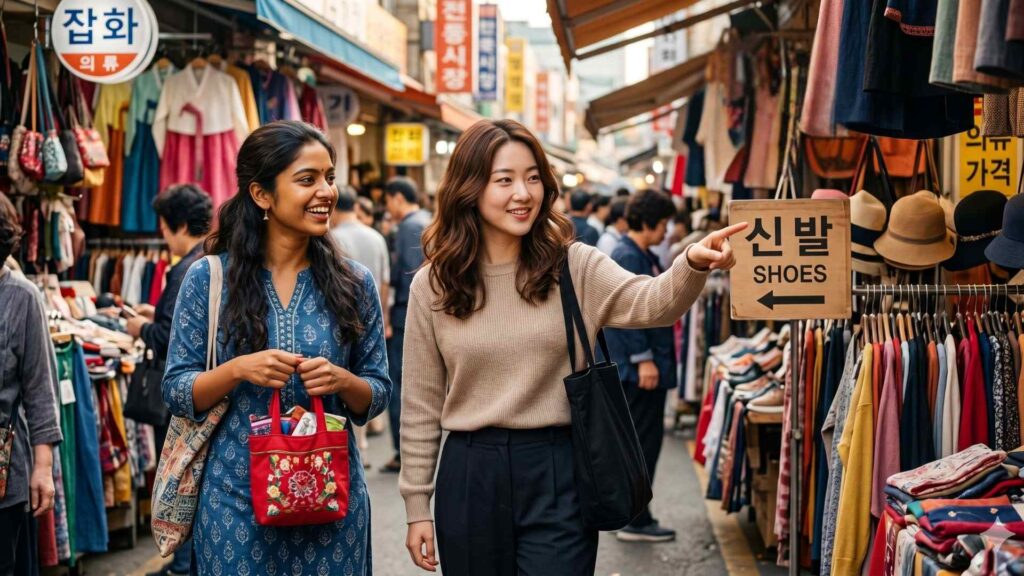
Let’s read a conversation between two international students: Xuyen (from Vietnam) and Aditi (from India). They are enjoying a weekend shopping trip at a traditional Korean market near their university. Pay close attention to how they use today’s grammar-Korean adjective modifier point!
① Listening Practice (듣기 연습)
Instructions: Listen to the dialogue and answer the following questions.
1) 여기는 어디입니까?
2) 누가 가방을 샀습니까?
- 아디티 : 수엔 씨, 여기 물건이 정말 많아요! 예쁜 옷도 있어요.
- 수 엔 : 네, 이 시장은 싼 물건이 많아서 자주 와요. 아디티 씨는 뭘 사고 싶어요?
- 아디티 : 저는 작은 가방을 찾고 있어요. 어! 저기 빨간 가방이 있어요!
- 수 엔 : 정말 예쁜 가방이네요.
- 아디티 : 저 빨간 가방은 얼마예요?
- 판매원 : 이만 원이에요.
- 아디티 : 와, 정말 싼 가격이에요! 살게요. 수엔 씨는요?
- 수 엔 : 저는 편한 하얀 신발을 사고 싶어요. 저쪽에 신발 가게가 있으니까 같이 가요!
👉 Click Dialogue Translation!
- 아디티 : Xuyen, there are so many things here! There are pretty clothes too.
- 수 엔 : Yes, this market has a lot of cheap things, so I come here often. What do you want to buy, Aditi?
- 아디티 : I am looking for a small bag. Oh! There is a red bag over there!
- 수 엔 : That is a really pretty bag.
- 아디티 : How much is that red bag?
- 판매원 : It is 20,000 won.
- 아디티 : Wow, that is a really cheap price! I will buy it. How about you, Xuyen?
- 수 엔 : I want to buy comfortable, white shoes. There is a shoe store over there, so let’s go together!
② Comprehension Questions (내용 이해 질문)
1) 아디티 씨는 어떤 가방을 샀습니까?
2) 가방은 얼마입니까?
3) 수엔 씨는 어떤 물건을 사고 싶어 합니까?
5. AI Tutor Practice
🤖 Digital Literacy Tip! The best way to master a new language is to practice using it actively. We want you to use AI as your personal conversation partner! Copy the prompt box below and paste it into ChatGPT (or any AI tool) to start practicing your real-life shopping dialogue with Korean adjective modifier right now.
[Copy and paste this prompt into AI ]
Act as a kind and encouraging Korean language teacher. I am a beginner-level student practicing the grammar "-ㄴ/은 [명사]" (Korean adjective modifying a noun) based on a shopping/market context.

Please follow these steps:
1. Greet me warmly in easy Korean and ask me what kind of item I want to buy at the traditional market today.
2. When I reply in Korean, check if I correctly used the "-ㄴ/은" adjective modifier grammar form.
3. If I make a mistake with grammar, spelling, or vocabulary, gently point out the error, explain why, and provide the corrected sentence.
4. Keep the conversation going for 3-4 turns by asking simple follow-up questions (such as asking about the color, size, or price of the item).
5. Please use simple Korean suitable for an elementary/TOPIK Level 2 learner, and include English translations in parentheses for your responses so I can follow along easily.
6. Today’s Quiz
Test your understanding of Korean adjective modifier with these practice exercises based on today’s lesson!
[Quiz 1] Conjugate the adjective in the brackets to complete the phrase.
- ( 예쁘다: to be pretty ) + 옷 → __________ 옷
- ( 작다: to be small ) + 가방 → __________ 가방
- ( 편하다: to be comfortable ) + 신발 → __________ 신발
- ( 비싸다: to be expensive ) + 옷→ __________ 옷
👉 Click here to see the [Quiz 1 Answers]
- 예쁜 옷 (pretty clothes)
- 작은 가방 (small bag)
- 편한 신발 (comfortable shoes)
- 비싼 옷 (expensive clothes)
[Quiz 2] Combine the two short sentences into one fluid sentence using today’s grammar, following the example.
Example (보기): 가방이 있어요. 그 가방은 커요. => 큰 가방이 있어요. (There is a big bag.)
- 옷이 있어요. 그 옷은 싸요. => _____________________
- 신발이 있어요. 그 신발은 편해요.=> _____________________
👉 Click here to see the [Quiz 2 Answers]
- 싼 옷이 있어요. (There are cheap clothes.)
- 편한 신발이 있어요. (There are comfortable shoes.)
7. Wrap-up & Next Lesson
Fantastic job today! Today, we completely conquered the korean adjective modifier form!
You have learned how to use the adjective modifier -ㄴ/은 to vividly describe people and objects around you. Now you don’t have to just point at an object and say “this” or “that”—you can proudly say “예쁜 옷 (pretty clothes)” or “작은 가방 (small bag)”!
In our next lesson (Day 2), we will explore how to talk about money and costs at the market using [Korean Numbers: Sino-Korean Numbers (일·이·삼·사…)]. You will learn exactly how to ask for prices and understand numbers up to tens of thousands in Korean!
Keep up the incredible work, stay curious, and see you!
If you have any questions, please leave a comment~!
여러분, 다음에 또 만나요!
<Latest Posts>