
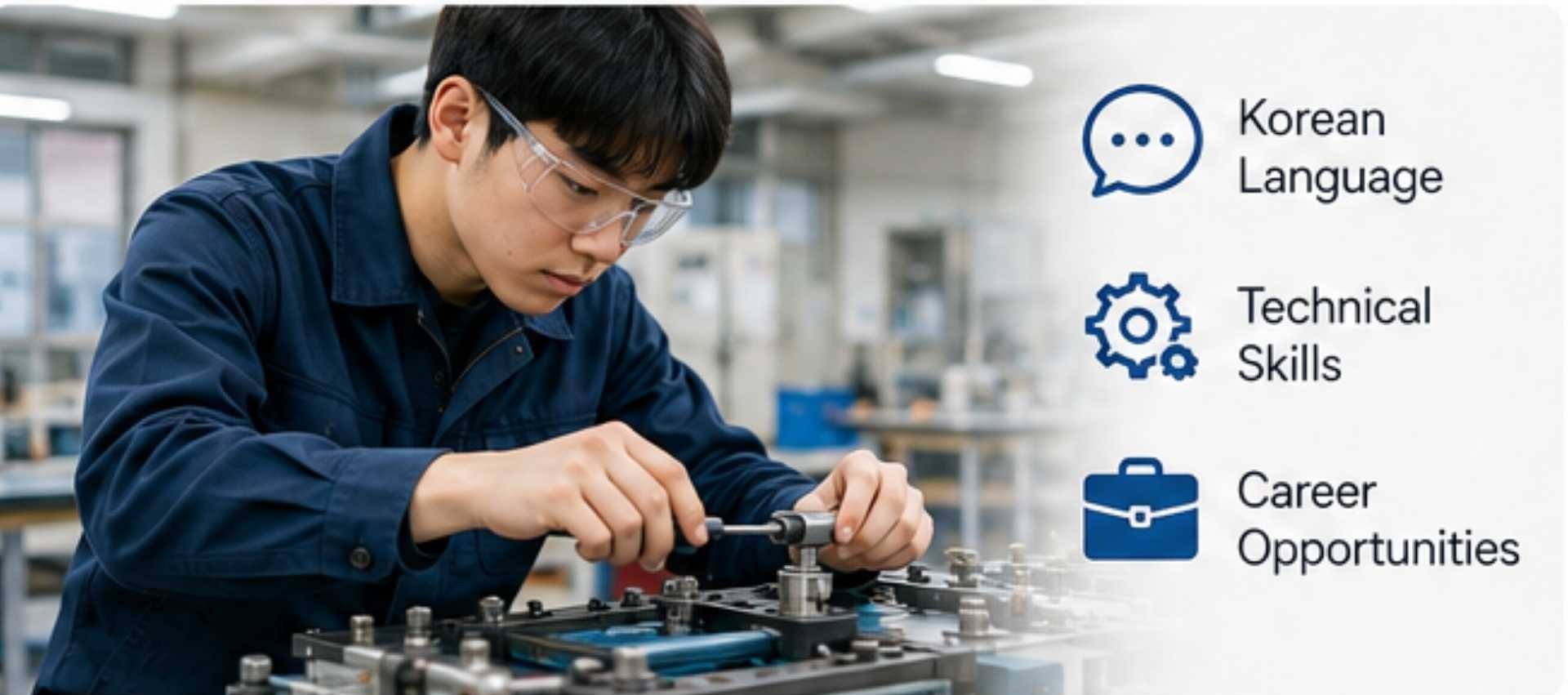
Many international students dream to study in Korea for 2 years, hoping it will change the next 20 years of their life.
They watch Korean dramas. They listen to K-pop. They study Korean. They imagine a better life in Korea.
But here is the important question.
Do you want to go to Korea only for a short time?
or Do you want to build a real future in Korea?
These two goals are very different.
Going to Korea is not enough. A visa is not enough. A school admission letter is not enough. If you want to stay longer, work legally, and live with more stability, you need a plan.
That plan should include three things:
1. Korean language skill
2. Professional technical skill
3. A legal path after graduation
This is why many students should not only ask,
“How can I go to Korea?”
They should ask a better question:
“What can I become in Korea?”
This article explains one possible path: studying in Korea, learning a real skill, joining internship or field training, and preparing for work and long-term stay opportunities after graduation.
This is not a magic promise. It is not an easy shortcut.
But for the right student, it can be a strong and realistic path.
Why Just “Going to Korea” Is Not Enough
Many international students make one big mistake.
They think Korea itself is the goal.
So they focus only on these questions:
– Which school can accept me?
– How fast can I get a visa?
– How much money do I need first?
– Can I work part-time?
These questions are important. But they are not enough.
After you arrive in Korea, your real life begins.
You need to understand classes. You need to talk with professors. You need to live with Korean people. You need to work with Korean staff. You need to follow rules. You need to prepare your next visa.
If your Korean is weak, life becomes hard.
If you do not have a skill, getting a good job becomes hard.
If your major and job do not connect, your visa plan may become hard.
So the smart question is not: “Can I enter Korea?”
The smart question is:
“After I enter Korea, what path can help me grow?”
A good study plan to study in Korea for 2 years should not end at admission. It must connect to graduation, work, and a better future.
Korea Is Changing: Students With Skills May Have More Chances
Korea is facing a big change.
Many local areas need young workers. Many factories need people who can learn machines, technology, safety rules, and real work. At the same time, Korea wants better international students, not only more international students.
In March 2026, Korea’s Ministry of Justice announced the [2030 Future Strategy for Immigration Policy].
In that announcement, the government included a new direction for “development-type specialized technical workforce” to help manufacturing industries and regional areas.
Source: [Ministry of Justice, 2030 Immigration Policy Future Strategy]
In April 2026, the Ministry of Justice also started a public-private council to discuss the future direction of international student visa policy.
Source: [Korea Immigration Service, International Student Visa Policy Council]
This means one thing clearly:
Korea is not only thinking about students who come, study, and leave.
Korea is also thinking about students who can study, grow, work, and help local industries.
This is important for you.
If you learn Korean and build a technical skill, you may have more chances than students who only want to enter Korea without preparation.
A New Type of Study Plan: Korean Language + Technical Skills
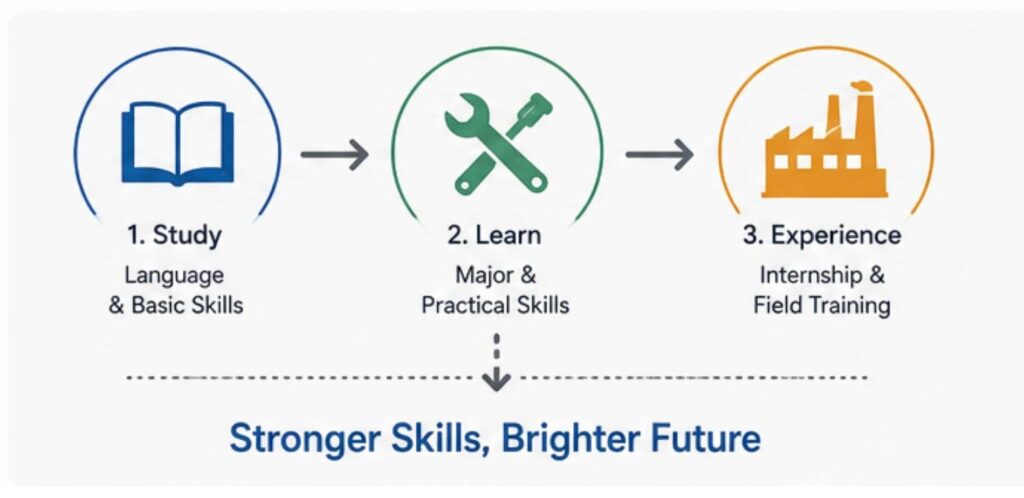
Technical skills for studying in Korea
For many students, the best future path may not be only a normal university degree.
A technical college or a specialized technical department can be a better choice for some students.
Why?
Because these programs focus on real skills for those who want to study in Korea for 2 years.
Students can study fields such as:
– future automobiles
– electric vehicles
– machinery
– smart manufacturing
– industrial equipment
– welding and production technology
– electronics
– battery-related fields
– factory automation
– maintenance and safety
These areas are not only classroom subjects.
They connect to real Korean industries.
A strong student does not only say, “I studied Korean.”
A strong student can say:
“I can understand Korean, and I can do useful technical work.”
That is a very different message
What Can You Build in 2 Years?
When you decide to study in Korea for 2 years, this period may sound short. But if you use these two years well, it can completely change your direction.
But if you use two years well, it can change your direction.
In the first stage, you build basic life and study power in Korea.
You learn how to understand Korean classes.
You learn how to ask questions.
You learn how Korean colleges work.
You learn rules, schedules, safety, and teamwork.
In the second stage, you learn your major.
You study basic theory. You practice in labs. You use tools, machines, software, or equipment. You learn how to solve problems. You learn how to work with others.
In the third stage, you prepare for the field.
Some programs include field practice, industry training, or internship in the last semester. This can help students understand real Korean workplaces before graduation.
This is important because Korean companies do not only want a diploma.
They want people who can:
– arrive on time
– follow safety rules
– understand instructions
– communicate in Korean
– work with a team
– learn quickly
– solve real problems
If you can show these skills, you become more than a foreign student.
You become a highly skilled professional that Korean companies are actively looking for.
Why Korean Language Still Matters
Some students think technical skills are enough.
They are not enough.
In Korea, Korean language is not only for daily life. It is also a work skill.
At school, you need Korean to understand lessons.
At work, you need Korean to understand safety rules.
In a factory, one small misunderstanding can become a big problem.
If a manager says, “Stop the machine,” you must understand quickly.
If a professor explains how to use equipment, you must understand clearly.
If a company asks you about your work experience, you must answer with confidence.
This is why TOPIK is important.
You do not need to put TOPIK in the title of this article. But in real life, TOPIK can be very important.
For some study-to-work programs, Korean ability is a key condition at admission and graduation. Some programs may require TOPIK Level 3 or a similar Korean language level at the beginning. For employment visa preparation after graduation, a higher Korean level may be needed, depending on the visa type and latest rules.
So do not study Korean only to pass a test.
Study Korean to protect your future.
Before you choose a school, ask yourself:
– Can I keep studying Korean?
– Do I want to learn a real skill?
– Am I ready to follow school and visa rules?
– Do I want a short experience or a long-term future?
If you are not sure, do not decide too fast.
First, learn the full path step by step.
Next: Why Internship Can Become the Most Important Semester in Korea.