Korean Liberation Day(Gwangbokjeol): Do Koreans Still Dislike Japan? – Part 2

Korean Liberation Day
📌 한국어로 읽고 싶어요? 👉 [한국어 블로그]

Welcome back! In Part 1 of our Korean Liberation Day (Gwangbokjeol) series, we talked about how Korea got its light back — the country and the language that were taken, the people who protected them, and the liberation of 1945.

But that light still has some shadow left. This is why the story of 광복절(Gwang-bok-jeol) does not end in 1945.

A story that is not finished yet

The Japanese occupation looks like a past that is completely over. But some of the wounds from that time still continue today.

The clearest examples are the Japanese Military Sexual Slavery “comfort women” victims and the forced mobilization victims. Some of the grandmothers who suffered are still alive today. They live in the same time as us.

In front of the Japanese Embassy in Seoul, there is a Statue of a Girl (소녀상) — a statue made to remember the “comfort women” victims. The long-running gatherings there quietly say that this problem is not over yet.
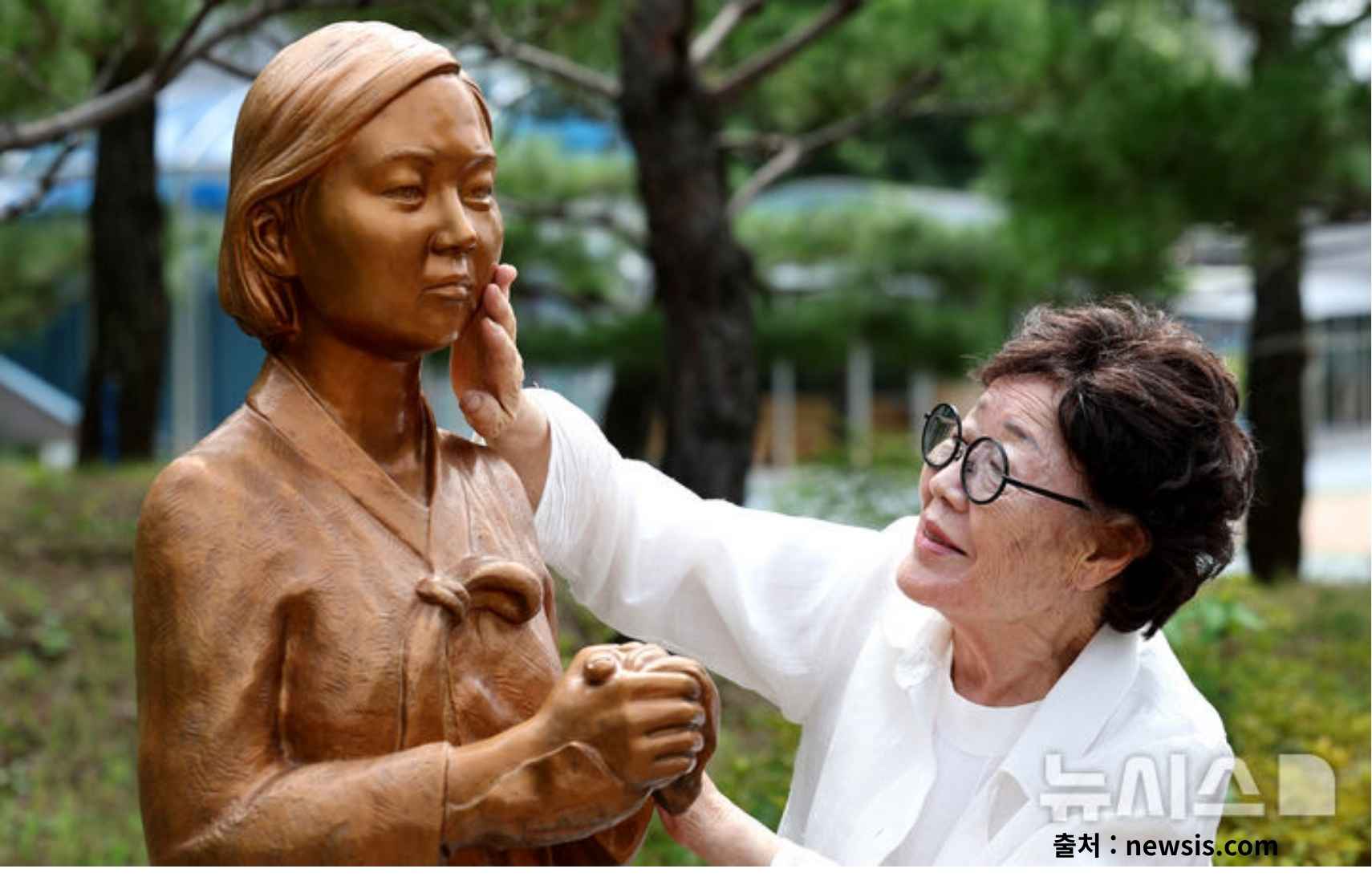
Korean Liberation Day Statue of a Girl

Legal fights also continue. One side wants to remember, the other side wants to erase. Even now, the two countries’ views have not come closer.

There is another situation to watch carefully — the Sado Mine (사도광산). This is a mine where about 1,500 Korean people were taken by force and made to work hard during the occupation. In 2024, Japan listed it as a UNESCO World Heritage site and promised to properly explain the “whole history,” including the forced labor. But in the actual exhibition, the word “forced” was missing, and both Koreans and Japanese were described as just “all workers.” So in 2026, UNESCO again asked Japan to tell the history properly.

Because things like this happen, in Korea, remembering itself is seen as an effort and a responsibility. If there is a force trying to erase, there must also be a force trying to keep.

Korea keeps this history in films

This is why so many films about painful history are made in Korea — to not forget, and to keep a record. If you are interested, you could start with these:

  • 아이 캔 스피크 I Can Speak” (2017) — The story of a survivor of Japanese Military Sexual Slavery (known as the “Comfort Women”) who learns English to testify before the U.S. Congress. Its light, approachable tone makes it a good starting point for anyone new to this history.
  • 귀향 Spirits’ Homecoming” (2016) — A film that faces the “Japanese Military comfort women” history directly. It was hard to get funding, so it was completed with support from many ordinary citizens.
  • 군함도 The Battleship Island” (2017) — The story of Koreans forced to work in the Hashima Island coal mine. Good to watch together with the Sado Mine story above.
  • 허스토리 Herstory” (2018) — Based on the true “Kanpu Trial,” where survivors in the 1990s stood up in a Japanese court themselves.

So, do Koreans still dislike Japan?

When you live in Korea, foreigners often ask this question. But the answer is not that simple.

Today, Korea and Japan are close neighbors. Many people travel between them and enjoy each other’s food, films, and music. Not many Koreans see each Japanese person living today as the same as the old Japanese empire.

But many Koreans also do not think the past is completely finished. So feelings toward Japan are often split into two hearts.

On one side is the feeling, “I want to get along well with Japanese people today.” On the other side is the feeling, “The wrongs of the past should be remembered clearly and resolved.” These two are not fighting each other — they are more like two feelings sitting side by side inside one person.

When history shows up in daily life — the Korea–Japan match

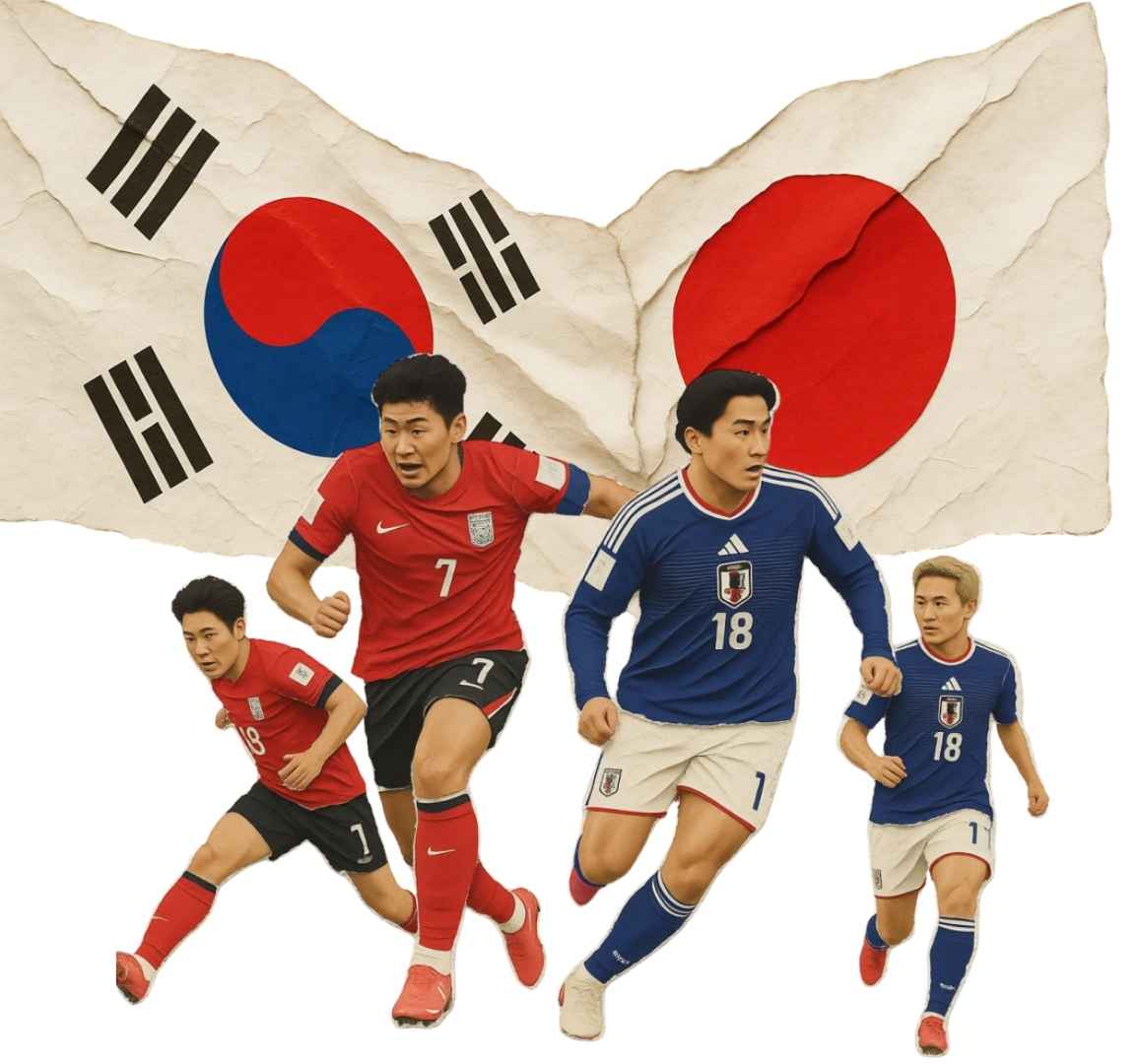
This subtle feeling sometimes jumps out at unexpected moments. A famous example is the Korea–Japan match (한일전), a sports game between Korea and Japan.

Whether it’s soccer or baseball, when the opponent is Japan, even people who usually don’t care about sports gather in front of the TV. In Korea, there is a half-joking saying: “We can lose to other countries, but we can’t lose to Japan.”

To a foreigner, this may look a little too much. But this heat is not really “hate” — it is closer to “pride that doesn’t want to lose.” After the game, most people go back to normal life, plan a trip to Japan, and eat Japanese ramen.

Speaking of travel — when Gwangbokjeol comes near, some people say, “Do I really have to travel to Japan on this exact day?” In reality, some Koreans do go to Japan even on this day. It just means that, on this one day, actions connected to Japan feel a little heavier than usual. If you are a foreigner, just knowing this feeling will help you understand Korean society much more deeply.

Remembering does not mean hating

When I talk about Gwangbokjeol, this is the part I most want to share.

The reason we remember history should not be to hate Japanese people today. But we should also be careful with the words, “For the future, let’s just forget the past.”

One country taking another by force. Taking people away to war and hard labor. Crushing the dignity of women. Trying to erase a people’s language. These things need to be remembered clearly. Remembering is not the same word as hating. It is closer to a promise: that such things must never happen again.

Today, I think about “Gwangbokjeol” once more

81 years ago, the people who met liberation came out to the streets and waved the Korean flag. It must have been the joy of getting their country back.

Some went to prison for shouting for independence. Some had their names taken away. Some were dragged to battlefields and factories. And some quietly studied Hangeul, made dictionaries, and passed the Korean language to the next generation.

Today, we speak and write Korean without a second thought, and people all over the world learn this language. If those people could see it, how would they feel? Maybe a little surprised — and maybe a little happy.

Gwangbokjeol is not a history only for Koreans. If you are learning Korean, then for just this one day, it would be nice to remember what kind of time this language passed through to reach you.

Gwangbokjeol. The day the light came back. And a day to quietly promise not to forget the time when that light was lost.

If your country has a similar day, please tell me in the comments~! I’d love to know, too.

See you in the next story. 안녕! 👋

📢 Want to learn more about Korean culture? 👉 [ Korean Culture ] 

📖 Key words in this story

WordMeaning
Wianbu (위안부)Japanese Military ‘Comfort Women’ — victims of Japanese Military Sexual Slavery during the colonial period; an issue that remains unresolved today.
Sonyeosang (소녀상)The “Statue of a Girl,” made to remember the “comfort women” victims.
Hanil Cheonggugwon Hyeopjeong (한일청구권협정)The 1965 agreement between Korea and Japan about compensation.
Sado Gwangsan (사도광산)A Japanese mine where Koreans were forced to work. Controversial after its UNESCO listing.
Haniljeon (한일전)A sports match between Korea and Japan.
Taegeukgi (태극기)The national flag of South Korea.

How to Use TOPIK Writing Paper (원고지): 5 Simple Rules (Part 3)

TOPIK Writing Paper
📢 한국어로 공부하고 싶어요? 👉  [ 한국어로 읽기 ]

Welcome back! 😊 Today, let’s learn how to use the TOPIK writing paper (원고지) step by step.

In Part 2, we learned the “-다 / -이다” written style used in TOPIK writing. Haven’t seen it yet? Read it first 👉 [ Part 2 How to change “-아요/어요” into “-다”].

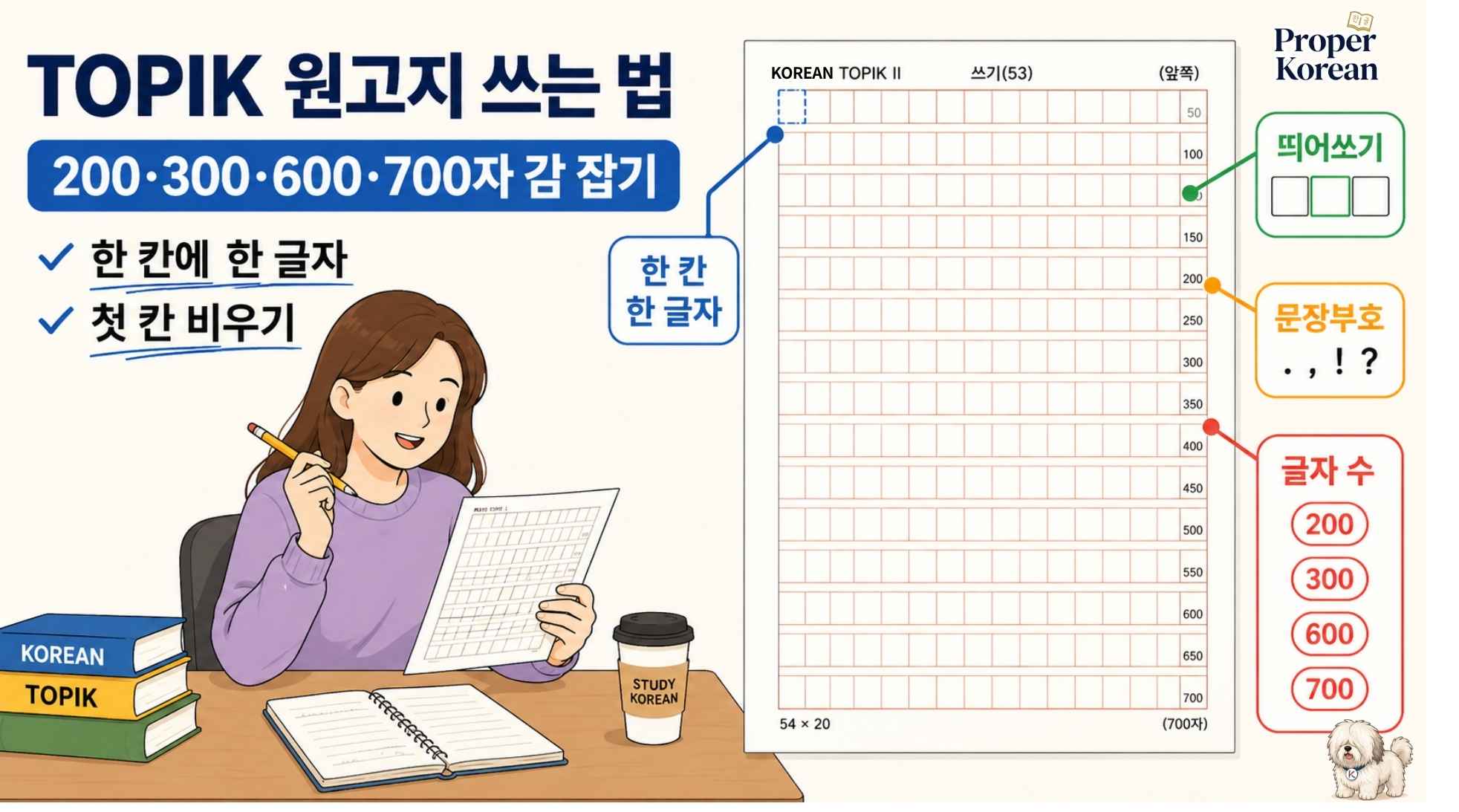
Today is about the TOPIK writing paper — in Korean it’s called 원고지. When you first see all the little squares, it can look complicated. But don’t worry. Today you don’t need to memorize every rule. You only need these three things.

💡 Remember just these:

  • What goes in one square?
  • How do I handle spaces?
  • How long are 200 and 600 characters?

Let’s take them one at a time.

1. Why does TOPIK use writing paper?

In Questions 53 and 54 you write longer text.

Question 53 is 200–300 characters, and Question 54 is 600–700 characters.

So the answer sheet has small squares for your writing.

These squares make it easy to see where your writing starts, whether you left spaces, and how much you have written. It feels awkward at first, but after a few tries it becomes easy.

2. The most important rule: one character per square

This is the first rule to remember. Write one character in one square. And a space also takes one empty square.

For example, “한국어가 좋다.” looks like this:

So don’t write it all joined together like “한국어가좋다.” Leave spaces, just like normal writing.

3. Leave the first square empty when you begin

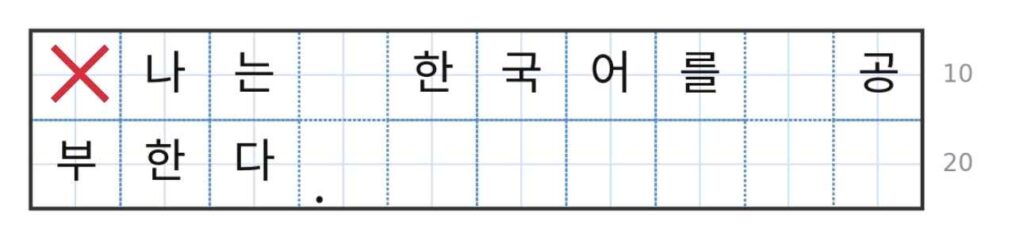
When you start writing, don’t write in the very first square. Leave the first square empty and start from the second square.

For example, if you begin with “나는 한국어를 공부한다.”, it starts like this:

Why leave it empty? It shows that a new paragraph is starting.

💡 Remember

  • New text → leave the first square empty
  • New paragraph → leave the first square empty

4. A new line is NOT a new paragraph

Beginners often get confused here.

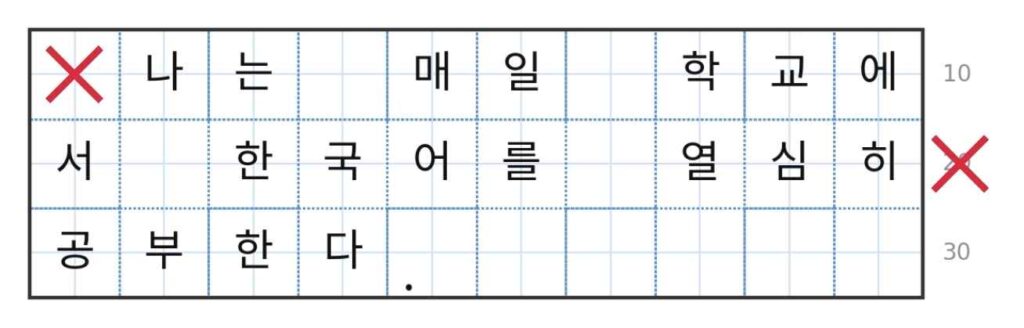
When a line ends and you move down to the next line, that is not a new paragraph. So keep writing from the first square of the next line. Do not leave it empty again.

In other words, changing lines and changing paragraphs are different.

SituationFirst square
Just a new lineKeep writing from the first square
A new paragraphLeave it empty, start from the second square

Just remember this difference. Also, if there is no room to leave a space at the end of a line, don’t leave the next line’s first square empty — start the next word right from the first square.

5. Punctuation also takes one square

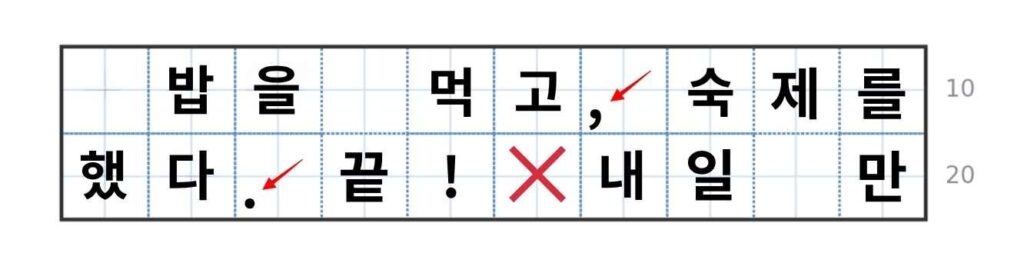
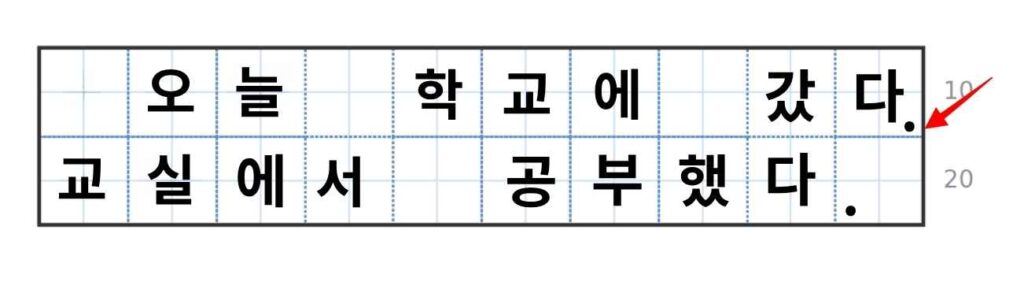
When a sentence ends, write a period “.” Punctuation marks also go one per square. A comma “,” is the same. (Write the period and comma in the bottom-left of the square, like the image below.)

The official rule says to leave one empty square after “?” and “!”, but you don’t have to leave a square after a period “.“, comma “,“, or colon “:“.

For now, you don’t need many complex marks. Just learning to use the period correctly is enough.

6. What if the sentence ends in the last square?

Sometimes you write the last character in the last square, but you still need a period. There is no square left. In this case, do not go to the next line just for the period. Write the last character and the period together in the same last square. It looks a little strange at first, but it is the official rule.

7. Numbers are written differently

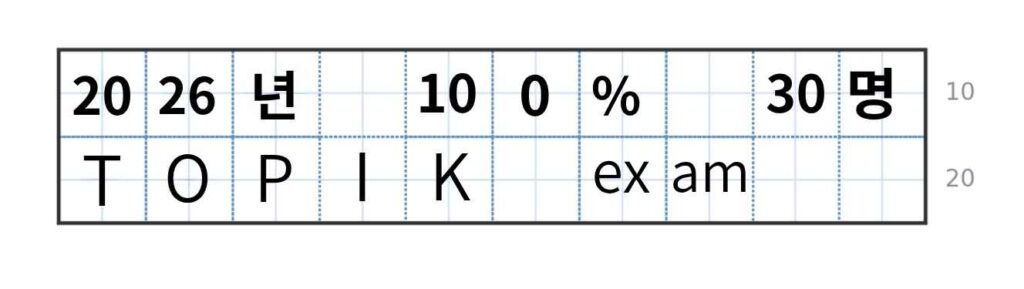
When you study Question 53, you write many numbers. (For example: 2026년, 100%, 30명.) Unlike Korean letters, Arabic numbers go two digits per square. If you can’t split it evenly, write two digits per square from the front, and put the rest in the next square.

For English letters, write capital letters one per square, and lowercase letters two per square.

Don’t worry about memorizing this perfectly now. Once you start writing Question 53 graphs, you’ll use numbers often and get used to it naturally.

8. So how long is 200~300 characters?

This is the question students ask most.

“Teacher, how much is 200~300 characters?”

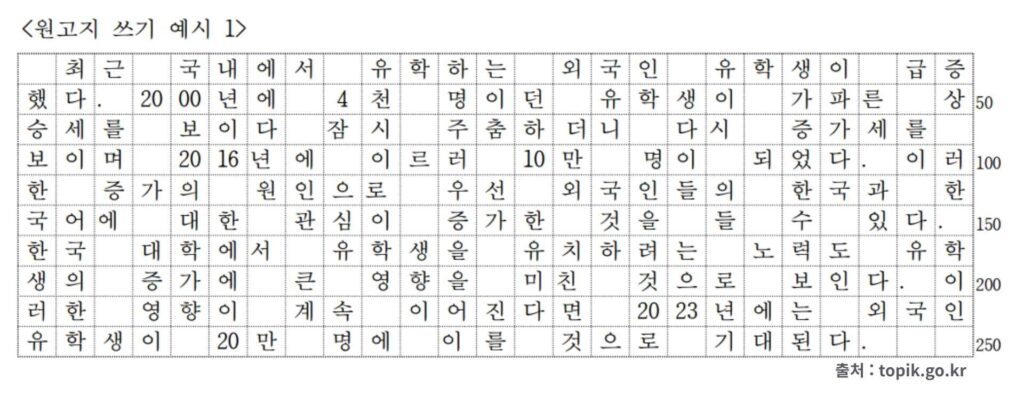
At first it’s hard to count 200, 300 characters in your head. So it’s better to get a feel using the squares. On the right side of the official paper you’ll see numbers like 50 → 100 → 150 → 200 → 250, so you can check how much you’ve written with your eyes.

And one very important thing!

💡 When you count characters, spaces (empty squares) also count as one character each. The answer sheet even says “between 600 and 700 characters, including spaces.”

Since Question 53 is 200–300 characters, think of it as writing past the 200 mark and up to just inside 300.

At first, don’t try to write it all at once — grow it slowly: 50 → 100 → 150 → 200.

9. How long are 300, 600, and 700 characters?

300 characters is just 100 more than 200. It’s the length of a few more sentences.

Question 54 is 600–700 characters. It looks very long at first, but don’t think of 600 as one big block. Think of it as 200 + 200 + 200 — connect three short parts and you get about 600 characters.

Also, the goal is not to fill every square up to 700. What matters is writing what the question asks in the right length. Repeating the same words or adding useless sentences just to reach the number is not a good idea.

600 characters is not a “wall you must fill.” It’s the length you build by connecting several sentences.

For both 53 and 54, we’ll practice step by step later: one sentence → connect two → the whole text.

10. Do I have to count every character?

You don’t need to count “one, two, three…” during the test. The paper marks your position every 50 characters, so you can see about how long your writing is. If you practice with real writing paper, you’ll get a feel like “about here is 100 characters.” That feeling makes the real test much easier.

11. Common mistakes on the writing paper

Beginners often make these mistakes on the TOPIK writing paper.

❌ Two characters in one square
❌ No spaces between words
❌ Leaving the first square empty every time the line changes
❌ Not leaving the first square empty for a new paragraph
❌ Writing the period outside the square
❌ Writing numbers one digit per square, like Korean letters

You don’t have to be perfect from the start. With writing paper, actually writing by hand is much more important than just reading.

12. Let’s write today ✏️

Writing paper is learned by hand, not just by eyes. Prepare a squared notebook, or download the real TOPIK answer sheet below and practice on it.

📄 Download 👉 TOPIK II writing answer sheets & 원고지 사용법 (manuscript paper guide) PDF  

<Practice 1>

한국어를 배우는 학생이 많다.

Check: Did you leave the first square empty? / One character per square? / A space square between words? / A period at the end?

<Practice 2>

나는 학교에서 한국어를 공부한다. 친구와 같이 공부하면 재미있다.

There are two sentences. A finished sentence is not a new paragraph. So even if the line changes in the second sentence, do not leave the first square empty.

<Practice 3>
Try copying a 200–300 character piece, like a real TOPIK answer. Once you copy it a few times, it becomes familiar fast. Want more? Download the file below and copy a Question 54 model answer too.

You can download the 원고지 사용법 (manuscript paper guide) PDF in 12. Let’s write today above. 👆

⚠️ One more thing! If you turn the answer sheet sideways and write, you get 0 points. Keep the answer sheet upright, in the given direction.

Summary 🌱

Here are the five things to remember today.

Rule
Write one character per square
A space takes one empty square (and it counts as a character)
Leave the first square empty for new text / a new paragraph
Don’t leave the first square empty when only the line changes
Q53 is 200–300 characters, Q54 is 600–700 characters

And one more thing. Don’t be afraid of the character count from the start. You build 200 characters by connecting sentences one by one, and 600 characters by joining short parts one by one. We’ll practice that step by step.

Take it slowly, one step at a time, and you can reach the level you want.

If you have any questions about using the TOPIK writing paper, leave a comment.

Next time, we’ll learn what graders look at when they give points in TOPIK writing.

See you in the next lesson!

🔎 Still finding levels 1–2 hard? Review the basics first 👉 [ TOPIK I study ]

❓ FAQ

Q: How many characters go in one square on the writing paper?

A: Just one character. A space also takes one empty square.

Q: When do I leave the first square empty?

A: When you start new text or a new paragraph. When only the line changes, do not leave it empty.

Q: How do I write numbers?

A: Arabic numbers go two digits per square. Example: 2025 → 20 | 25.

Q: Do spaces count in the character count?

A: Yes, spaces (empty squares) count as characters. Also, if you turn the answer sheet sideways, you get 0 points — always keep it upright.


<Latest Posts>

error: Content is protected !!