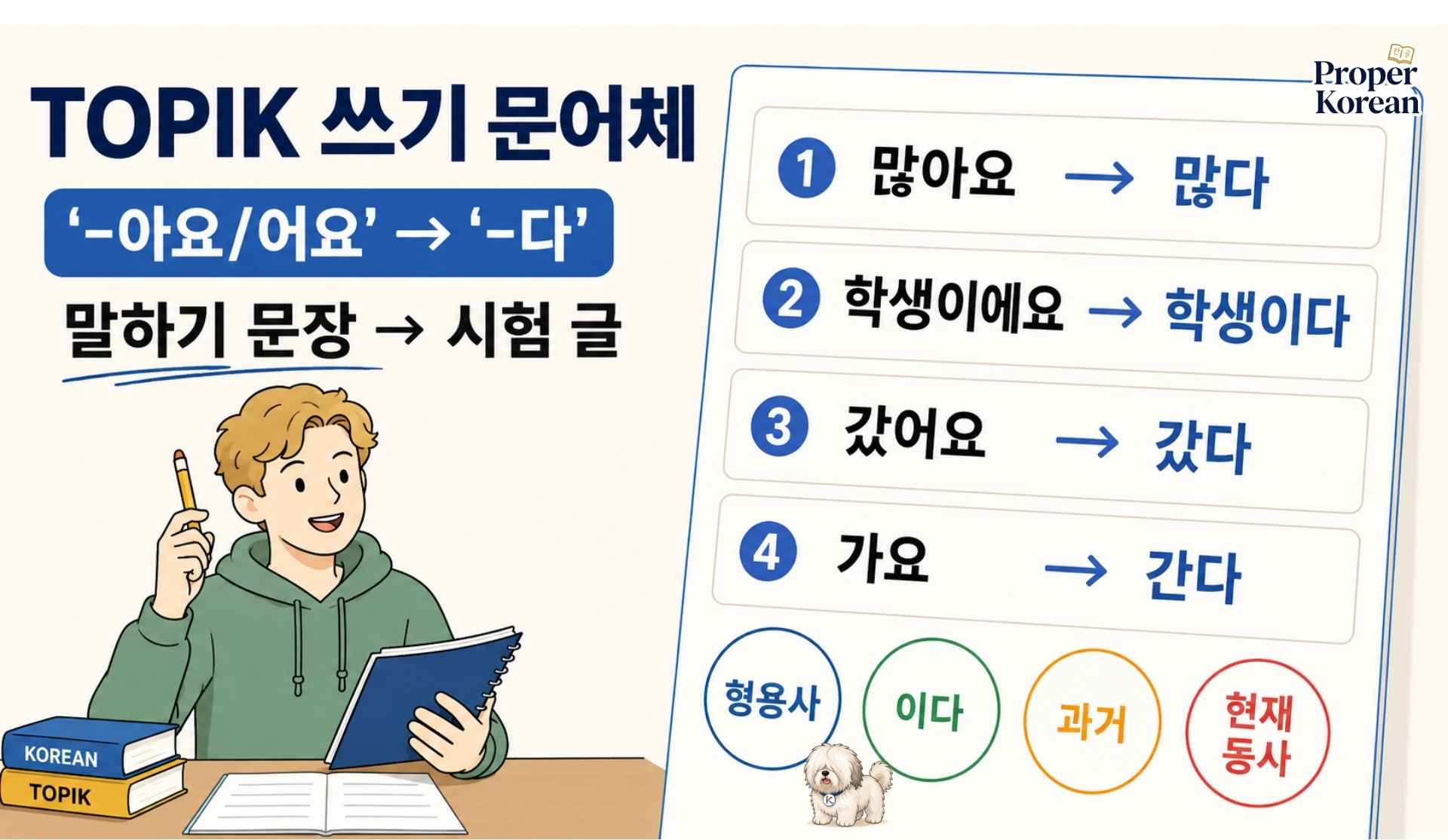
📢 한국어로 공부하고 싶어요? 👉 [ 한국어로 읽기 ]
Welcome back! 😊 Today, let’s learn how to use the TOPIK writing paper (원고지) step by step.
In Part 2, we learned the “-다 / -이다” written style used in TOPIK writing. Haven’t seen it yet? Read it first 👉 [ Part 2 How to change “-아요/어요” into “-다”].
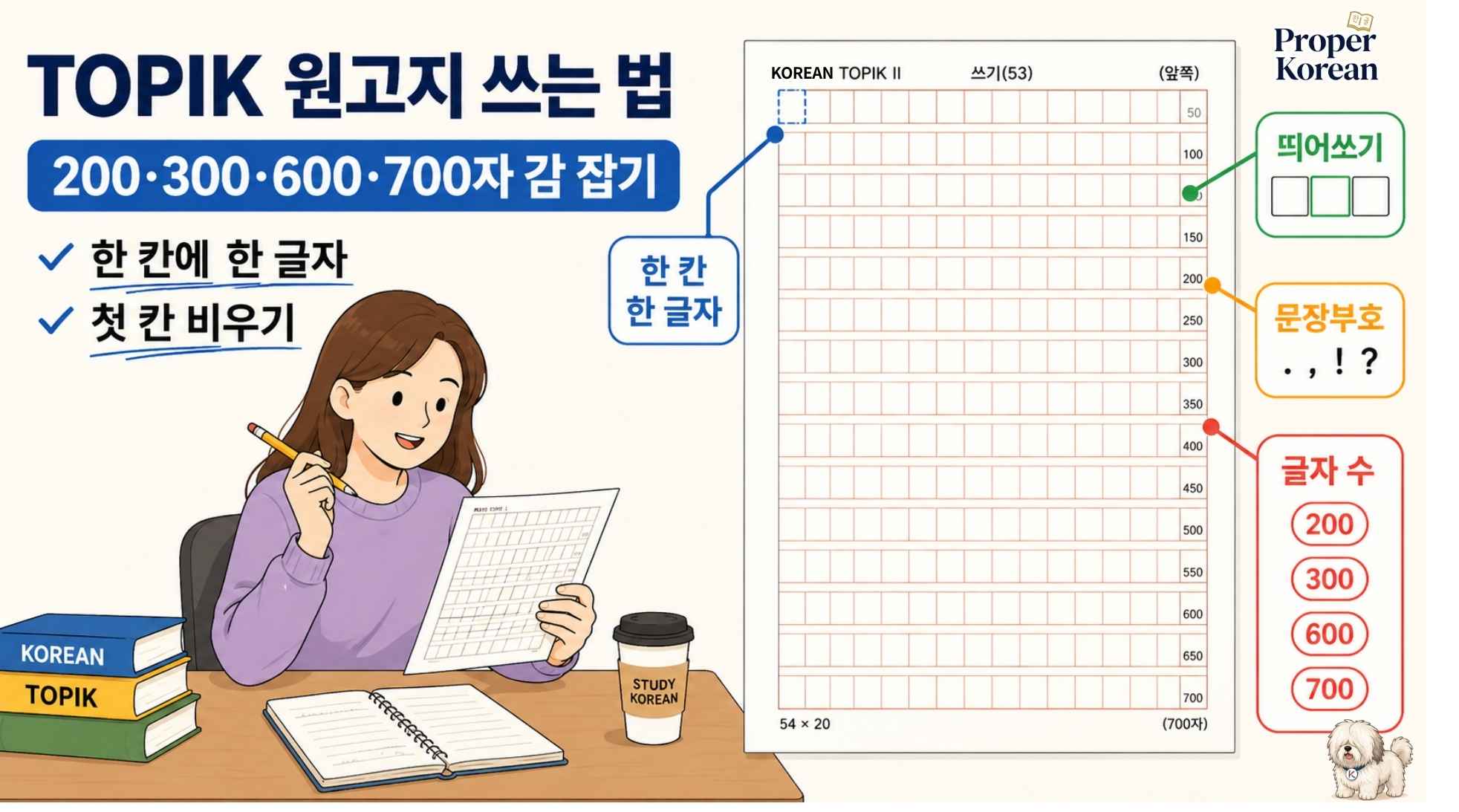
Today is about the TOPIK writing paper — in Korean it’s called 원고지. When you first see all the little squares, it can look complicated. But don’t worry. Today you don’t need to memorize every rule. You only need these three things.
💡 Remember just these:
- What goes in one square?
- How do I handle spaces?
- How long are 200 and 600 characters?
Let’s take them one at a time.
1. Why does TOPIK use writing paper?
In Questions 53 and 54 you write longer text.
Question 53 is 200–300 characters, and Question 54 is 600–700 characters.
So the answer sheet has small squares for your writing.
These squares make it easy to see where your writing starts, whether you left spaces, and how much you have written. It feels awkward at first, but after a few tries it becomes easy.
2. The most important rule: one character per square
This is the first rule to remember. Write one character in one square. And a space also takes one empty square.
For example, “한국어가 좋다.” looks like this:

So don’t write it all joined together like “한국어가좋다.” Leave spaces, just like normal writing.
3. Leave the first square empty when you begin
When you start writing, don’t write in the very first square. Leave the first square empty and start from the second square.
For example, if you begin with “나는 한국어를 공부한다.”, it starts like this:
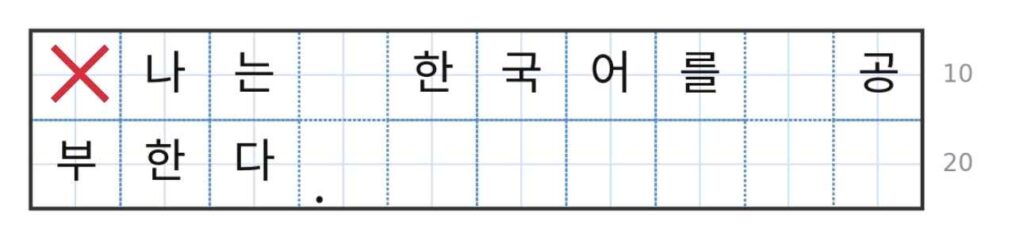
Why leave it empty? It shows that a new paragraph is starting.
💡 Remember
- New text → leave the first square empty
- New paragraph → leave the first square empty
4. A new line is NOT a new paragraph
Beginners often get confused here.
When a line ends and you move down to the next line, that is not a new paragraph. So keep writing from the first square of the next line. Do not leave it empty again.
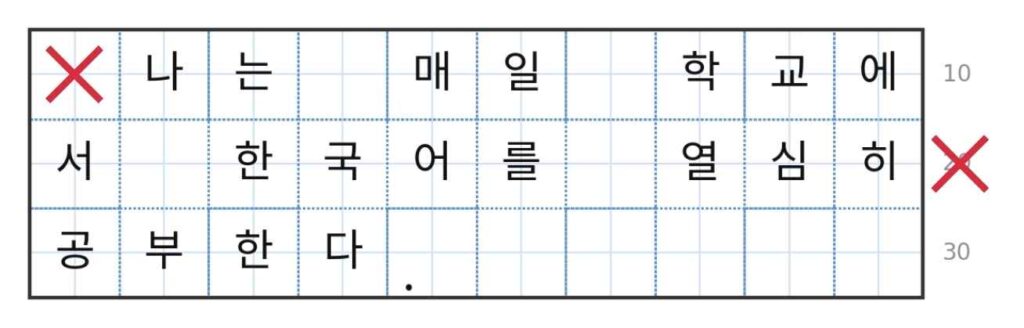
In other words, changing lines and changing paragraphs are different.
| Situation | First square |
|---|---|
| Just a new line | Keep writing from the first square |
| A new paragraph | Leave it empty, start from the second square |
Just remember this difference. Also, if there is no room to leave a space at the end of a line, don’t leave the next line’s first square empty — start the next word right from the first square.
5. Punctuation also takes one square
When a sentence ends, write a period “.” Punctuation marks also go one per square. A comma “,” is the same. (Write the period and comma in the bottom-left of the square, like the image below.)
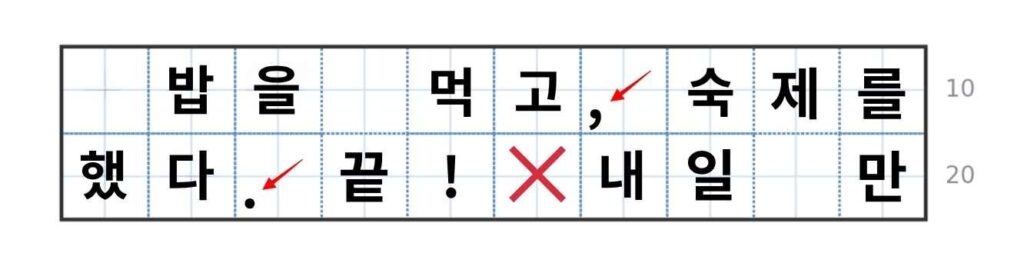
The official rule says to leave one empty square after “?” and “!”, but you don’t have to leave a square after a period “.“, comma “,“, or colon “:“.
For now, you don’t need many complex marks. Just learning to use the period correctly is enough.
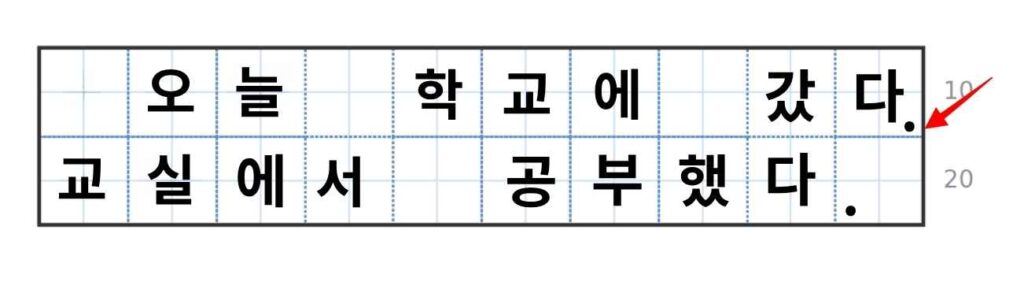
6. What if the sentence ends in the last square?
Sometimes you write the last character in the last square, but you still need a period. There is no square left. In this case, do not go to the next line just for the period. Write the last character and the period together in the same last square. It looks a little strange at first, but it is the official rule.
7. Numbers are written differently
When you study Question 53, you write many numbers. (For example: 2026년, 100%, 30명.) Unlike Korean letters, Arabic numbers go two digits per square. If you can’t split it evenly, write two digits per square from the front, and put the rest in the next square.
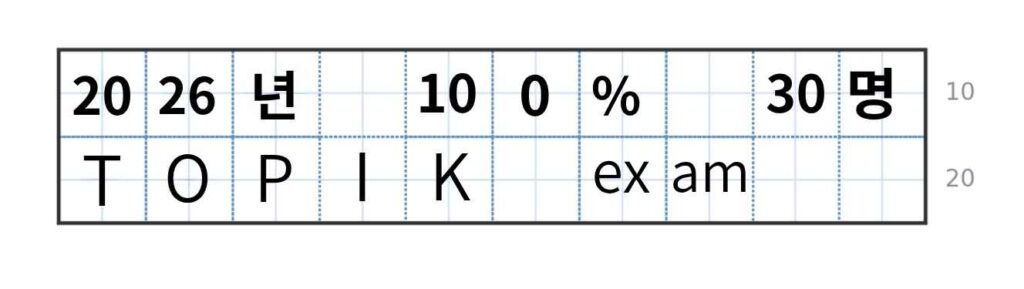
For English letters, write capital letters one per square, and lowercase letters two per square.
Don’t worry about memorizing this perfectly now. Once you start writing Question 53 graphs, you’ll use numbers often and get used to it naturally.
8. So how long is 200~300 characters?
This is the question students ask most.
“Teacher, how much is 200~300 characters?”
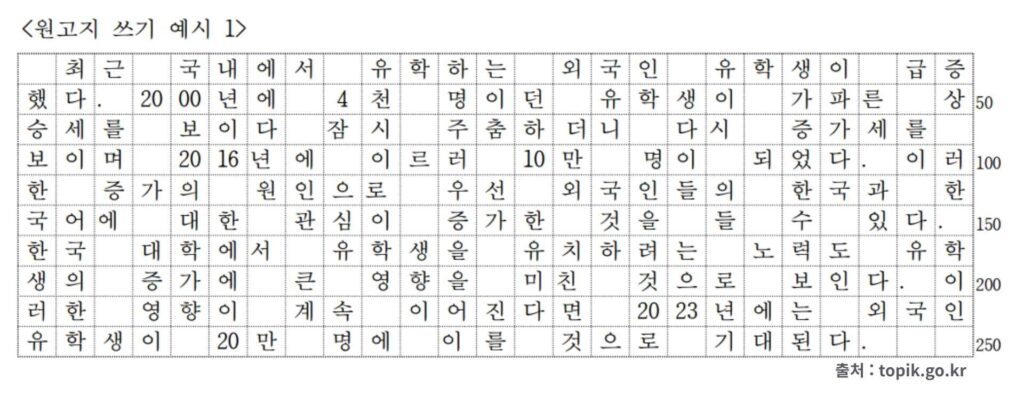
At first it’s hard to count 200, 300 characters in your head. So it’s better to get a feel using the squares. On the right side of the official paper you’ll see numbers like 50 → 100 → 150 → 200 → 250, so you can check how much you’ve written with your eyes.
And one very important thing!
💡 When you count characters, spaces (empty squares) also count as one character each. The answer sheet even says “between 600 and 700 characters, including spaces.”
Since Question 53 is 200–300 characters, think of it as writing past the 200 mark and up to just inside 300.
At first, don’t try to write it all at once — grow it slowly: 50 → 100 → 150 → 200.
9. How long are 300, 600, and 700 characters?
300 characters is just 100 more than 200. It’s the length of a few more sentences.
Question 54 is 600–700 characters. It looks very long at first, but don’t think of 600 as one big block. Think of it as 200 + 200 + 200 — connect three short parts and you get about 600 characters.
Also, the goal is not to fill every square up to 700. What matters is writing what the question asks in the right length. Repeating the same words or adding useless sentences just to reach the number is not a good idea.
600 characters is not a “wall you must fill.” It’s the length you build by connecting several sentences.
For both 53 and 54, we’ll practice step by step later: one sentence → connect two → the whole text.
10. Do I have to count every character?
You don’t need to count “one, two, three…” during the test. The paper marks your position every 50 characters, so you can see about how long your writing is. If you practice with real writing paper, you’ll get a feel like “about here is 100 characters.” That feeling makes the real test much easier.
11. Common mistakes on the writing paper
Beginners often make these mistakes on the TOPIK writing paper.
❌ Two characters in one square
❌ No spaces between words
❌ Leaving the first square empty every time the line changes
❌ Not leaving the first square empty for a new paragraph
❌ Writing the period outside the square
❌ Writing numbers one digit per square, like Korean letters
You don’t have to be perfect from the start. With writing paper, actually writing by hand is much more important than just reading.
12. Let’s write today ✏️
Writing paper is learned by hand, not just by eyes. Prepare a squared notebook, or download the real TOPIK answer sheet below and practice on it.
📄 Download 👉 TOPIK II writing answer sheets & 원고지 사용법 (manuscript paper guide) PDF
<Practice 1>
한국어를 배우는 학생이 많다.
Check: Did you leave the first square empty? / One character per square? / A space square between words? / A period at the end?
<Practice 2>
나는 학교에서 한국어를 공부한다. 친구와 같이 공부하면 재미있다.
There are two sentences. A finished sentence is not a new paragraph. So even if the line changes in the second sentence, do not leave the first square empty.
<Practice 3>
Try copying a 200–300 character piece, like a real TOPIK answer. Once you copy it a few times, it becomes familiar fast. Want more? Download the file below and copy a Question 54 model answer too.
You can download the 원고지 사용법 (manuscript paper guide) PDF in 12. Let’s write today above. 👆
⚠️ One more thing! If you turn the answer sheet sideways and write, you get 0 points. Keep the answer sheet upright, in the given direction.
Summary 🌱
Here are the five things to remember today.
| Rule | |
|---|---|
| ① | Write one character per square |
| ② | A space takes one empty square (and it counts as a character) |
| ③ | Leave the first square empty for new text / a new paragraph |
| ④ | Don’t leave the first square empty when only the line changes |
| ⑤ | Q53 is 200–300 characters, Q54 is 600–700 characters |
And one more thing. Don’t be afraid of the character count from the start. You build 200 characters by connecting sentences one by one, and 600 characters by joining short parts one by one. We’ll practice that step by step.
Take it slowly, one step at a time, and you can reach the level you want.
If you have any questions about using the TOPIK writing paper, leave a comment.
Next time, we’ll learn what graders look at when they give points in TOPIK writing.
See you in the next lesson!
🔎 Still finding levels 1–2 hard? Review the basics first 👉 [ TOPIK I study ]
❓ FAQ
Q: How many characters go in one square on the writing paper?
A: Just one character. A space also takes one empty square.
Q: When do I leave the first square empty?
A: When you start new text or a new paragraph. When only the line changes, do not leave it empty.
Q: How do I write numbers?
A: Arabic numbers go two digits per square. Example: 2025 → 20 | 25.
Q: Do spaces count in the character count?
A: Yes, spaces (empty squares) count as characters. Also, if you turn the answer sheet sideways, you get 0 points — always keep it upright.
<Latest Posts>