TOPIK Writing Style: Turn Speaking Into “-다” Sentences (3 Simple Rules)-Part 2

TOPIK writing style

🔎 한국어로 읽고 싶어요? 👉 [ 한국어로 읽기 ]

Welcome back! 😊

In Part 1 we learned what the TOPIK writing test looks like.

Today we learn the first real skill of TOPIK writing style: how to change the way you speak into the way you write on the test.

New to this? Don’t worry. There is really just one big idea, plus one small thing to watch. Let’s go slowly, together.

📌 Remember just one thing:
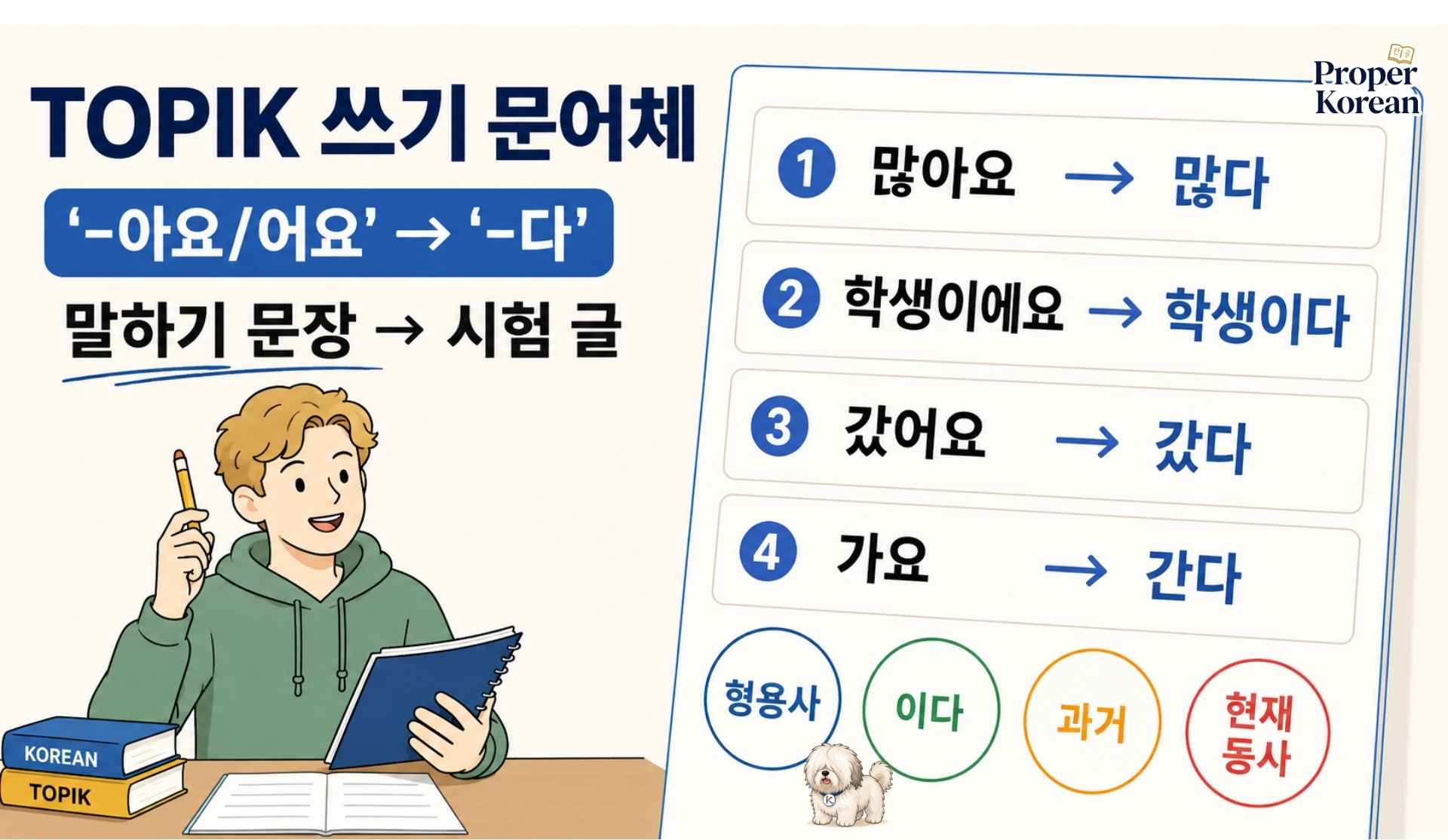
in TOPIK writing style, drop the speaking ending “-아요/어요” and end the sentence with “-다.”
eg. 사람이 많아요 → 사람이 많다

💡One thing to watch:
The exact ending changes a little depending on the word type — noun, verb, or adjective. (Explained below.)

Speaking vs writing

We speak in a friendly way.
But for TOPIK Questions 53 and 54, we write a little differently.

SpeakingWriting (test)
거리에 사람이 많아요.거리에 사람이 많다.
오늘 서울은 날씨가 좋아요.오늘 서울은 날씨가 좋다.
저는 한국 대학교 학생이에요.나는 한국 대학교 학생이다.

Rule 1 — Adjectives and nouns

Adjectives (big, good, many…) and “noun + 이에요/예요” become “-다 / -이다.”

SpeakingWriting
많아요많다
좋아요좋다
학생이에요학생이다
문제예요문제이다

Rule 2 — Past tense

Past “-았어요/었어요” becomes “-았다/었다.” The past meaning stays the same.

SpeakingWriting
많았어요많았다
좋았어요좋았다
만났어요만났다

Rule 3 — Present-tense verbs (watch here ⚠️)

Present-tense verbs are the one different case. They become “-ㄴ다/는다.”
There are just three patterns.

TypeRuleExample
No batchim (final consonant)-ㄴ다가다 → 간다
Has batchim-는다먹다 → 먹는다 / 읽다 → 읽는다
“-하다” verbs-한다공부하다 → 공부한다

The most common mistake: 저 → 나, 제 → 내

📌 Many students forget this!
In speaking we say 저 / 제, but in TOPIK writing style we use 나 / 내.
SpeakingWriting
저는 학생이에요.나는 학생이다.
제 방이 커요. 방이 크다.
제가 만들었어요.내가 만들었다.

So: 저 → 나, 제 → 내, 제가 → 내가. “저/제” are polite speaking words, but writing uses “나/내.”

Longer sentences work the same way

Even in a long sentence, just change the last part.

SpeakingWriting
한국어를 배우는 학생이 많아요.한국어를 배우는 학생이 많다.
저는 친구와 같이 한국 음식을 먹었어요.나는 친구와 같이 한국 음식을 먹었다.

Practice: change speaking into writing ✏️

Change each speaking sentence into TOPIK writing style.
📢 Try it first, then open the answer to check.

1. 거리에 사람이 많아요.

→ (                               )


🔽 See the answer (1)

거리에 사람이 많다.

📝 This is an adjective. Drop “-아요” and add -다. (많아요 → 많다)


2. 오늘 서울은 날씨가 좋아요.

→ (                                )


🔽 See the answer (2)

오늘 서울은 날씨가 좋다.

📝 Also an adjective. End it with -다. (좋아요 → 좋다)


3. 저는 한국 대학교 학생이에요.

→ (                                )


🔽 See the answer (3)

나는 한국 대학교 학생이다.

📝 “Noun + 이에요/예요” becomes -이다. Also change 저는 → 나는. (학생이에요 → 학생이다)


4. 여기는 제가 다니는 학교예요.

→ (                                )


🔽 See the answer (4)

여기는 내가 다니는 학교이다.

📝 “-예요” also becomes -이다. And change 제가 → 내가. (학교예요 → 학교이다)


5. 어제 오랜만에 고향 친구를 만났어요.

→ (                                )


🔽 See the answer (5)

어제 오랜만에 고향 친구를 만났다.

📝 It’s the past, so use -았다/었다. The past meaning stays. (만났어요 → 만났다)


6. 학생들이 아침 일찍 학교에 가요.

→ (                                )


🔽 See the answer (6)

학생들이 아침 일찍 학교에 간다.

📝 A present-tense verb. No batchim, so -ㄴ다. (가 + ㄴ다 = 간다)


7. 지하철에서 많은 사람들이 책을 읽어요.

→ (                                )


🔽 See the answer (7)

지하철에서 많은 사람들이 책을 읽는다.

📝 A present-tense verb. Has batchim, so -는다. (읽 + 는다 = 읽는다)


8. 제 친구가 매일 한국어를 공부해요.

→ (                                )


🔽 See the answer (8)

내 친구가 매일 한국어를 공부한다.

📝 “-하다” verbs become -한다. And change 제 → . (공부해요 → 공부한다)


9. 요즘 한국어를 배우는 외국인 학생이 많아요.

→ (                                )


🔽 See the answer (9)

요즘 한국어를 배우는 외국인 학생이 많다.

📝 Long sentence, but don’t worry — just change the last part. (많아요 → 많다)


10. 주말에 가족과 같이 공원에 갔어요.

→ (                                )


🔽 See the answer (10)

주말에 가족과 같이 공원에 갔다.

📝 It’s the past, so use -았다/었다. (갔어요 → 갔다)

Remember these 3 things

TypeChange like this
① Adjectives & 이다많아요 → 많다 / 학생이에요 → 학생이다
② Past갔어요 → 갔다 / 먹었어요 → 먹었다
③ Present verbs가요 → 간다 / 먹어요 → 먹는다

Only present-tense verbs use “-ㄴ다/는다.” Everything else is simply “-다.”

Practice 5 more minutes on your own

Think of a sentence you say often.
First write it the speaking way (“-아요/어요”), then change it to TOPIK writing style.
Just 5 sentences a day is enough.

Practice with AI 🤖

If it’s hard to practice alone, you can use an AI.
Copy the text below.

I am a beginner studying TOPIK II writing. Please give me one easy Korean sentence at a time. I will change the “-아요/어요” sentence into a “-다” written sentence. Check if my answer is correct, and if it is wrong, explain why in easy Korean. Please check present-tense verbs (“-ㄴ다/는다”) carefully.

⚠️ AI can make mistakes. Always check important test rules with real past exams or a trusted textbook.

Summary

In TOPIK writing style, instead of speaking words like 많아요 / 학생이에요 / 공부해요, we write 많다 / 학생이다 / 공부한다. You don’t need hard vocabulary yet — first practice writing correct sentences with easy words you already know.
Longer writing comes next.

Great job today!

Practice a little each day, and you can reach the level you want. 🌱

See you in the next lesson!

🔎 Still finding levels 1–2 hard? Review the basics first 👉 [ TOPIK I study ]

❓ FAQ

Q: How do sentences end in TOPIK writing?

A: Most sentences end with “-다.” Example: 사람이 많아요 → 사람이 많다.

Q: Does every word change to “-다”?

A: Adjectives, “-이다,” and the past simply become “-다” (많다, 학생이다, 갔다). Only present-tense verbs change to “-ㄴ다/는다” (가요 → 간다, 먹어요 → 먹는다).

Q: What is the most common student mistake?

A: Using 저 / 제. In written style, change 저 → 나 and 제 → 내.

Q: Do I need to know many difficult words?

A: No. Writing correct sentences with easy words comes first. Longer writing comes after that.


TOPIK I Reading 34–39 ④: 7 Adverbs to Fill the Blank (아주 · 자주 · 같이)

TOPIK I Reading

📌 한국말로 공부하고 싶어요? 👉 [한국어]

Do adverbs like 아주, 자주, and 가끔 look confusing in TOPIK I reading? 😊

The trick is simple: each adverb has one clear meaning. Learn 7 of them, and these questions become easy!

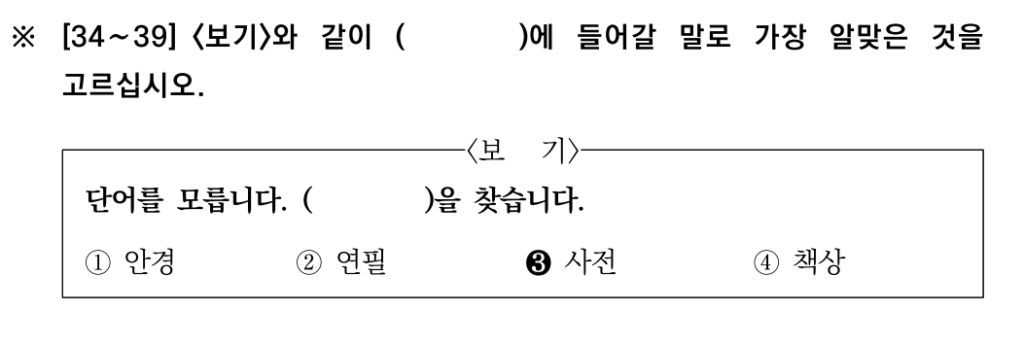
In questions 34–39, an adverb blank asks how much, how often, or how. Each TOPIK I reading question is worth 2 points.

Try each one first, then open the answer to check.

① Remember just one thing

Choose an adverb by its meaning, and read the other sentence for the clue.
e.g. 날씨가 (    ) 춥습니다 → How cold? → 아주 (very)
e.g. 좋아해서 (    ) 마십니다 → How often? → 자주 (often)

② Adverb card

MeaningAdverb
very much (degree)아주 (very)
many times (often)자주 (often)
sometimes, a little가끔 (sometimes)
together (with someone)같이 (together)
for the first time처음 (first time)
before something else먼저 (first / before)
quickly빨리 (quickly)
📌 Pair to remember: 자주 (often) ↔ 가끔 (sometimes).
📌 아주 often comes before an adjective. (아주 춥다 · 아주 맛있다)

Practice: TOPIK I reading adverb blanks

Try each TOPIK I reading question first.

Read the two sentences, choose the adverb, then open the box to check.

Question 1

오늘은 날씨가 (       ) 춥습니다. 그래서 옷을 많이 입습니다.

① 아주② 자주③ 가끔④ 먼저


🔽 See the answer (Question 1)

Q: 오늘은 날씨가 ( ) 춥습니다.
(Today the weather is ( ) cold.)
👉 How cold? (degree)

A: ✅① 아주 (very) → It is very cold, so I wear many clothes!

② 자주 = often (many times).

③ 가끔 = sometimes.

④ 먼저 = first / before.


💡 Tip: before an adjective (춥다 · 덥다 · 맛있다), for “how much” → 아주 (very)!


Question 2

저는 커피를 좋아합니다. 그래서 (       ) 마십니다.

① 자주② 가끔③ 먼저④ 아까


🔽 See the answer (Question 2)

Q: 저는 커피를 좋아합니다. 그래서 ( ) 마십니다.
(I like coffee. So I drink it ( ).)
👉 I like it — how often?

A: ✅① 자주 (often) → If you like it, you drink it often!

② 가끔 = sometimes (a little).

③ 먼저 = first / before.

④ 아까 = a while ago.


💡 Tip: like it, so many times → 자주 (often)! (opposite: 가끔)


Question 3

저는 보통 걸어서 갑니다. (       ) 버스를 탑니다.

① 가끔② 아주③ 같이④ 빨리


🔽 See the answer (Question 3)

Q: 저는 보통 걸어서 갑니다. ( ) 버스를 탑니다.
(I usually walk. ( ) I take the bus.)
👉 Usually walk — the bus is how often?

A: ✅① 가끔 (sometimes) → I usually walk, but sometimes I take the bus!

② 아주 = very (much).

③ 같이 = together.

④ 빨리 = quickly.


💡 Tip: usually A, and ( ) B → “B sometimes” → 가끔!


Question 4

친구를 만났습니다. 우리는 (       ) 밥을 먹었습니다.

① 가장② 아직③ 같이④ 별로


🔽 See the answer (Question 4)

Q: 친구를 만났습니다. 우리는 ( ) 밥을 먹었습니다.
(I met my friend. We ate ( ).)
👉 “We” — did it together?

A: ✅③ 같이 (together) → We ate together with the friend!

① 가장 = most.

② 아직 = still / not yet.

④ 별로 = not really.


💡 Tip: “우리는 (we)” + ( ) → 같이 (together)!


Question 5

저는 그 사람을 모릅니다. 내일 (       ) 만납니다.

① 처음② 보통③ 제일④ 항상


🔽 See the answer (Question 5)

Q: 저는 그 사람을 모릅니다. 내일 ( ) 만납니다.
(I don’t know that person. Tomorrow I meet them ( ).)
👉 Don’t know them — which meeting is it?

A: ✅① 처음 (first time) → You don’t know them, so tomorrow is the first time!

② 보통 = usually.

③ 제일 = most.

④ 항상 = always.


💡 Tip: meet a person you don’t know → 처음 (first time)!


Question 6

이 케이크가 (       ) 맛있습니다. 그래서 매일 먹습니다.

① 아주② 가끔③ 먼저④ 아까


🔽 See the answer (Question 6)

Q: 이 케이크가 ( ) 맛있습니다.
(This cake is ( ) delicious.)
👉 How delicious? (degree)

A: ✅① 아주 (very) → It is very delicious, so I eat it every day!

② 가끔 = sometimes.

③ 먼저 = first / before.

④ 아까 = a while ago.


💡 Tip: before an adjective (맛있다), for “how much” → 아주 (very)!


Question 7

저는 아침에 (       ) 세수를 합니다. 그리고 밥을 먹습니다.

① 먼저② 가끔③ 아주④ 같이


🔽 See the answer (Question 7)

Q: 저는 아침에 ( ) 세수를 합니다. 그리고 밥을 먹습니다.
(In the morning I wash my face ( ). Then I eat.)
👉 Wash → eat: which order?

A: ✅① 먼저 (first) → I wash my face first, then I eat!

② 가끔 = sometimes.

③ 아주 = very.

④ 같이 = together.


💡 Tip: do A ( ), then B → “A first” → 먼저!


Question 8

시간이 없습니다. 그래서 (       ) 갑니다.

① 빨리② 같이③ 처음④ 가끔


🔽 See the answer (Question 8)

Q: 시간이 없습니다. 그래서 ( ) 갑니다.
(I have no time. So I go ( ).)
👉 No time — how do you go?

A: ✅① 빨리 (quickly) → If you have no time, you go quickly!

② 같이 = together.

③ 처음 = first time.

④ 가끔 = sometimes.


💡 Tip: no time → 빨리 (quickly)!

③ How to memorize the adverbs easily

Now you have practiced, here is the fastest way to grow your TOPIK I reading vocabulary.

  1. Group by meaning. degree (아주), how often (자주 · 가끔), together (같이).
  2. Learn the pair. 자주 (often) ↔ 가끔 (sometimes). They are opposites.
  3. Read the OTHER sentence and ask: how much? how often? how?
  4. Quiz yourself. See a meaning, and say the adverb. (many times → ?)

🤖Practice with AI: a Korean adverb speed game

You can practice TOPIK I reading alone with AI — and grow your Korean speaking too!

First, turn on the AI’s voice (read-aloud).

Then answer out loud in Korean. The game is played only in Korean.

🗣️”Let’s play a Korean adverb speed game. Please speak only in Korean during the game — no English. You say a short situation in Korean (for example: 좋아해서 여러 번 마셔요), and I say the adverb in Korean out loud (for example: 자주). Give me 10 quickly, then tell me my score in Korean. Use only beginner words.”

⚠️ AI can make mistakes.

Always check with real past exams at the end. AI is for practice; the past exams are the answer key.

Summary

  • Choose an adverb by its meaning, and read the other sentence for the clue.
  • 아주 (degree) · 자주 / 가끔 (how often) · 같이 (together) · 처음 / 먼저 (order) · 빨리 (quickly).
  • Learn 자주 ↔ 가끔 as a pair to erase wrong choices fast.

Good Job! Keep practicing, and you can all pass TOPIK Level 2. 🎉

Have a question? Please leave a comment.

See you in the next lesson!

📢 want to practice TOPIKⅠ Listening next? 👉 [ TOPIKⅠ Listening ] 

FAQ

Q: What are TOPIK I reading questions 34–39?

A: They ask you to fill a blank with the right word — a particle, noun, verb, adjective, or adverb. Each question is worth 2 points.

Q: How do I choose the right adverb for the blank?

A: Choose by meaning and read the other sentence. Ask: how much (아주), how often (자주 · 가끔), or how (같이 · 빨리)?

Q: Where does 아주 usually go?

A: 아주 (very) usually comes before an adjective, like 아주 춥다 (very cold) or 아주 맛있다 (very delicious).