
📌쉬운 한국말로 공부해요. 👉 [한국어]
Welcome!
This TOPIK I listening guide covers the first four questions *[1~4] of the test.
In these questions, you hear a short question in Korean and choose the answer that fits.
They look easy, but these TOPIK I listening questions are worth 14 points together
(Questions 1 and 2 are 4 points each; Questions 3 and 4 are 3 points each).
Today we will learn one simple skill, and then practice a lot. Try each question first.
Then open the answer to check. 😊
Remember just one thing
When you listen, ask yourself: “What is the question asking?”
- If there is a question word (when, where, who, what, how…) → give the matching information.
- If there is no question word → answer with “네 (yes)” or “아니요 (no)”.
Practice: TOPIK I listening questions 1–4
Try each TOPIK I listening question first.
Listen (or read the question), pick your answer, then open the box to check.
<Example>
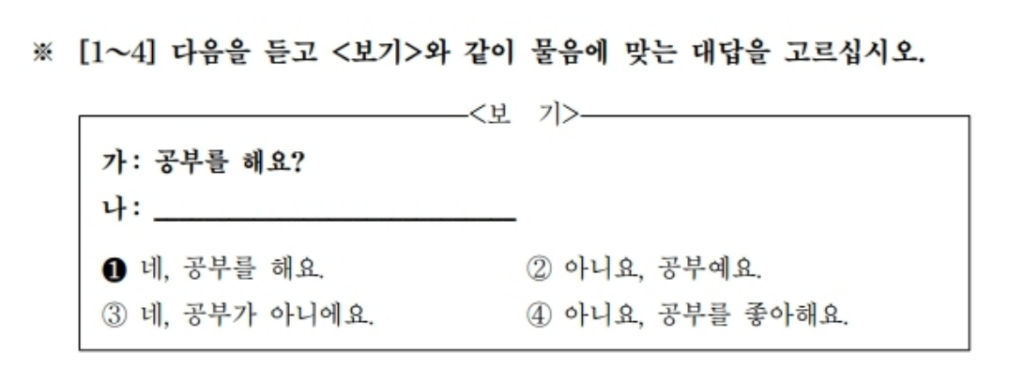
Question 1
🔊 [Audio: listen to the question]
① 네, 책이에요. ② 아니요, 책이 있어요.
③ 네, 책이 많아요. ④ 아니요, 책이 좋아요.
👉 Click! See the answer (Question 1)
Answer is ③
Q : 책이 많아요? (Are there many books?) 👉 This asks if there are many books.
A : ③ 네, 책이 많아요. → It matches the question. ✅
① 책이에요 = says what it is. Not about “many”.
② 책이 있어요 = says the books are there or not. Different from “many”.
④ 책이 좋아요 = says you like books. Different from “many”.
💡 Tips: Same word “책”, but the question asks about number: many or few.
Question 2
🔊 [Audio: listen to the question]
① 네, 주스가 없어요. ② 아니요, 주스를 좋아해요.
③ 네, 주스가 아니에요. ④ 아니요, 주스를 안 마셔요.
👉 Click! See the answer (Question 2)
Answer is ④
Q: 주스를 마셔요? (Do you drink juice?) 👉 This asks if you really drink juice.
A: ④ 아니요, 주스를 안 마셔요 → “안” makes “drink” negative. ✅ (You need to listen carefully to “안”!)
① 주스가 없어요 = there is no juice. Not “drink”.
② 주스를 좋아해요 = you like juice. You can like it but not drink it now.
③ 주스가 아니에요 = says what it is (it is not juice).
💡 Tips: 마시다 (to drink) and 좋아하다 (to like) are different. A common trap!
Question 3
🔊 [Audio: listen to the question]
① 내일 만나요. ② 교실에서 만나요.
③ 학생을 만나요. ④ 동생하고 만나요.
👉 Click! See the answer (Question 3)
Answer is ①
Q: 언제 친구를 만나요? (When do you meet your friend?) 👉 “언제 (when)” asks for a time.
A: ① 내일 만나요 → a time! ✅
② 교실에서 = a place (answer to “where”)
③ 학생을 = a person (answer to “whom”)
④ 동생하고 = a person you go with (answer to “with whom”)
💡 Tips: All four are correct Korean sentences. But only one gives a time.
Question 4
🔊 [Audio: listen to the question]
① 지금 가요. ② 학교에 가요.
③ 버스로 가요. ④ 선생님이 가요.
👉 Click! See the answer (Question 4)
Answer is ③
Q: 집에 어떻게 가요? (How do you go home?) 👉 “어떻게 (how)” asks for a method. The place is already “home”.
A: ③ 버스로 가요 → a method! ✅
① 지금 = a time (answer to “when”)
② 학교에 = changes the place to “school” (but the question is “home”!)
④ 선생님이 = the person who goes (answer to “who”)
💡 Tips: “-로/으로” (by bus, by subway) is often the method answer.
More Questions
🔊 [Audio: listen to the question]
① 네, 사과가 싸요. ② 네, 사과가 있어요.
③ 아니요, 사과가 좋아요. ④ 아니요, 사과예요.
👉 Click! See the answer (Question 5)
Answer is ①
Q: 사과가 싸요? (Are the apples cheap?) 👉 This asks if the apples are cheap (price).
A: ① 네, 사과가 싸요 → It matches the question. ✅
② 사과가 있어요 = the apples are there or not. Not price.
③ 사과가 좋아요 = you like apples. Not price.
④ 사과예요 = says what it is. Not price.
💡 Tips: The question asks only one thing: price (cheap / expensive).
More Question
🔊 [Audio: listen to the question]
① 네, 텔레비전이 없어요. ② 아니요, 텔레비전을 좋아해요.
③ 네, 텔레비전이 아니에요. ④ 아니요, 텔레비전을 안 봐요.
👉 Click! See the answer (Question 6)
Answer is ④
Q: 텔레비전을 봐요? (Do you watch TV?) 👉 This asks if you really watch TV.
A: ④ 아니요, 텔레비전을 안 봐요 → “안” makes “watch” negative. ✅ (You need to listen carefully to “안”!)
① 텔레비전이 없어요 = there is no TV. Not “watch”.
② 텔레비전을 좋아해요 = you like TV. You can like it but not watch it now.
③ 텔레비전이 아니에요 = says what it is (it is not a TV).
💡 Tip: 보다 (to watch) and 좋아하다 (to like) are different. A common trap!
More Question
🔊 [Audio: listen to the question]
① 지금 먹어요. ② 식당에서 먹어요.
③ 친구하고 먹어요. ④ 김밥을 먹어요.
👉 Click! See the answer (Question 7)
Answer is ②
Q: 어디에서 밥을 먹어요? (Where do you eat?) 👉 “어디에서 (where)” asks for a place.
A: ② 식당에서 먹어요 → a place! ✅
① 지금 = a time (answer to “when”)
③ 친구하고 = a person you eat with (answer to “with whom”)
④ 김밥을 = a food (answer to “what”)
💡 Tip: All four are correct. But only one gives a place.
More Question
🔊 [Audio: listen to the question]
① 아홉 시에 와요. ② 집에서 와요.
③ 자전거로 와요. ④ 동생이 와요.
👉 Click! See the answer (Question 8)
Answer is ③
Q: 학교에 어떻게 와요? (How do you come to school?) 👉 “어떻게 (how)” asks for a method.
A: ③ 자전거로 와요 → a method! ✅
① 아홉 시에 = a time (answer to “when”)
② 집에서 = the place you come from (answer to “where”)
④ 동생이 = the person who comes (answer to “who”)
💡 Tip: “-로/으로” (by bike, by bus) is often the method answer.
Key expression card
| When you hear… | Look for this answer |
|---|---|
| 언제 / 몇 시 (when / what time) | a time — eg. 내일 (tomorrow), 세 시에 (at 3), 주말에 (on the weekend) |
| 어디에서 (where) | a place — eg. 학교에서 (at school), 식당에서 (at a restaurant) |
| 누구하고 / 누가 (who) | a person — eg. 친구하고 (with a friend), 동생이 (my sibling) |
| 뭐 / 무엇 (what) | a thing or action — eg. 김밥을 (gimbap), 편지를 써요 (write a letter) |
| 어떻게 (how) | a method — eg. 버스로 (by bus), 걸어서 (on foot) |
| 무슨 / 며칠 (what kind / what date) | a type or a date |
| (no question word) | “네 (yes)” / “아니요 (no)” |
⚠️ Always listen for: “안” (not), “못” (cannot), “없다” (there isn’t), “아니다” (is not). One of these small words can change the answer!
Practice TOPIK I listening with AI
You can practice TOPIK I listening alone, anytime. Copy the sentences below and send them to an AI (like ChatGPT or Claude).
① Make new questions 🤖
“Please make 5 practice questions like TOPIK I listening questions 1–4 (‘choose the correct answer’). Rules: use only beginner Korean words; one sentence for each question; four choices; only one correct answer; make the wrong choices grammatically correct but with a different type of information (time, place, person, method); do not tell me the answer until I answer first.”
② Check the question 🤖
“Please check if this question has only one correct answer. Look at each of the four choices one by one, and see if it can answer the question naturally.”
⚠️ AI can make mistakes. Always check with real past exams at the end. AI is for practice; the past exams are the answer key.
Summary
- Question word? → give the matching information. No question word? → “네 (yes)” / “아니요 (no)”.
- Always listen for “안”, “못”, “없다”, “아니다”.
- Study a little TOPIK I listening every day, and questions 1–4 will feel easy!
You can do it 화이팅!
If you have any questions, leave a comment!
See you in the next lesson! 🌱
🔎 Learn more about Grammar 👉 [ Grammar -에 vs -에서 ]
<Latest Posts>

Topic exam practice
고맙습니다. 꺼비따 씨!🥰