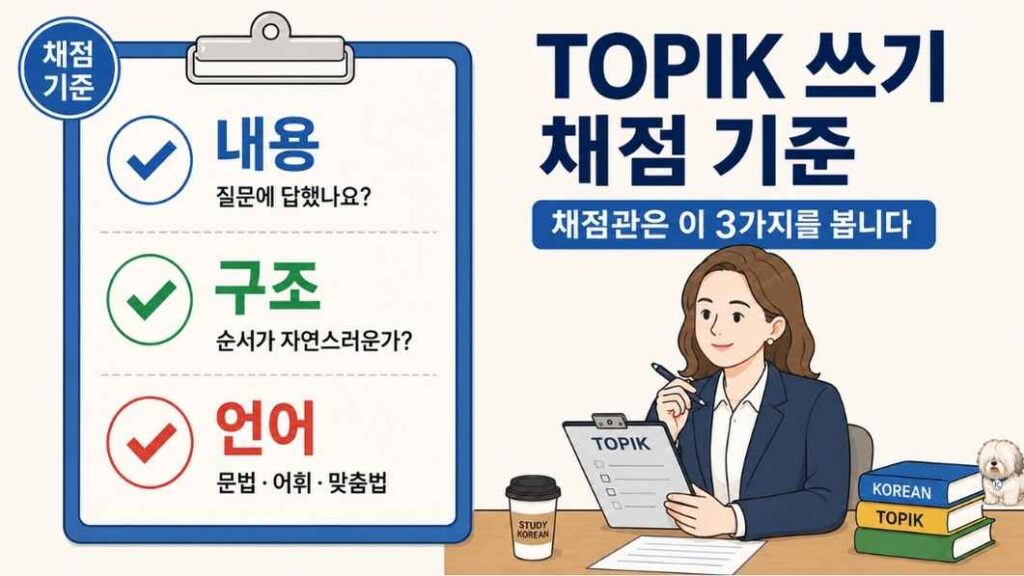
![TOPIK I reading question [34-39]](https://properkorean.com/wp-content/uploads/2026/08/Proper-Korean-3.jpg)
📌 Prefer to read in Korean? 한국어로 공부하고 싶어요? 👉 [한국말로 배워요!]
Welcome! 😊
In TOPIK I reading, questions 31–33 ask one thing: “What is this text about?”
You read a short text and choose its topic from four choices. Each question is worth 2 points.
These TOPIK I reading questions are all about vocabulary. If you know the words, you can answer very fast.
Today you will learn a simple “category box” method, and then practice.
Try each question first, then open the answer to check.
① Remember just one thing
Two words share a box → that box is the answer!
e.g. 사과 (apple), 바나나 (banana) → both go in the “과일 (fruit)” box 👉 answer: fruit.
② Category card (quick reference)
- ~원 (won) → 값 (price) — eg. 오천 원 (5,000 won)
- ~살 (years old) → 나이 (age) — eg. 스무 살 (20 years old)
- ~시 (o’clock) → 시간 (time) — eg. 열두 시 (12 o’clock)
| Box (the answer word) | When you see these words… |
|---|---|
| 음식 (food) | 김치, 라면, 불고기, 비빔밥 |
| 과일 (fruit) | 사과, 바나나, 수박, 포도 |
| 나라 (country) | 한국, 미국, 미얀마 (“~에서 왔습니다”) |
| 직업 (job) | 선생님, 의사, 회사원, 요리사 |
| 날씨 (weather) | 비, 눈, 바람, 춥다, 덥다 |
| 취미 (hobby) | 운동, 등산, 그림 (“좋아합니다”, “자주 합니다”) |
Practice: TOPIK I reading questions 31–33
Try each TOPIK I reading question first.
Read the short text, choose the topic, then open the box to check.
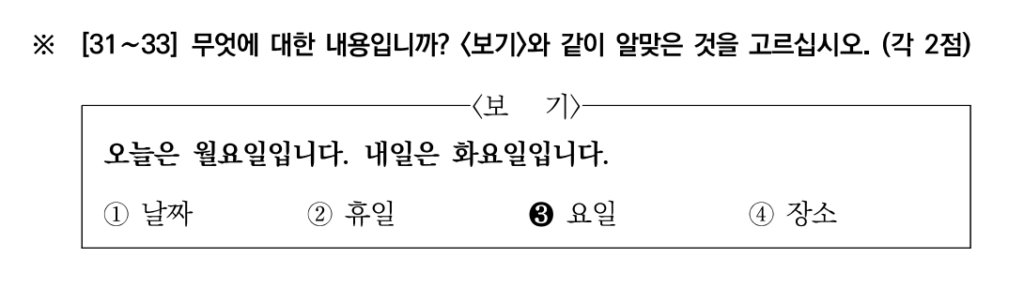
Question 1
김치가 맛있습니다. 라면도 맛있습니다.
① 요일② 나라③ 음식④ 값
🔽 See the answer (Question 1)
Q: 김치가 맛있습니다. 라면도 맛있습니다. (Kimchi is delicious. Ramyeon is delicious too.) 👉 “김치”, “라면” → things you eat.
A: ③ 음식 (food) → Both are food! ✅
① 요일 (day) = no words like Monday or Tuesday.
② 나라 (country) = no words like Korea or Japan.
④ 값 (price) = no words like “~원 (won)”.
💡 Tip: When you see food names → the “음식 (food)” box!
Question 2
저는 미국에서 왔습니다. 친구는 미얀마에서 왔습니다.
① 나라② 음식③ 요일④ 선물
🔽 See the answer (Question 2)
Q: 저는 미국에서 왔습니다. 친구는 미얀마에서 왔습니다. (I am from US. My friend is from Myanmar.) 👉 “미국”, “미얀마” → country names.
A: ① 나라 (country) → Both are countries! ✅
② 음식 / ③ 요일 / ④ 선물 = no such words here.
💡 Tip: “~에서 왔습니다 (I came from ~)” + a country name → the “나라 (country)” box!
Question 3
수미 씨는 요리를 합니다. 식당 요리사입니다.
① 가족② 직업③ 이름④ 나이
🔽 See the answer (Question 3)
Q: 수미 씨는 요리를 합니다. 식당 요리사입니다. (Sumi cooks. She is a restaurant cook.) 👉 “요리사 (cook)” → the work someone does.
A: ② 직업 (job) → “cook” is a job! ✅
① 가족 (family) = no words like father or sibling.
③ 이름 / ④ 나이 = no such words here.
💡 Tip: When you see a job name (cook, doctor, teacher) → the “직업 (job)” box!
Question 4
저는 열 살입니다. 동생은 여덟 살입니다.
① 날짜② 시간③ 나이④ 이름
🔽 See the answer (Question 4)
Q: 저는 열 살입니다. 동생은 여덟 살입니다. (I am ten years old. My younger sibling is eight years old.) 👉 “열 살”, “여덟 살” → “~살 (years old)”!
A: ③ 나이 (age) → “~살” means age! ✅
① 날짜 / ② 시간 / ④ 이름 = no such words here.
💡 Tip: ⭐ When you see “~살” → always the “나이 (age)” box!
Question 5
커피는 사천 원입니다. 우유는 이천 원입니다.
① 맛② 옷③ 값④ 일
🔽 See the answer (Question 5)
Q: 커피는 사천 원입니다. 우유는 이천 원입니다. (Coffee is 4,000 won. Milk is 2,000 won.) 👉 “사천 원”, “이천 원” → “~원 (won)”!
A: ③ 값 (price) → “~원” means price! ✅
① 맛 / ② 옷 / ④ 일 = no such words here.
💡 Tip: ⭐ When you see “~원 (won)” → always the “값 (price)” box!
Question 6
지금은 점심입니다. 열두 시입니다.
① 시간② 요일③ 직업④ 휴일
🔽 See the answer (Question 6)
Q: 지금은 점심입니다. 열두 시입니다. (It is lunchtime now. It is twelve o’clock.) 👉 “점심”, “열두 시” → a time (“~시”).
A: ① 시간 (time) → “twelve o’clock” is a time! ✅
② 요일 / ③ 직업 / ④ 휴일 = no such words here.
💡 Tip: ⭐ When you see “~시 (o’clock)” → always the “시간 (time)” box!
Question 7
오늘은 눈이 옵니다. 아주 춥습니다.
① 계획② 날씨③ 방학④ 계절
🔽 See the answer (Question 7)
Q: 오늘은 눈이 옵니다. 아주 춥습니다. (It is snowing today. It is very cold.) 👉 “눈 (snow)”, “춥다 (cold)” → about the weather.
A: ② 날씨 (weather) → snow and cold are weather! ✅
① 계획 / ③ 방학 = no such words here.
④ 계절 (season) = needs words like spring, summer, fall, winter. They are not here.
💡 Tip: rain, snow, wind, hot, cold → the “날씨 (weather)” box! (Do not confuse it with “season”.)
Question 8
저는 그림을 좋아합니다. 주말에 자주 그립니다.
① 쇼핑② 장소③ 취미④ 날씨
🔽 See the answer (Question 8)
Q: 저는 그림을 좋아합니다. 주말에 자주 그립니다. (I like drawing. I often draw on weekends.) 👉 “그림 (drawing)”, “자주 그립니다 (often draw)” → something you enjoy doing.
A: ③ 취미 (hobby) → drawing is a hobby! ✅
① 쇼핑 / ② 장소 / ④ 날씨 = no such words here.
💡 Tip: “좋아합니다 (like)” + “자주 합니다 (often do)” → the “취미 (hobby)” box!
③ How to memorize the words easily
Now you have practiced, here is the fastest way to build your TOPIK I reading vocabulary.
- Group by box. Don’t memorize words one by one. Put 김치, 라면, 불고기 together in the “food” box — about 3–5 words per box.
- Make pairs. One word + one box: doctor–job, snow–weather, apple–fruit.
- Learn the 3 signal units first: ~원 → 값, ~살 → 나이, ~시 → 시간. When you see them, you already know the answer!
- Quiz yourself. Cover the box name, look at a word, and say the box.
🤖Practice with AI: a listening game 🎧
Here is a new game — a listening game. The AI reads two short Korean sentences, and you say the topic in one Korean word. You only need one word, so it is easy — and you train your ears too!
First, turn on the AI’s voice (read-aloud). The AI reads in Korean; you answer with one Korean word out loud.
🗣️“Let’s play a topic listening game. Read TWO short, easy Korean sentences out loud (beginner level, slowly). I will listen and say the topic in ONE Korean word. Then tell me if I am right in English. For example, you read ‘사과가 맛있어요. 바나나도 맛있어요.’ and I should say ‘과일 (fruit)’. Pick topics from: food, fruit, country, job, family, weather, hobby, clothes, price, age, time. Give me 5 rounds and count my score.”
⚠️ AI can make mistakes. Always check with real past exams at the end. AI is for practice; the past exams are the answer key.th real past exams at the end. AI is for practice; the past exams are the answer key.
Summary
- Find the “box (category)” of the words. Two words, one box = the answer!
- Remember the 3 signal units: ~원 → 값, ~살 → 나이, ~시 → 시간.
- Study a little TOPIK I reading every day. Learn one box each day — that is enough!
OK! You Work hard Today!
Don’t give up. Keep practicing, and you can all pass TOPIK Level 2. 🎉
If you have any questions, leave a comment.
See you in the next lesson! 🌱
📢 want to practice TOPIKⅠ Listening next? 👉 [ TOPIKⅠ Listening ]
FAQ
Q: What are TOPIK I reading questions 31–33?
A: You read a short text and choose its topic (화제) from four choices. Each question is worth 2 points.
Q: How do I find the topic fast?
A: Find which “box (category)” the words go into. When two words share the same box, that box is the answer (사과, 바나나 → 과일 / fruit).
Q: Which words give the answer away instantly?
A: Signal units: ~원 → 값 (price), ~살 → 나이 (age), ~시 → 시간 (time). When you see them, you already know the answer.