TOPIK I Reading 34–39 ⑤: 9 Korean Particles for the Blank (에 / 에서 · 을/를)

TOPIK I Reading

📌 한국말로 공부하고 싶어요? 👉 [한국어]

Do small Korean particles like 에, 에서, and 을 feel tricky in TOPIK I reading? 😊 Here is the secret: each particle has one clear role. Learn the roles, and these questions become easy!

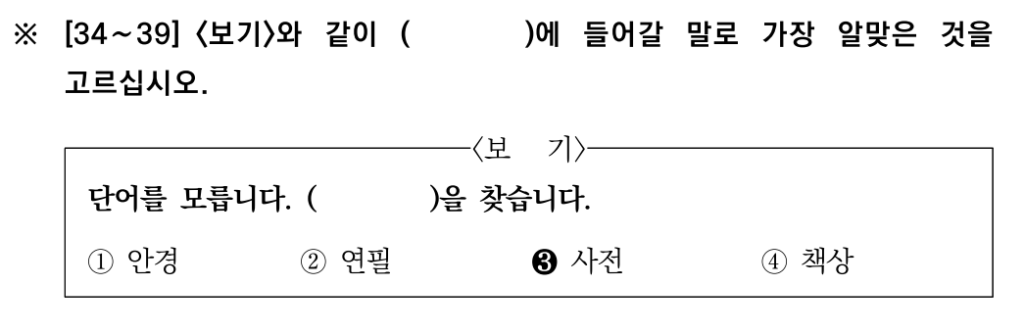
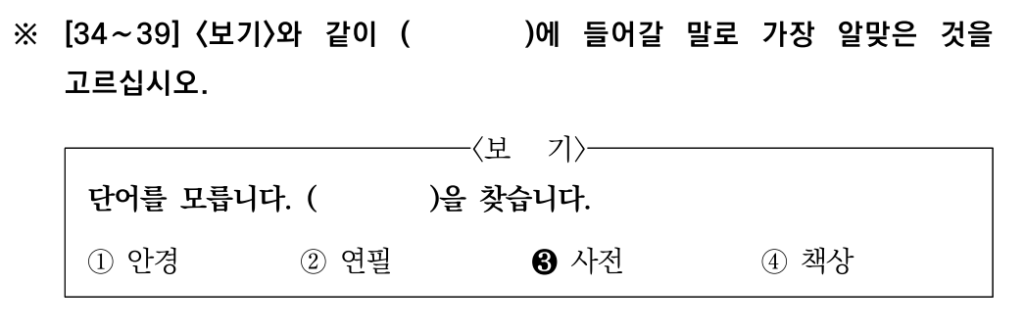
In questions 34–39, a particle blank tests one small word after a noun. Each TOPIK I reading question is worth 2 points.

Try each one first, then open the answer to check.

① Remember just one thing


A particle attaches to a noun and gives it a role.
Read the sentence, and choose the role it needs.

e.g. 밥 (    ) 먹어요 → “eat WHAT?” → 을 (object)

② Particle card

ParticleRoleExample
이/가subject (who / what)친구가 와요
을/를object (what)밥을 먹어요
place you go to / time학교에 가요
에서place of action / from식당에서 먹어요
하고 (와/과)and, with빵하고 우유
also (too)저도 가요
only물만 마셔요
에게 (한테)to a person친구에게 줘요
of (possession)동생의 가방
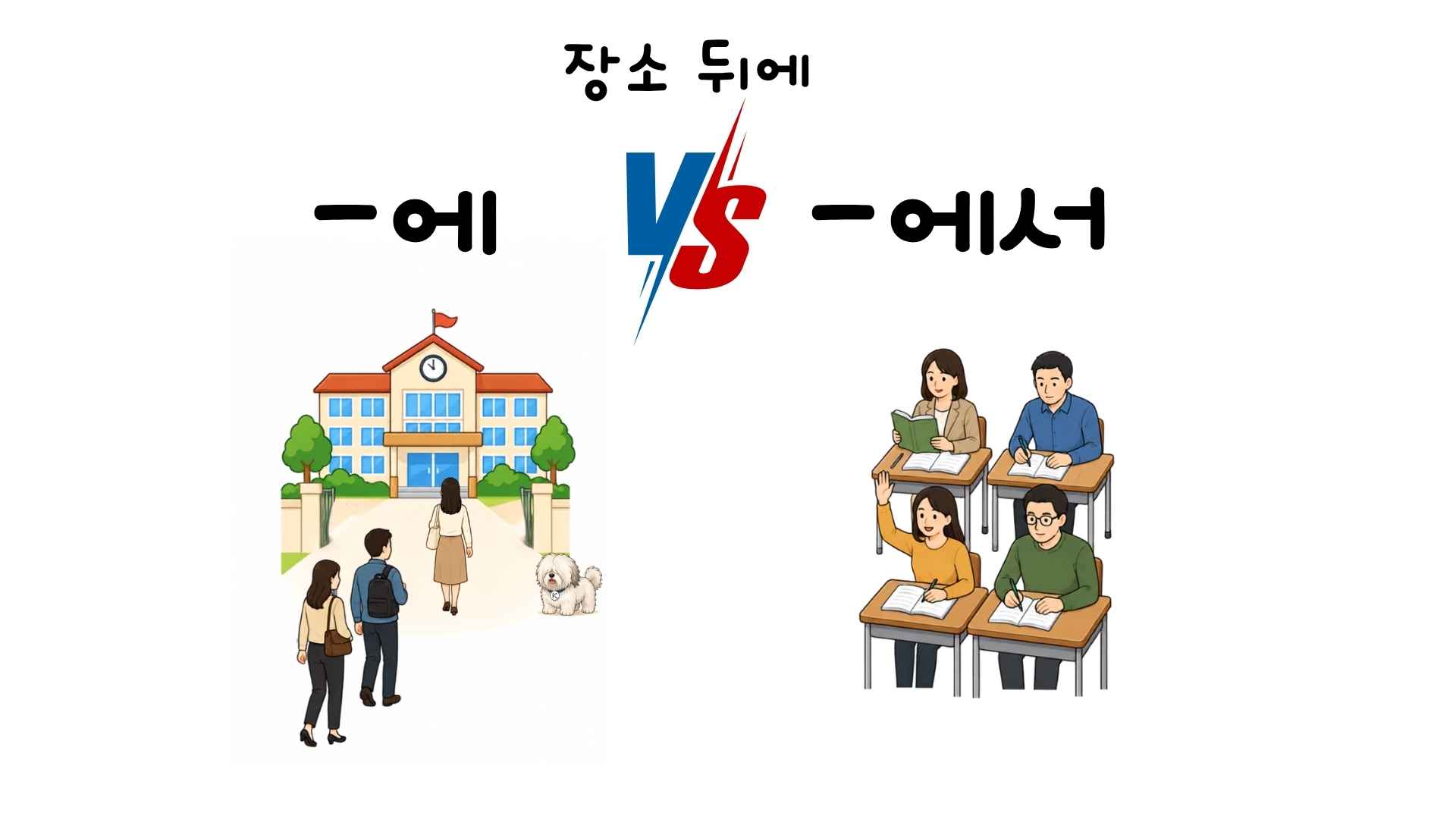
📌 -에 vs -에서: 가다 / 오다 → -에 (학교에 가요) · do something → -에서 (학교에서 공부해요)

📌 -을/를: after a final consonant → -을 (밥을) · after a vowel → -를 (사과를)
💡Do you want to study more in detail [-에 vs-에서]? Check this 👉 [ -에 vs -에서 ]

Practice: TOPIK I reading particle blanks

Try each TOPIK I reading question first.

Read the sentence, choose the particle, then open the box to check.
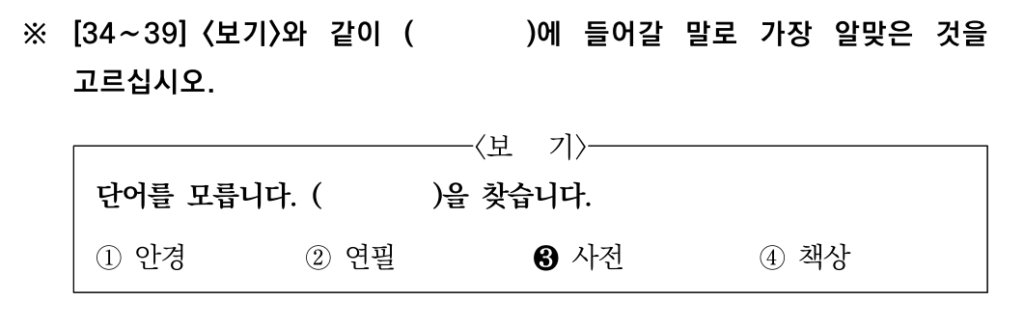
Question 1

저는 베트남(       ) 왔습니다.

① 이② 의③ 에서④ 하고


🔽 See the answer (Question 1)

Q: 저는 베트남( ) 왔습니다.
(I came ( ) Vietnam.)
👉 Came FROM where? (starting place)

A: ✅③ 에서 → “~에서 오다” means “come from ~”. From Vietnam!

① 이 = subject marker (-이/가).

② 의 = of (possession).

④ 하고 = and / with.


💡 Tip: come/came from a country or place → ~에서!


Question 2

형은 학생입니다. 저(       ) 학생입니다.

① 만② 에③ 를④ 도


🔽 See the answer (Question 2)

Q: 형은 학생입니다. 저( ) 학생입니다.
(My older brother is a student. I am ( ) a student.)
👉 Brother is, and I am → “also”?

A: ✅④ 도 → “-도” means “also / too”. I am also a student!

① 만 = only.

② 에 = to a place / time.

③ 를 = object marker (-을/를); a verb should follow.


💡 Tip: same as before (“also”) → -도!


Question 3

시장에서 사과(       ) 배를 삽니다.

① 하고② 만③ 까지④ 에서


🔽 See the answer (Question 3)

Q: 시장에서 사과( ) 배를 삽니다.
(At the market, I buy apples ( ) pears.)
👉 apples “and” pears?

A: ✅① 하고 → “-하고” means “and / with”. Apples and pears!

② 만 = only.

③ 까지 = up to / until.

④ 에서 = at a place / from.


💡 Tip: A ( ) B (both) → -하고 (= -와/과)!


Question 4

친구 생일입니다. 친구(       ) 선물을 줍니다.

① 도② 를③ 에서④ 에게


🔽 See the answer (Question 4)

Q: 친구 생일입니다. 친구( ) 선물을 줍니다.
(It is my friend’s birthday. I give a gift ( ) my friend.)
👉 Give TO whom? (a person)

A: ✅④ 에게 → For a person, use “-에게”. To my friend!

① 도 = also.

② 를 = object marker (-을/를).

③ 에서 = at a place / from.


💡 Tip: a person + give/send → -에게 (= -한테)!


Question 5

다른 것은 없습니다. 물(       ) 있습니다.

① 을② 만③ 도④ 로


🔽 See the answer (Question 5)

Q: 다른 것은 없습니다. 물( ) 있습니다.
(There is nothing else. There is ( ) water.)
👉 Nothing else, water “only”?

A: ✅② 만 → “-만” means “only”. Only water!

① 을 = object marker (-을/를); a verb should follow.

③ 도 = also.

④ 로 = by / with (a way or tool).


💡 Tip: only one thing → -만!


Question 6

이것은 제 것이 아닙니다. 동생(       ) 가방입니다.

① 도② 만③ 의④ 을


🔽 See the answer (Question 6)

Q: 이것은 제 것이 아닙니다. 동생( ) 가방입니다.
(This is not mine. It is my sibling’s ( ) bag.)
👉 Whose bag?

A: ✅③ 의 → “의” means “of (possession)”. My sibling’s bag!

① 도 = also.

② 만 = only.

④ 을 = object marker (-을/를); a verb should follow.


💡 Tip: whose thing (possession) → -의!


Question 7

방이 덥습니다. 그래서 창문(       ) 엽니다.

① 에② 의③ 을④ 이


🔽 See the answer (Question 7)

Q: 방이 덥습니다. 그래서 창문( ) 엽니다.
(The room is hot. So I open the window ( ).)
👉 Open WHAT? (object)

A: ✅③ 을 → “-을/를” marks the object (what). Open the window!

① 에 = to a place / time.

② 의 = of (possession).

④ 이 = subject marker (-이/가).


💡 Tip: do something to WHAT → -을/를! (“창문” ends in a consonant, so -을)


Question 8

저는 아침에 학교(       ) 갑니다.

① 에② 에서③ 을④ 도


🔽 See the answer (Question 8)

Q: 저는 아침에 학교( ) 갑니다.
(In the morning I go ( ) school.)
👉 Go TO where? (destination)

A: ✅① 에 → “~에 가다” means the place you go to. To school!

② 에서 = the place of an action (학교에서 공부해요); not used with 가다.

③ 을 = object marker (-을/를).

④ 도 = also.


💡 Tip: -에 vs -에서! 가다·오다 → -에 (학교에 가요) · do something → -에서 (학교에서 공부해요)

③ How to memorize the particles easily

Now you have practiced, here is the fastest way to grow your TOPIK I reading vocabulary.

  1. Learn each particle by its role. 을/를 (what), 에 (to a place), 에서 (place of action), 에게 (to a person), 의 (whose).
  2. Focus on the tricky pair: 에 ↔ 에서. (가다 → 에, do something → 에서)
  3. 을/를 rule: after a consonant → 을, after a vowel → 를.
  4. Read out loud. Your ear will learn the natural particle.

🤖Practice with AI: a Korean particle game

You can practice TOPIK I reading alone with AI — and grow your Korean speaking too!

First, turn on the AI’s voice (read-aloud).

Then answer out loud in Korean. The game is played only in Korean.🗣️

“Let’s play a Korean particle game. Please speak only in Korean during the game — no English. You read a short sentence with one blank in Korean (for example: 학교 ( ) 갑니다), and I say the correct particle out loud in Korean (for example: 에). Give me 10 quickly, then tell me my score in Korean. Use only beginner words.”

⚠️ AI can make mistakes.

Always check with real past exams at the end. AI is for practice; the past exams are the answer key.

Summary

  • A particle gives a noun its role. Read the sentence and choose the role.
  • Always split 에 (go to) vs 에서 (do something / from).
  • 을/를 depends on the final letter: 밥을 / 사과를.

Well done! Keep practicing, and you can all pass TOPIK Level 2. 🎉

Have a question? Please leave a comment.

See you in the next lesson!

📢 want to practice TOPIKⅠ Listening next? 👉 [ TOPIKⅠ Listening ] 

FAQ

Q: What are TOPIK I reading questions 34–39?

A: They ask you to fill a blank with the right word — a particle, noun, verb, adjective, or adverb. Each question is worth 2 points.

Q: How do I choose the right particle?

A: Each particle has a role. Read the sentence and pick the role it needs: object (을/를), destination (에), place of action (에서), to a person (에게), or possession (의).

Q: What is the difference between 에 and 에서?

A: Use 에 for the place you go to (학교에 가요). Use 에서 for the place where you do something (학교에서 공부해요) or “from.”
TOPIK I Reading 34–39 ④: 7 Adverbs to Fill the Blank (아주 · 자주 · 같이)

TOPIK I Reading

📌 한국말로 공부하고 싶어요? 👉 [한국어]

Do adverbs like 아주, 자주, and 가끔 look confusing in TOPIK I reading? 😊

The trick is simple: each adverb has one clear meaning. Learn 7 of them, and these questions become easy!

In questions 34–39, an adverb blank asks how much, how often, or how. Each TOPIK I reading question is worth 2 points.

Try each one first, then open the answer to check.

① Remember just one thing

Choose an adverb by its meaning, and read the other sentence for the clue.
e.g. 날씨가 (    ) 춥습니다 → How cold? → 아주 (very)
e.g. 좋아해서 (    ) 마십니다 → How often? → 자주 (often)

② Adverb card

MeaningAdverb
very much (degree)아주 (very)
many times (often)자주 (often)
sometimes, a little가끔 (sometimes)
together (with someone)같이 (together)
for the first time처음 (first time)
before something else먼저 (first / before)
quickly빨리 (quickly)
📌 Pair to remember: 자주 (often) ↔ 가끔 (sometimes).
📌 아주 often comes before an adjective. (아주 춥다 · 아주 맛있다)

Practice: TOPIK I reading adverb blanks

Try each TOPIK I reading question first.

Read the two sentences, choose the adverb, then open the box to check.

Question 1

오늘은 날씨가 (       ) 춥습니다. 그래서 옷을 많이 입습니다.

① 아주② 자주③ 가끔④ 먼저


🔽 See the answer (Question 1)

Q: 오늘은 날씨가 ( ) 춥습니다.
(Today the weather is ( ) cold.)
👉 How cold? (degree)

A: ✅① 아주 (very) → It is very cold, so I wear many clothes!

② 자주 = often (many times).

③ 가끔 = sometimes.

④ 먼저 = first / before.


💡 Tip: before an adjective (춥다 · 덥다 · 맛있다), for “how much” → 아주 (very)!


Question 2

저는 커피를 좋아합니다. 그래서 (       ) 마십니다.

① 자주② 가끔③ 먼저④ 아까


🔽 See the answer (Question 2)

Q: 저는 커피를 좋아합니다. 그래서 ( ) 마십니다.
(I like coffee. So I drink it ( ).)
👉 I like it — how often?

A: ✅① 자주 (often) → If you like it, you drink it often!

② 가끔 = sometimes (a little).

③ 먼저 = first / before.

④ 아까 = a while ago.


💡 Tip: like it, so many times → 자주 (often)! (opposite: 가끔)


Question 3

저는 보통 걸어서 갑니다. (       ) 버스를 탑니다.

① 가끔② 아주③ 같이④ 빨리


🔽 See the answer (Question 3)

Q: 저는 보통 걸어서 갑니다. ( ) 버스를 탑니다.
(I usually walk. ( ) I take the bus.)
👉 Usually walk — the bus is how often?

A: ✅① 가끔 (sometimes) → I usually walk, but sometimes I take the bus!

② 아주 = very (much).

③ 같이 = together.

④ 빨리 = quickly.


💡 Tip: usually A, and ( ) B → “B sometimes” → 가끔!


Question 4

친구를 만났습니다. 우리는 (       ) 밥을 먹었습니다.

① 가장② 아직③ 같이④ 별로


🔽 See the answer (Question 4)

Q: 친구를 만났습니다. 우리는 ( ) 밥을 먹었습니다.
(I met my friend. We ate ( ).)
👉 “We” — did it together?

A: ✅③ 같이 (together) → We ate together with the friend!

① 가장 = most.

② 아직 = still / not yet.

④ 별로 = not really.


💡 Tip: “우리는 (we)” + ( ) → 같이 (together)!


Question 5

저는 그 사람을 모릅니다. 내일 (       ) 만납니다.

① 처음② 보통③ 제일④ 항상


🔽 See the answer (Question 5)

Q: 저는 그 사람을 모릅니다. 내일 ( ) 만납니다.
(I don’t know that person. Tomorrow I meet them ( ).)
👉 Don’t know them — which meeting is it?

A: ✅① 처음 (first time) → You don’t know them, so tomorrow is the first time!

② 보통 = usually.

③ 제일 = most.

④ 항상 = always.


💡 Tip: meet a person you don’t know → 처음 (first time)!


Question 6

이 케이크가 (       ) 맛있습니다. 그래서 매일 먹습니다.

① 아주② 가끔③ 먼저④ 아까


🔽 See the answer (Question 6)

Q: 이 케이크가 ( ) 맛있습니다.
(This cake is ( ) delicious.)
👉 How delicious? (degree)

A: ✅① 아주 (very) → It is very delicious, so I eat it every day!

② 가끔 = sometimes.

③ 먼저 = first / before.

④ 아까 = a while ago.


💡 Tip: before an adjective (맛있다), for “how much” → 아주 (very)!


Question 7

저는 아침에 (       ) 세수를 합니다. 그리고 밥을 먹습니다.

① 먼저② 가끔③ 아주④ 같이


🔽 See the answer (Question 7)

Q: 저는 아침에 ( ) 세수를 합니다. 그리고 밥을 먹습니다.
(In the morning I wash my face ( ). Then I eat.)
👉 Wash → eat: which order?

A: ✅① 먼저 (first) → I wash my face first, then I eat!

② 가끔 = sometimes.

③ 아주 = very.

④ 같이 = together.


💡 Tip: do A ( ), then B → “A first” → 먼저!


Question 8

시간이 없습니다. 그래서 (       ) 갑니다.

① 빨리② 같이③ 처음④ 가끔


🔽 See the answer (Question 8)

Q: 시간이 없습니다. 그래서 ( ) 갑니다.
(I have no time. So I go ( ).)
👉 No time — how do you go?

A: ✅① 빨리 (quickly) → If you have no time, you go quickly!

② 같이 = together.

③ 처음 = first time.

④ 가끔 = sometimes.


💡 Tip: no time → 빨리 (quickly)!

③ How to memorize the adverbs easily

Now you have practiced, here is the fastest way to grow your TOPIK I reading vocabulary.

  1. Group by meaning. degree (아주), how often (자주 · 가끔), together (같이).
  2. Learn the pair. 자주 (often) ↔ 가끔 (sometimes). They are opposites.
  3. Read the OTHER sentence and ask: how much? how often? how?
  4. Quiz yourself. See a meaning, and say the adverb. (many times → ?)

🤖Practice with AI: a Korean adverb speed game

You can practice TOPIK I reading alone with AI — and grow your Korean speaking too!

First, turn on the AI’s voice (read-aloud).

Then answer out loud in Korean. The game is played only in Korean.

🗣️”Let’s play a Korean adverb speed game. Please speak only in Korean during the game — no English. You say a short situation in Korean (for example: 좋아해서 여러 번 마셔요), and I say the adverb in Korean out loud (for example: 자주). Give me 10 quickly, then tell me my score in Korean. Use only beginner words.”

⚠️ AI can make mistakes.

Always check with real past exams at the end. AI is for practice; the past exams are the answer key.

Summary

  • Choose an adverb by its meaning, and read the other sentence for the clue.
  • 아주 (degree) · 자주 / 가끔 (how often) · 같이 (together) · 처음 / 먼저 (order) · 빨리 (quickly).
  • Learn 자주 ↔ 가끔 as a pair to erase wrong choices fast.

Good Job! Keep practicing, and you can all pass TOPIK Level 2. 🎉

Have a question? Please leave a comment.

See you in the next lesson!

📢 want to practice TOPIKⅠ Listening next? 👉 [ TOPIKⅠ Listening ] 

FAQ

Q: What are TOPIK I reading questions 34–39?

A: They ask you to fill a blank with the right word — a particle, noun, verb, adjective, or adverb. Each question is worth 2 points.

Q: How do I choose the right adverb for the blank?

A: Choose by meaning and read the other sentence. Ask: how much (아주), how often (자주 · 가끔), or how (같이 · 빨리)?

Q: Where does 아주 usually go?

A: 아주 (very) usually comes before an adjective, like 아주 춥다 (very cold) or 아주 맛있다 (very delicious).

TOPIK I Reading 34–39 ③: 8 Adjective Blanks & 5 Opposite Pairs

TOPIK I Reading

📌 한국말로 공부하고 싶어요? 👉 [한국어]

Do you keep mixing up 쉽다 (easy) and 어렵다 (hard) in TOPIK I reading? 😊

Don’t worry — the other sentence always tells you which one. Just read it first!

In questions 34–39, an adjective blank asks about a state — how something is (아프다, 바쁘다, 가깝다…). Each TOPIK I reading question is worth 2 points.

Try each one first, then open the answer to check.

① Remember just one thing

An adjective describes a state (how something is).
Read the other sentence — the reason or result — and choose the state that fits.
e.g. 약을 먹어요 (take medicine) → 아프다 (sick/hurt).
And learn opposite pairs (쉽다 ↔ 어렵다) to erase wrong choices fast.

② Adjective card

When you see this situation…Use this adjective
약을 먹어요 / 병원에 가요아프다 (sick / hurt)
시간이 없어요 / 일이 많아요바쁘다 (busy)
늦게까지 일했어요피곤하다 (tired)
집 앞에 있어요 / 걸어가요가깝다 (close / near)
시험을 잘 봤어요쉽다 (easy)
점수가 나빴어요어렵다 (difficult)
발이 아파요 (신발)작다 (small)
📌 Learn opposite pairs together — then you can erase the wrong choice fast.
많다 ↔ 적다 (many ↔ few) · 크다 ↔ 작다 (big ↔ small) · 가깝다 ↔ 멀다 (near ↔ far) · 쉽다 ↔ 어렵다 (easy ↔ hard) · 싸다 ↔ 비싸다 (cheap ↔ expensive)

Practice: TOPIK I reading adjective blanks

Try each TOPIK I reading question first.

Read the two sentences, choose the adjective, then open the box to check.

Question 1

이가 (       ). 그래서 치과에 갑니다.

① 아픕니다② 예쁩니다③ 짧습니다④ 좋습니다


🔽 See the answer (Question 1)

Q: 이가 ( ). 그래서 치과에 갑니다.
(My tooth ( ). So I go to the dentist.)
👉 The other sentence: “치과에 갑니다 (go to the dentist)”.

A: ✅① 아픕니다 (hurt) → If your tooth hurts, you go to the dentist!

② 예쁘다 = pretty.

③ 짧다 = short.

④ 좋다 = good / nice.


💡 Tip: go to a dentist/hospital / take medicine → 아프다 (hurt)!


Question 2

요즘 일이 많습니다. 그래서 아주 (       ).

① 조용합니다② 바쁩니다③ 가볍습니다④ 깨끗합니다


🔽 See the answer (Question 2)

Q: 요즘 일이 많습니다. 그래서 아주 ( ).
(These days I have a lot of work. So I am very ( ).)
👉 The other sentence: “일이 많습니다 (a lot of work)”.

A: ✅② 바쁩니다 (busy) → A lot of work makes you busy!

① 조용하다 = quiet.

③ 가볍다 = light (not heavy).

④ 깨끗하다 = clean.


💡 Tip: a lot of work / no time → 바쁘다 (busy)!


Question 3

학교가 집 앞에 있습니다. 그래서 아주 (       ).

① 큽니다② 비쌉니다③ 가깝습니다④ 깨끗합니다


🔽 See the answer (Question 3)

Q: 학교가 집 앞에 있습니다. 그래서 아주 ( ).
(The school is in front of my house. So it is very ( ).)
👉 The other sentence: “집 앞에 있습니다 (in front of the house)”.

A: ✅③ 가깝습니다 (close) → If it is in front of your house, it is close!

① 크다 = big.

② 비싸다 = expensive.

④ 깨끗하다 = clean.


💡 Tip: in front of the house / walk there → 가깝다 (near)! (opposite: 멀다 far)


Question 4

오늘 늦게까지 일했습니다. 그래서 조금 (       ).

① 작습니다② 무겁습니다③ 피곤합니다④ 비쌉니다


🔽 See the answer (Question 4)

Q: 오늘 늦게까지 일했습니다. 그래서 조금 ( ).
(Today I worked until late. So I am a little ( ).)
👉 The other sentence: “늦게까지 일했습니다 (worked until late)”.

A: ✅③ 피곤합니다 (tired) → Working late makes you tired!

① 작다 = small.

② 무겁다 = heavy.

④ 비싸다 = expensive.


💡 Tip: worked a lot / didn’t sleep → 피곤하다 (tired)!


Question 5

도서관에 갔습니다. 책이 아주 (       ).

① 넓습니다② 많습니다③ 쉽습니다④ 짧습니다


🔽 See the answer (Question 5)

Q: 도서관에 갔습니다. 책이 아주 ( ).
(I went to the library. There are very ( ) books.)
👉 The other sentence: “도서관 (library)”, “책 (books)”.

A: ✅② 많습니다 (many) → A library has many books!

① 넓다 = wide (a place is big).

③ 쉽다 = easy.

④ 짧다 = short.


💡 Tip: a big number of ~ → 많다 (many)! (opposite: 적다 few)


Question 6

시험 공부를 많이 했습니다. 그래서 시험이 (       ).

① 나빴습니다② 작았습니다③ 쉬웠습니다④ 재미없었습니다


🔽 See the answer (Question 6)

Q: 시험 공부를 많이 했습니다. 그래서 시험이 ( ).
(I studied a lot for the test. So the test was ( ).)
👉 The other sentence: “공부를 많이 했습니다 (studied a lot)”.

A: ✅③ 쉬웠습니다 (easy) → If you study a lot, the test feels easy!

① 나쁘다 = bad.

② 작다 = small.

④ 재미없다 = not fun.


💡 Tip: did well / studied a lot → 쉽다 (easy)! (opposite: 어렵다 hard)


Question 7

이 신발이 (       ). 그래서 발이 아픕니다.

① 큽니다② 작습니다③ 많습니다④ 좋습니다


🔽 See the answer (Question 7)

Q: 이 신발이 ( ). 그래서 발이 아픕니다.
(These shoes are ( ). So my feet hurt.)
👉 The other sentence: “발이 아픕니다 (feet hurt)”.

A: ✅② 작습니다 (small) → If shoes are small, your feet hurt!

① 크다 = big (big shoes don’t hurt your feet).

③ 많다 = many.

④ 좋다 = good / nice.


💡 Tip: shoes are small → feet hurt! (opposite: 크다 big)


Question 8

한국어 시험이 (       ). 그래서 점수가 나빴습니다.

① 쉬웠습니다② 어려웠습니다③ 짧았습니다④ 많았습니다


🔽 See the answer (Question 8)

Q: 한국어 시험이 ( ). 그래서 점수가 나빴습니다.
(The Korean test was ( ). So my score was bad.)
👉 The other sentence: “점수가 나빴습니다 (bad score)”.

A: ✅② 어려웠습니다 (difficult) → If the test is difficult, the score is bad!

① 쉽다 = easy (easy test → good score).

③ 짧다 = short.

④ 많다 = many.


💡 Tip: Q6 is 쉽다 (easy), Q8 is 어렵다 (hard).
Look at the RESULT (did well? / bad score?) to decide!

③ How to memorize the adjectives easily

Now you have practiced, here is the fastest way to grow your TOPIK I reading vocabulary.

  1. Learn situation ↔ adjective as a pair. (medicine → 아프다, a lot of work → 바쁘다)
  2. Learn opposite pairs together. (쉽다 ↔ 어렵다, 크다 ↔ 작다) You can erase the wrong choice fast.
  3. Read the OTHER sentence first — look at the reason or result. (feet hurt → shoes are small)
  4. Quiz yourself. See a situation, and say the adjective. (no time → ?)

🤖Practice with AI: a Korean opposite-word battle

You can practice TOPIK I reading alone with AI — and grow your Korean speaking too!

First, turn on the AI’s voice (read-aloud).

Then answer out loud in Korean. The game is played only in Korean.

🗣️”Let’s play a Korean opposite-word battle. Please speak only in Korean during the game — no English. You say an adjective in Korean (for example: 쉽다), and I say the opposite in Korean out loud (for example: 어렵다). Give me 10 quickly, then tell me my score in Korean. Use only beginner words.”

⚠️ AI can make mistakes.

Always check with real past exams at the end. AI is for practice; the past exams are the answer key.

Summary

  • An adjective is a state. Read the other sentence (reason or result) and match it.
  • Learn opposite pairs (쉽다 ↔ 어렵다) to erase wrong choices fast.
  • Same words, different result? Decide by the result. (good score → easy / bad score → hard)

Well done! Keep practicing, and you can all pass TOPIK Level 2. 🎉

Have a question? Please leave a comment.

See you in the next lesson!

📢 want to practice TOPIKⅠ Listening next? 👉 [ TOPIKⅠ Listening ] 

FAQ

Q: What are TOPIK I reading questions 34–39?

A: They ask you to fill a blank with the right word — a particle, noun, verb, adjective, or adverb. Each question is worth 2 points.

Q: How do I choose the right adjective for the blank?

A: Read the other sentence — the reason or the result — and pick the state that fits. (feet hurt → shoes are small)

Q: Why do opposite pairs help?

A: If you know 쉽다 ↔ 어렵다, you can quickly erase the wrong one and decide by the result (good score or bad score).

TOPIK I Reading 34–39 ②: 9 Korean “Partner Verbs” for the Blank

TOPIK I Reading

📌 Prefer to read in Korean? 한국어로 공부하고 싶어요?👉 [한국어로 배워요!]

Do you keep choosing the wrong verb in TOPIK I reading? 😊

Here is the secret: Korean has fixed “partner verbs.” Some nouns always go with one special verb. Once you know the pairs, these questions become easy!

Questions 34–39 give you two short sentences with one blank. Verbs are the most common answer here, so this type is very important. Each TOPIK I reading question is worth 2 points.

Try each one first, then open the answer to check.

① Remember just one thing

Korean uses fixed “partner verbs.”
Some nouns always go with one verb. e.g. 사진을 → 찍다 (take a photo).
And if there is no clear pair, read the other sentence for the situation.

② Partner-verb card

When you see this noun…Use this partner verb
사진을 (a photo)찍다 (take a photo)
춤을 (a dance)추다 (dance)
노래를 (a song)부르다 (sing)
전화를 (a phone call)하다 (make a call)
약을 (medicine)먹다 (take medicine)
책을 (a book)읽다 (read) · 보다 (read/look at)
영화를 (a movie)보다 (watch)
편지를 (a letter)부치다 · 보내다 (send)
선물을 (a gift)주다 (give) · 받다 (receive)

📌 No clear pair? Read the other sentence for the situation.

  • Sleep at night → wake up in the morning
  • tired → rest
  • not here yet → wait

Practice: TOPIK I reading verb blanks

Try each TOPIK I reading question first.

Read the two sentences, choose the verb, then open the box to check.

Question 1

생일 파티입니다. 우리는 사진을 (       ).

① 삽니다② 찍습니다③ 읽습니다④ 만납니다


🔽 See the answer (Question 1)

Q: 생일 파티입니다. 우리는 사진을 ( ). (It is a birthday party. We ( ) photos.) 👉 What verb goes with “사진을 (photos)”?

A: ✅② 찍습니다 → In Korean, photos go with “찍다 (take)”.

① 사다 = to buy.

③ 읽다 = to read (books).

④ 만나다 = to meet (people).


💡 Tip: 사진 (photo) always goes with 찍다! (English says “take,” but learn the Korean pair.)


Question 2

저는 음악을 좋아합니다. 매일 노래를 (     ).

① 봅니다② 씁니다③ 부릅니다④ 탑니다


🔽 See the answer (Question 2)

Q: 저는 음악을 좋아합니다. 매일 노래를 ( ). (I like music. Every day I ( ) songs.) 👉 What verb goes with “노래를 (songs)”?

A: ✅③ 부릅니다 → A song goes with “부르다 (sing)”.

① 보다 = to watch / see.

② 쓰다 = to write.

④ 타다 = to ride (a bus).


💡 Tip: 노래 (song) → 부르다 (sing)!


Question 3

밤 열한 시에 잡니다. 아침 여섯 시에 (      ).

① 삽니다② 옵니다③ 일어납니다④ 입습니다


🔽 See the answer (Question 3)

Q: 밤 열한 시에 잡니다. 아침 여섯 시에 ( ). (I sleep at 11 pm. At 6 am I ( ).) 👉 Other sentence: “잡니다 (sleep)”.

A: ✅③ 일어납니다 → After sleeping, in the morning you “일어나다 (wake up)”.

① 사다 = to buy.

② 오다 = to come.

④ 입다 = to wear.


💡 Tip: 자다 (sleep) ↔ 일어나다 (wake up). Read the other sentence!


Question 4

오늘 아주 피곤합니다. 그래서 집에서 (      ).

① 쉽니다② 됩니다③ 찾습니다④ 자릅니다


🔽 See the answer (Question 4)

Q: 오늘 아주 피곤합니다. 그래서 집에서 ( ). (I am very tired today. So at home I ( ).) 👉 Other sentence: “피곤합니다 (tired)”.

A: ✅① 쉽니다 → When you are tired, you “쉬다 (rest)”.

② 되다 = to become.

③ 찾다 = to find / look for.

④ 자르다 = to cut.


💡 Tip: 피곤하다 (tired) → 쉬다 (rest)!


Question 5

배가 아픕니다. 그래서 약을 (      ).

① 봅니다② 먹습니다③ 만납니다④ 씁니다


🔽 See the answer (Question 5)

Q: 배가 아픕니다. 그래서 약을 ( ). (My stomach hurts. So I ( ) medicine.) 👉 What verb goes with “약을 (medicine)”?

A: ✅② 먹습니다 → In Korean, medicine goes with “먹다 (take/eat)”.

① 보다 = to watch.

③ 만나다 = to meet.

④ 쓰다 = to write / to wear.


💡 Tip: 약 (medicine) → 먹다! (Even liquid medicine uses 먹다 in Korean.)


Question 6

오늘은 제 생일입니다. 친구들을 집에 (      ).

① 초대합니다② 가르칩니다③ 구경합니다④ 좋아합니다


🔽 See the answer (Question 6)

Q: 오늘은 제 생일입니다. 친구들을 집에 ( ). (Today is my birthday. I ( ) my friends to my house.) 👉 Other sentence: “생일 (birthday)”.

A: ✅① 초대합니다 → On your birthday, you “초대하다 (invite)” friends.

② 가르치다 = to teach.

③ 구경하다 = to look around / go sightseeing.

④ 좋아하다 = to like.


💡 Tip: 생일 (birthday) + 친구 (friends) → 초대하다 (invite)!


Question 7

친구가 아직 안 왔습니다. 그래서 친구를 (      ).

① 입니다② 보냅니다③ 기다립니다④ 가르칩니다


🔽 See the answer (Question 7)

Q: 친구가 아직 안 왔습니다. 그래서 친구를 ( ). (My friend has not come yet. So I ( ) my friend.) 👉 Other sentence: “아직 안 왔습니다 (not come yet)”.

A: ✅③ 기다립니다 → If someone has not come, you “기다리다 (wait)”.

① 이다 = to be.

② 보내다 = to send.

④ 가르치다 = to teach.


💡 Tip: 아직 안 왔습니다 (not here yet) → 기다리다 (wait)!


Question 8

동생은 춤을 좋아합니다. 춤을 아주 잘 (      ).

① 씁니다② 춥니다③ 탑니다④ 칩니다


🔽 See the answer (Question 8)

Q: 동생은 춤을 좋아합니다. 춤을 아주 잘 ( ).
(My sibling likes dancing. He/she ( ) very well.)
👉 What verb goes with “춤을 (a dance)”?

A: ✅ ② 춥니다 → A dance goes with “추다”.

① 쓰다 = to write.

③ 타다 = to ride.

④ 치다 = to play (piano/guitar) / to hit.


💡 Tip: 춤 (dance) → 추다! (추다 is used only for dancing.)

③ How to memorize the verbs easily

Now you have practiced, here is the fastest way to grow your TOPIK I reading vocabulary.

  1. Learn noun + verb as a pair. (사진–찍다, 춤–추다, 노래–부르다) Not one by one.
  2. Watch out — the pair is different from English! English says “take a photo,” but Korean says 사진을 찍다.
  3. Read the OTHER sentence for the situation. (tired → rest / not here yet → wait)
  4. Quiz yourself. See a noun, and say the verb. (사진을 → ?)

🤖Practice with AI: a Korean speaking game

You can practice TOPIK I reading alone with AI — and grow your Korean speaking too!
First, turn on the AI’s voice (read-aloud).
Then answer out loud in Korean, not by typing. The game is played only in Korean.

🗣️ “Let’s play a Korean partner-verb speed game. Please speak only in Korean slowly during the game — no English. You say a noun in Korean (for example: 사진을), and I answer the partner verb in Korean out loud (for example: 찍습니다). Give me 10 quickly, then tell me my score in Korean. Use only beginner words.”
⚠️ AI can make mistakes. Always check with real past exams at the end. AI is for practice; the past exams are the answer key.

Summary

  • Korean has fixed partner verbs — learn noun + verb as a pair.
  • No clear pair? Read the other sentence for the situation.
  • Remember: the Korean pair can be different from English (take a photo → 사진을 찍다).

Well done! Keep practicing, and you can all pass TOPIK Level 2. 🎉
Have a question? Please leave a comment.

See you in the next lesson!

📢 want to practice TOPIKⅠ Listening next? 👉 [ TOPIKⅠ Listening ] 

<FAQ>

Q: What are TOPIK I reading questions 34–39?

A: They ask you to fill a blank with the right word — a particle, noun, verb, adjective, or adverb. Each question is worth 2 points.

Q: How do I choose the right verb for the blank?

A: Look at the object noun and use its partner verb (사진을 → 찍다). If there is no clear pair, read the other sentence for the situation (tired → rest).

Q: Why is the Korean verb different from English?

A: Korean uses fixed “partner verbs.” English says “take a photo,” but Korean says 사진을 찍다. Learn the Korean pair as one set.

1 Simple Rule: Korean Place Particles -에 vs -에서 (Easy Guide)

Korean place particles

📌 한국말로 공부하고 싶어요? 👉 [한국어]

Hi! Let me guess. You wrote something like

“저는 학교 공부해요.”

You felt good about it. And then your teacher (or your app) said: “Almost! It should be -에서.”

And you thought: “But… they’re BOTH after 학교! They’re both places! Why?!” 😤

If that’s you, take a breath. You’re not bad at Korean — this is genuinely one of the most confusing things for beginners.

In this guide, we will learn about Korean place particles -에 vs -에서 and how to use them easily.

And today, in about three minutes, that confusion is going to disappear. Let’s do it. 😊

(New here? A “particle” is a tiny word added after a noun. In Korean, particles do the job of English words like “at, in, to.”)


The one question that fixes everything

Here’s the secret.

Whenever you’re stuck between -에 and -에서, don’t think about grammar rules.

Just ask yourself one question:

📍 “Am I just AT the place, or GOING to it?” → -에 (e)

🏃 “Am I DOING something at the place?” → -에서 (eseo)

That’s it. That’s the whole trick.

Everything below is just showing you why this works — and once you see it, you won’t forget it.


📍 Korean place particles: When to use -에

Sometimes you’re not doing anything at a place. You’re simply there, or you’re on your way there. That’s ‘-에’.

It comes in two cases:

① Where something IS / ISN’T (existence, location) 👉 –에 + 있다 / 없다

  • 앤디가 한국 있어요. — Andy is in Korea.
  • 우유가 냉장고 없어요. — There’s no milk in the fridge.

② Where you’re GOING / COMING / ATTENDING (destination) 👉 –에 + 가다 / 오다 / 다니다

  • 학교 가요. — I go to school.
  • 와요. — I come home.
  • 학교 다녀요. — I attend school.

💡 다니다 = to go somewhere regularly (school, work, church). It’s about going, so → 에.

⚠️ Careful! 다니다 is only for places you go to on a regular schedule — 학교에 다녀요 (school), 회사에 다녀요 (work). You can’t use it for your own home or room. ❌ 집에 다녀요 / ❌ 방에 다녀요 don’t work, because your home isn’t a place you “attend.” For home, just use 가다/오다 → 집에 가요, 집에 와요.


🏃 -에서 — something is HAPPENING here

This is another essential rule for Korean place particles. Now picture a place full of action.

Eating. Studying. Playing. Meeting.

When stuff is happening at a place, that’s 에서.

  • 학교에서 공부해요. — I study at school. (action: studying!)
  • 식당에서 밥을 먹어요. — I eat at a restaurant. (action: eating!)
  • 운동장에서 축구를 해요. — I play soccer on the field. (action: playing!)
  • 카페에서 친구를 만나요. — I meet a friend at a café. (action: meeting!)

Feel the difference?

These places are busy. Something is going on. 👉 Any action — 공부하다, 먹다, 만나다, 하다 — grabs 에서.


Here’s the “아하! aha!” moment

Ready for the part that makes it all click?

Watch the exact same place — 학교 — change its particle:

SentenceWhat’s happening?Particle
저는 학교 가요Not there yet — I’m heading to the place
저는 학교 있어요Nothing — I’m just there
저는 학교에서 공부해요I’m doing something (studying)에서

So the place was never the point. The particle isn’t about the place — it’s about what you’re DOING there. 🤯

That’s the thing nobody told you. Once you see it, you can’t unsee it.


⚠️ The one trap that catches everyone

Okay, one warning — because this is where even good students slip. This trap happens often when learning Korean place particles.

있다 (to be) and 없다 (to not be) FEEL like actions, right? Like you’re “doing” being-there.

But nope! — they just mean something exists in a place.

So they take –, not -에서.

There’s a student in the classroom.

교실 학생이 있어요. ⭕

교실에서 학생이 있어요. ❌

Burn this one into your memory: 📢 있다 · 없다 → always 에.


Can you fix these?

Each sentence below is wrong. Can you feel why?

Wrong ❌Why?Correct ⭕
저는 학교에서 있어요있다 = just being there → 에저는 학교 있어요
냉장고에서 우유가 있어요있다 = just being there → 에냉장고 우유가 있어요
운동장 축구를 해요하다 = action! → 에서운동장에서 축구를 해요
식당 밥을 먹어요먹다 = action! → 에서식당에서 밥을 먹어요

Your turn — trust the question!

Fill in or 에서. Before each one, ask: am I just there, or doing something?

  1. 저는 집___ 있어요. (I ___ at home.)
  2. 저는 집___ 밥을 먹어요. (I eat ___ home.)
  3. 친구가 한국___ 살아요. (My friend lives ___ Korea.)
  4. 학생들이 교실___ 공부해요. (Students study ___ the classroom.)
  5. 저는 내일 학교___ 가요. (I go ___ school tomorrow.)

How many did you get?

If you missed one, don’t worry — just ask “the question” again and it’ll make sense. 💪


Just remember this!

Mastering Korean place particles (-에 vs -에서) takes a bit of practice, but keeping this simple rule in mind will help you every time!

Ask yourself…ParticleExample
Am I just there? (있다/없다)-에 있어요
Am I going / coming? (가다/오다/다니다)-에학교 가요
Am I doing something?-에서식당에서 밥을 먹어요

📢 One line to rule them all:

Just being there or going →

Doing something there → 에서

Good job!

Hope this guide makes Korean place particles crystal clear for you!

Have a question? Please leave a comment.

See you in the next lesson!

📢 Want to practice TOPIKⅠ next? 👉 [ TOPIKⅠ Practice ] 

TOPIK Ⅰ Reading [34–39] ①: Noun (Place & Object) Blanks

TOPIK I Reading

📌 Prefer to read in Korean? 한국어로 공부하고 싶어요? 👉 [한국어로 배워요!]

Welcome! 😊

In TOPIK Ⅰ Reading, questions 34–39 ask you to fill in the blank.
Each question is worth 2 points.

These TOPIK Ⅰ Reading questions mix different word types — particles, nouns, verbs, adjectives, and adverbs. So we will study them one type at a time. Today is the first type: noun blanks — especially places and objects.

Try each question first, then open the answer to check.

① Remember just one thing

If the blank is a place or a thing, read the other sentence first.
The activity in that sentence tells you the answer.
e.g. “책을 삽니다 (I buy books)” → Where do you buy books? → 서점 (bookstore)!

② Place & object card

When you see this activity…The answer is this place / thing
돈을 찾다 (get money)은행 (bank)
밥을 먹다 (eat a meal)식당 (restaurant)
책을 사다 (buy books)서점 (bookstore)
책을 빌리다 (borrow books)도서관 (library)
편지·소포를 보내다 (send a letter/parcel)우체국 (post office)
약을 사다 (buy medicine)약국 (pharmacy)
영화를 보다 (watch a movie)극장 (theater)
공부하다 (study)학교 (school)
아프다 (be sick)병원 (hospital)
비가 오다 (it rains) → thing우산 (umbrella)
눈이 나쁘다 (bad eyesight) → thing안경 (glasses)

Practice: TOPIK Ⅰ Reading noun blanks

Try each TOPIK Ⅰ Reading question first.


Read the two sentences, choose the answer, then open the box to check.

Question 1

(       )에 갑니다. 돈을 찾습니다.

① 학교② 은행③ 극장④ 식당


🔽 See the answer (Question 1)

Q: ( )에 갑니다. 돈을 찾습니다. (I go to the ( ). I get money.) 👉 The other sentence: “돈을 찾습니다 (get money)”.

A: ✅② 은행 (bank) → You get money at the bank!

① 학교 (school) = a place to study.

③ 극장 (theater) = a place to watch movies.

④ 식당 (restaurant) = a place to eat.

💡 Tip: get / put money → 은행 (bank)!


Question 2

점심시간입니다. (       )에서 밥을 먹습니다.

① 은행② 서점③ 식당④ 약국


🔽 See the answer (Question 2)

Q: 점심시간입니다. ( )에서 밥을 먹습니다. (It is lunchtime. I eat at the ( ).) 👉 The other sentence: “밥을 먹습니다 (eat a meal)”.

A: ✅③ 식당 (restaurant) → You eat at a restaurant!

① 은행 (bank, money) / ② 서점 (bookstore, books) / ④ 약국 (pharmacy, medicine) = not a place to eat.

💡 Tip: eat a meal → 식당 (restaurant)!


Question 3

(       )에 갑니다. 책을 빌립니다.

① 도서관② 시장③ 공항④ 병원


🔽 See the answer (Question 3)

Q: ( )에 갑니다. 책을 빌립니다. (I go to the ( ). I borrow books.) 👉 The other sentence: “책을 빌립니다 (borrow books)”.

A: ✅① 도서관 (library) → You borrow books at the library!

② 시장 / ③ 공항 / ④ 병원 = not a place to borrow books.

💡 Tip: BUY books → 서점 (bookstore) / BORROW books → 도서관 (library)! (Don’t mix them up.)


Question 4

머리가 아픕니다. (       )에서 약을 삽니다.

① 약국② 학교③ 극장④ 우체국


🔽 See the answer (Question 4)

Q: 머리가 아픕니다. ( )에서 약을 삽니다. (I have a headache. I buy medicine at the ( ).) 👉 The other sentence: “약을 삽니다 (buy medicine)”.

A: ✅① 약국 (pharmacy) → You buy medicine at a pharmacy!

② 학교 / ③ 극장 / ④ 우체국 = not a place to buy medicine.

💡 Tip: buy medicine → 약국 (pharmacy)!


Question 5

비가 많이 옵니다. 그래서 (       )을 씁니다.

① 지갑② 안경③ 우산④ 사전


🔽 See the answer (Question 5)

Q: 비가 많이 옵니다. 그래서 ( )을 씁니다. (It is raining a lot. So I use a ( ).) 👉 The other sentence: “비가 옵니다 (it rains)”.

A: ✅③ 우산 (umbrella) → When it rains, you use an umbrella!

① 지갑 / ② 안경 / ④ 사전 = not for rain.

💡 Tip: it rains → 우산 (umbrella)!


Question 6

눈이 나쁩니다. 그래서 (       )을 씁니다.

① 모자② 안경③ 시계④ 가방


🔽 See the answer (Question 6)

Q: 눈이 나쁩니다. 그래서 (       )을 씁니다. (My eyes are bad. So I wear ( ).) 👉 The other sentence: “눈이 나쁩니다 (bad eyes)”.

A: ✅② 안경 (glasses) → If your eyes are bad, you wear glasses!

① 모자 / ③ 시계 / ④ 가방 = not for your eyes.

💡 Tip: The verb “쓰다” works for umbrella, glasses, AND hat. So don’t look only at “쓰다” — look at the situation: is it rain? or bad eyes?


Question 7

(       )에서 영화를 봅니다. 아주 재미있습니다.

① 극장② 은행③ 서점④ 병원


🔽 See the answer (Question 7)

Q: ( )에서 영화를 봅니다. 아주 재미있습니다. (I watch a movie at the ( ). It is very fun.) 👉 The other sentence: “영화를 봅니다 (watch a movie)”.

A: ✅① 극장 (theater) → You watch movies at a theater!

② 은행 / ③ 서점 / ④ 병원 = not a place to watch movies.

💡 Tip: watch a movie → 극장 (theater)!


Question 8

편지를 씁니다. (       )에서 부칩니다.

① 시장② 우체국③ 학교④ 식당


🔽 See the answer (Question 8)

Q: 편지를 씁니다. ( )에서 부칩니다. (I write a letter. I send it at the ( ).) 👉 The other sentence: “편지를 부칩니다 (send a letter)”.

A: ✅② 우체국 (post office) → You send letters at the post office!

① 시장 / ③ 학교 / ④ 식당 = not a place to send letters.

💡 Tip: send a letter / parcel → 우체국 (post office)!

③ How to memorize the words easily

Now you have practiced, here is the fastest way to grow your TOPIK Ⅰ Reading vocabulary.

  1. Learn activity ↔ place as pairs. (buy books–bookstore, buy medicine–pharmacy) Not one by one.
  2. For each place, say one sentence: “What do you do there?” (bank → “I get money.”)
  3. Read the OTHER sentence first. Look at the sentence without the blank first.
  4. Quiz yourself. See an activity, and say the place. (eat a meal → ?)

🤖Practice with AI

You can practice TOPIK Ⅰ Reading alone with AI.— and grow your Korean speaking too!
This drill trains the main skill of this type: reading the activity and finding the place.
Copy the message below and send it to an AI (like ChatGPT or Claude).

or turn on the AI’s voice (read-aloud). Then answer out loud in Korean. The game is played only in Korean.

🗣️“Please give me a place quiz. Use only in Korean during the game — no English. Give me an activity (for example, ‘책을 삽니다’), and I will say the place (for example, ‘서점’). Then tell me if I am right in Korean. Please keep going with beginner place words.”

⚠️ AI can make mistakes. Always check with real past exams at the end. AI is for practice; the past exams are the answer key.

Summary

  • If the blank is a place or a thing, read the other sentence first.
  • The activity tells you the answer. (buy books → bookstore)
  • For verbs like “쓰다” used in many ways, decide by the situation.

Well done!
Keep practicing, and you can all pass TOPIK Level 2. 🎉
Have a question? Please leave a comment.

See you in the next lesson!

📢 want to practice TOPIKⅠ Listening next? 👉 [ TOPIKⅠ Listening ] 

FAQ

Q: What are TOPIK I reading questions 34–39?

A: You fill a blank with the right word — a particle, noun, verb, adjective, or adverb. Each question is worth 2 points.

Q: How do I choose the right place or object?

A: Read the other sentence. Its activity tells you the answer (책을 삽니다 / buy books → 서점 / bookstore).

Q: Why can the verb 쓰다 have different answers?

A: 쓰다 works for umbrella, glasses, and hat. Don’t pick by the verb alone — decide by the situation (rain? or bad eyes?).