
📌 Prefer to read in Korean? 한국어로 공부하고 싶어요? 👉 [한국어로 배워요!]
Welcome! 😊
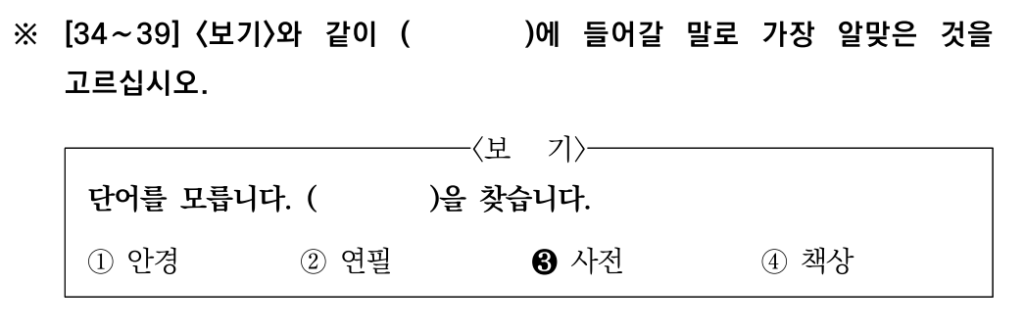
In TOPIK Ⅰ Reading, questions 34–39 ask you to fill in the blank.
Each question is worth 2 points.
These TOPIK Ⅰ Reading questions mix different word types — particles, nouns, verbs, adjectives, and adverbs. So we will study them one type at a time. Today is the first type: noun blanks — especially places and objects.
Try each question first, then open the answer to check.
① Remember just one thing
The activity in that sentence tells you the answer.
e.g. “책을 삽니다 (I buy books)” → Where do you buy books? → 서점 (bookstore)!
② Place & object card
| When you see this activity… | The answer is this place / thing |
|---|---|
| 돈을 찾다 (get money) | 은행 (bank) |
| 밥을 먹다 (eat a meal) | 식당 (restaurant) |
| 책을 사다 (buy books) | 서점 (bookstore) |
| 책을 빌리다 (borrow books) | 도서관 (library) |
| 편지·소포를 보내다 (send a letter/parcel) | 우체국 (post office) |
| 약을 사다 (buy medicine) | 약국 (pharmacy) |
| 영화를 보다 (watch a movie) | 극장 (theater) |
| 공부하다 (study) | 학교 (school) |
| 아프다 (be sick) | 병원 (hospital) |
| 비가 오다 (it rains) → thing | 우산 (umbrella) |
| 눈이 나쁘다 (bad eyesight) → thing | 안경 (glasses) |
Practice: TOPIK Ⅰ Reading noun blanks
Try each TOPIK Ⅰ Reading question first.
Read the two sentences, choose the answer, then open the box to check.
Question 1
( )에 갑니다. 돈을 찾습니다.
① 학교② 은행③ 극장④ 식당
🔽 See the answer (Question 1)
Q: ( )에 갑니다. 돈을 찾습니다. (I go to the ( ). I get money.) 👉 The other sentence: “돈을 찾습니다 (get money)”.
A: ✅② 은행 (bank) → You get money at the bank!
① 학교 (school) = a place to study.
③ 극장 (theater) = a place to watch movies.
④ 식당 (restaurant) = a place to eat.
💡 Tip: get / put money → 은행 (bank)!
Question 2
점심시간입니다. ( )에서 밥을 먹습니다.
① 은행② 서점③ 식당④ 약국
🔽 See the answer (Question 2)
Q: 점심시간입니다. ( )에서 밥을 먹습니다. (It is lunchtime. I eat at the ( ).) 👉 The other sentence: “밥을 먹습니다 (eat a meal)”.
A: ✅③ 식당 (restaurant) → You eat at a restaurant!
① 은행 (bank, money) / ② 서점 (bookstore, books) / ④ 약국 (pharmacy, medicine) = not a place to eat.
💡 Tip: eat a meal → 식당 (restaurant)!
Question 3
( )에 갑니다. 책을 빌립니다.
① 도서관② 시장③ 공항④ 병원
🔽 See the answer (Question 3)
Q: ( )에 갑니다. 책을 빌립니다. (I go to the ( ). I borrow books.) 👉 The other sentence: “책을 빌립니다 (borrow books)”.
A: ✅① 도서관 (library) → You borrow books at the library!
② 시장 / ③ 공항 / ④ 병원 = not a place to borrow books.
💡 Tip: BUY books → 서점 (bookstore) / BORROW books → 도서관 (library)! (Don’t mix them up.)
Question 4
머리가 아픕니다. ( )에서 약을 삽니다.
① 약국② 학교③ 극장④ 우체국
🔽 See the answer (Question 4)
Q: 머리가 아픕니다. ( )에서 약을 삽니다. (I have a headache. I buy medicine at the ( ).) 👉 The other sentence: “약을 삽니다 (buy medicine)”.
A: ✅① 약국 (pharmacy) → You buy medicine at a pharmacy!
② 학교 / ③ 극장 / ④ 우체국 = not a place to buy medicine.
💡 Tip: buy medicine → 약국 (pharmacy)!
Question 5
비가 많이 옵니다. 그래서 ( )을 씁니다.
① 지갑② 안경③ 우산④ 사전
🔽 See the answer (Question 5)
Q: 비가 많이 옵니다. 그래서 ( )을 씁니다. (It is raining a lot. So I use a ( ).) 👉 The other sentence: “비가 옵니다 (it rains)”.
A: ✅③ 우산 (umbrella) → When it rains, you use an umbrella!
① 지갑 / ② 안경 / ④ 사전 = not for rain.
💡 Tip: it rains → 우산 (umbrella)!
Question 6
눈이 나쁩니다. 그래서 ( )을 씁니다.
① 모자② 안경③ 시계④ 가방
🔽 See the answer (Question 6)
Q: 눈이 나쁩니다. 그래서 ( )을 씁니다. (My eyes are bad. So I wear ( ).) 👉 The other sentence: “눈이 나쁩니다 (bad eyes)”.
A: ✅② 안경 (glasses) → If your eyes are bad, you wear glasses!
① 모자 / ③ 시계 / ④ 가방 = not for your eyes.
💡 Tip: The verb “쓰다” works for umbrella, glasses, AND hat. So don’t look only at “쓰다” — look at the situation: is it rain? or bad eyes?
Question 7
( )에서 영화를 봅니다. 아주 재미있습니다.
① 극장② 은행③ 서점④ 병원
🔽 See the answer (Question 7)
Q: ( )에서 영화를 봅니다. 아주 재미있습니다. (I watch a movie at the ( ). It is very fun.) 👉 The other sentence: “영화를 봅니다 (watch a movie)”.
A: ✅① 극장 (theater) → You watch movies at a theater!
② 은행 / ③ 서점 / ④ 병원 = not a place to watch movies.
💡 Tip: watch a movie → 극장 (theater)!
Question 8
편지를 씁니다. ( )에서 부칩니다.
① 시장② 우체국③ 학교④ 식당
🔽 See the answer (Question 8)
Q: 편지를 씁니다. ( )에서 부칩니다. (I write a letter. I send it at the ( ).) 👉 The other sentence: “편지를 부칩니다 (send a letter)”.
A: ✅② 우체국 (post office) → You send letters at the post office!
① 시장 / ③ 학교 / ④ 식당 = not a place to send letters.
💡 Tip: send a letter / parcel → 우체국 (post office)!
③ How to memorize the words easily
Now you have practiced, here is the fastest way to grow your TOPIK Ⅰ Reading vocabulary.
- Learn activity ↔ place as pairs. (buy books–bookstore, buy medicine–pharmacy) Not one by one.
- For each place, say one sentence: “What do you do there?” (bank → “I get money.”)
- Read the OTHER sentence first. Look at the sentence without the blank first.
- Quiz yourself. See an activity, and say the place. (eat a meal → ?)
🤖Practice with AI
You can practice TOPIK Ⅰ Reading alone with AI.— and grow your Korean speaking too!
This drill trains the main skill of this type: reading the activity and finding the place.
Copy the message below and send it to an AI (like ChatGPT or Claude).
or turn on the AI’s voice (read-aloud). Then answer out loud in Korean. The game is played only in Korean.
🗣️“Please give me a place quiz. Use only in Korean during the game — no English. Give me an activity (for example, ‘책을 삽니다’), and I will say the place (for example, ‘서점’). Then tell me if I am right in Korean. Please keep going with beginner place words.”
⚠️ AI can make mistakes. Always check with real past exams at the end. AI is for practice; the past exams are the answer key.
Summary
- If the blank is a place or a thing, read the other sentence first.
- The activity tells you the answer. (buy books → bookstore)
- For verbs like “쓰다” used in many ways, decide by the situation.
Well done!
Keep practicing, and you can all pass TOPIK Level 2. 🎉
Have a question? Please leave a comment.
See you in the next lesson!
📢 want to practice TOPIKⅠ Listening next? 👉 [ TOPIKⅠ Listening ]
FAQ
Q: What are TOPIK I reading questions 34–39?
A: You fill a blank with the right word — a particle, noun, verb, adjective, or adverb. Each question is worth 2 points.
Q: How do I choose the right place or object?
A: Read the other sentence. Its activity tells you the answer (책을 삽니다 / buy books → 서점 / bookstore).
Q: Why can the verb 쓰다 have different answers?
A: 쓰다 works for umbrella, glasses, and hat. Don’t pick by the verb alone — decide by the situation (rain? or bad eyes?).