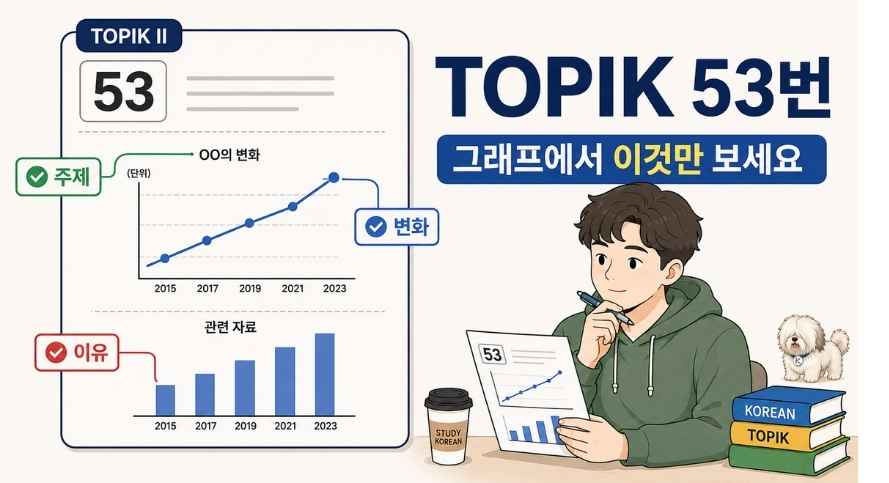
TOPIK Writing Scoring: The 3 Things Graders Check

TOPIK Writing Scoring
Prefer to study in Korean? 👉 [ 한국어로 읽기 ] 

Welcome back! 😊

Understanding TOPIK Writing Scoring is key to a high score. In Part 3, we learned how to use the TOPIK writing paper (원고지). Haven’t seen it? Read it first 👉 [ Part 3 link ]

Today we learn something very important: how TOPIK writing is scored. Many students think like this.

“If I know a lot of grammar, I get a high score.”
“If I use difficult words, my score is good.”
“If I just write many characters, it’s fine.”

Grammar and vocabulary are important, of course. But graders don’t look only at those. They look at three big things.

💡 Remember just this: 
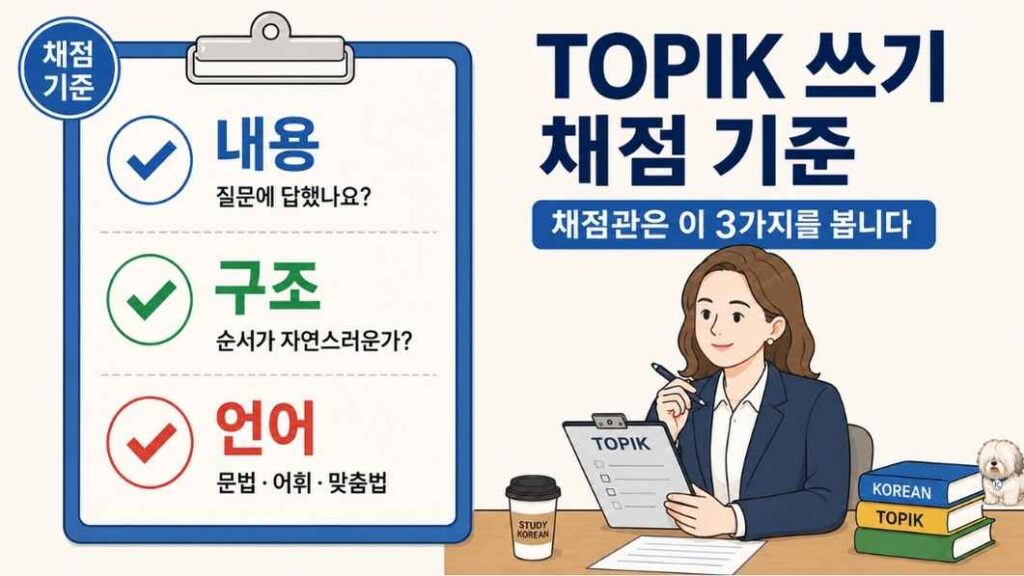
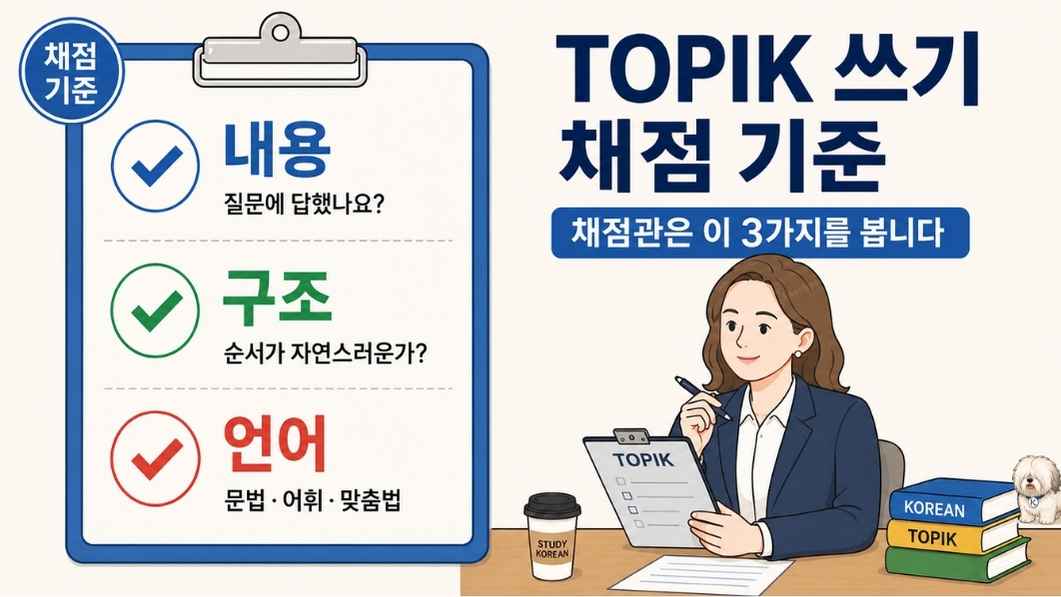
Graders check ① Content · ② Structure · ③ Language.

• Content = Did you answer the question?

• Structure = Does it flow in order?

• Language = Is it accurate and in written style?

1. Why should you know the scoring criteria?

TOPIK writing is not simply “write something in Korean.” It is a test where you read what the question asks, and write to match it. So even if you write many nice sentences, you won’t get a good score if you don’t answer the question.

For example, imagine the question asks:

Q: Write about your most memorable trip.

Where did you go? Why is it memorable? What did you do on the trip?

If a student only writes “I like travel. Travel is fun,” the sentences may be correct. But the student did not answer what the question asked. The important thing is not just writing Korean sentences — it’s writing an answer that fits the question.

2. What does Level 3 writing need?

Level 3 does not ask for perfect, advanced writing. The official Level 3 criteria say you should be able to write about familiar topics, write a simple text with the structure of an explanatory passage, and write using the written-style ending (문어체 종결형).

In simple words, a student aiming for Level 3 should be able to write:

an easy topic · in paragraphs · in written-style sentences · with connected content

You don’t need many difficult words from the start. First, writing on-topic, in order, and accurately is what matters.

3. How TOPIK Writing Scoring Works

Graders give points in three areas. The point breakdown shows you what matters most.

AreaQ53 (30 pts)Q54 (50 pts)
Content & task712
Structure712
Language use1626

Look — language use is more than half in both questions. That’s exactly why the written style and accurate sentences we learned in Part 2 matter so much. (How each area splits into high/mid/low, we’ll see in detail later, when we study Questions 53 and 54.)


4. First, “Content” — did you answer the question?

The first thing graders check is content. In simple words: “Did you answer what the question asked?”

Question 53 gives you data (a graph or chart). So instead of writing many of your own opinions, you should accurately write what is in the data / what is high or low / what the differences are.

Question 54 asks for your own opinion on a topic. But you must answer all of the questions given in the prompt.

5. How to get content points

Before you write, first mark what the question is asking. For example, if Question 54 has three questions:

① What is the problem? ② Why does it happen? ③ How can it be solved?

Then answer each one with one sentence. Don’t try to write a long text at the start.

One question = one answer.

This is the first way to earn content points.


6. Second, “Structure” — does it flow in order?

The second thing is structure, the order of your writing. In a good text, sentences don’t appear randomly — ideas connect naturally.

Question 53 usually goes like this:

① Introduce what the data is → ② The most important point → ③ Compare / show differences → ④ Final summary

Question 54 goes like this:

① Introduce the topic → ② Your opinion → ③ Reasons / examples → ④ Conclusion

The official criteria also check whether the writing is logical, whether paragraphs are well divided, and whether you use linking expressions (담화 표지) well. These are words like:

먼저 (first) · 그리고 (and) · 그러나 (but) · 그래서 (so) · 따라서 (therefore) · 마지막으로 (finally)

7. Weak structure vs. good structure

Weak structure

저는 운동을 좋아한다. 건강이 중요하다. 친구도 운동을 한다. 요즘 사람들은 바쁘다. 운동은 좋다.

Every sentence is Korean. But it’s hard to see what the writer wants to say first, or why.

Good structure

건강을 위해 운동은 중요하다. 먼저 운동을 하면 몸이 건강해진다. 그리고 스트레스를 줄일 수 있다. 그래서 바쁜 사람들도 조금씩 운동하는 것이 좋다.

This is much more natural, because it has an order: topic → reason 1 → reason 2 → conclusion.


8. Third, “Language” — accurate and appropriate?

The third thing is language — vocabulary, grammar, spelling, and written style. In simple words:

Did you use the right words? Is the grammar correct? Are spelling and spacing okay? Did you use written style, not speaking style?

Here is a very important official rule. Using the endings “-ㅂ니다/습니다” or “-아/어요” loses points. So “-습니다” is not okay, and “-아/어요” is not okay either. The written style “-다 / -이다” is the correct one.

사람이 많아요. / 저는 그렇게 생각해요. (❌)
사람이 많다. / 나는 그렇게 생각한다. (✅)

This is why the “-다 / -이다” written style from Part 2 is so important.

9. Correct sentences come before hard words

A common student mistake: forcing in difficult words to get a higher score. But if you use a word you can’t use correctly yet, your writing becomes strange.

많은 사람은 운동이 필요하다. → (a little more natural) 많은 사람에게 운동이 필요하다.

Even with easy words, using the right particles and grammar matters. One correct sentence is often more valuable than one difficult word In TOPIK writing scoring.


10. Questions 51 and 52 also have criteria

Questions 51 and 52 are not long writing. You fill in the blank. But the rules here are clear too. You must look at the sentences before and after the blank and make the content connect naturally. If you use words or grammar that don’t fit the context, or add unnecessary content, you lose points.

Don’t write freely. · Read the sentence before and after. · Write one sentence. · Don’t add unnecessary words.

Also, even if your 51/52 answer is not perfect, points are given step by step, depending on how correctly you used the connecting and ending forms. So don’t leave it blank — always try.

11. Is a mistake always 0 points?

No. In TOPIK writing, you can get partial credit even if your answer is not perfect.

Even if it’s not perfect, you get points when you write.

So leaving a blank or skipping Question 54 because you’re afraid of small mistakes is not a good strategy. Write as much as you can, on topic.

But these two things are 0 points. Be careful!

⚠️ Copying the question (the test paper) word for word → 0 points.
⚠️ Writing on a completely different topic → 0 points.

12. What makes a good answer?

In official sample answers, high-scoring writing is not just good grammar. It writes what, why, and how clearly and specifically, has a beginning–middle–end, uses intermediate expressions accurately, and uses written style. So a good answer is good in all three:

Clear content. · Natural order. · Accurate Korean.


13. Five checks after you write

  1. Did you answer everything the question asked? (If there are 3 questions, answer all 3.)
  2. Did you avoid writing things unrelated to the topic?
  3. Is the order natural? (beginning, middle, end)
  4. Did you avoid listing only short sentences? (e.g., “운동은 좋다. 건강에 좋다.” → “운동은 건강에 좋기 때문에 많은 사람에게 필요하다.”)
  5. Are there sentences ending in “-아요/어요”? (좋아요 → 좋다 / 생각해요 → 생각한다)

Summary 🌱

In TOPIK writing scoring, graders check three big things: Content · Structure · Language.

AreaMeaning
ContentDid you write to match the question?
StructureDoes the writing flow in order?
LanguageDid you use vocabulary, grammar, spelling, and written style well?

Don’t try to write a perfect text from the start. Just practicing these four steps makes writing much easier.

Find the questions → Answer each with one sentence → Connect the sentences in order → Change them to “-다 / -이다” written style.

Take it slowly, one step at a time, and you can reach the level you want. If you have a question, leave a comment.

From the next post, we finally study Question 53. We’ll look at what kind of question it is, and what to read and write.

See you in the next lesson!

🔎 Still finding levels 1–2 hard? Review the basics first 👉 [ TOPIK I study ]

❓ FAQ

Q: What do graders check in TOPIK writing?
A: Three things — content (did you answer the question), structure (does it flow in order), and language (accurate and in written style).

Q: Which area has the most points?
A: Language use. It’s 16 of 30 points in Q53 and 26 of 50 in Q54 — more than half. That’s why written style and accuracy matter.

Q: Is a small mistake always 0 points?
A: No. There is partial credit, so you get points even if it’s not perfect. But copying the question or writing on a completely different topic gives 0 points.

Q: Can I write with “-습니다”?
A: No. Both “-ㅂ니다/습니다” and “-아/어요” lose points. Use the written style “-다 / -이다.”


<Latest Posts>
DAY 8: Work Life Vocabulary – 20 Essential TOPIK II Words

TOPIK II Work Life Vocabulary

안녕하세요? Welcome to DAY 8: TOPIK II Work Life Vocabulary! Work-related words often appear in TOPIK II reading and listening questions.

You do not need to know every word perfectly before you start.

First, play the game and see how many words you already know. Then learn the words you missed in [내 단어장] and try again.

Click 오늘의 학습 시작 🚀

⚠️ Careful! One letter changes everything : 결재 = approval at work / 결제 = payment
단어 로켓 · 직장 생활 DAY 8
🚀단어 로켓
Lv.1 🔥 0
중급 입문0 / 150 XP
TOPIK II

중급 필수 어휘
끝까지 정복하기

주제별로 하나씩 클리어하며 시험에 나오는 핵심 어휘를 내 것으로 만드세요.

🚀
0
마스터한 단어
0
클리어한 주제
0
최고 콤보
✏️
문장 빈칸 채우기
문맥에 맞는 단어 고르기 · TOPIK 유형
🔗
비슷한 말 · 반대말
유의어 · 반의어로 뜻 익히기
📖
뜻풀이 보고 단어 맞히기
쉬운 한국어 설명 + 작은 영어 힌트
주제 목차
TOPIK II 중급 어휘 25개 주제 · 순서대로 정복해 보세요.
0/23
🔥2 콤보! XP 1.5배

🎉 쇼핑 클리어!

모든 단어를 맞혔어요
0%
정확도
0
마스터
0
최고 콤보
+0 XP
내 단어장
틀렸던 단어가 모여요. 복습으로 완전히 내 것으로 만드세요.
🔎 한국어로 공부하고 싶어요? 👉 [ TOPIK II 필수 어휘 ② 인간관계·감정 ]

⭐ TOPIK Must-Know: 결재 vs. 결제

These two words sound almost the same, so they are easy to confuse.

결재 = approval at work

  • 상사에게 결재를 받다
  • 보고서를 결재하다

결제 = payment

  • 카드로 결제하다
  • 온라인으로 결제하다

How can you choose the answer?

Look at the words around the blank.

🏢 회사 · 상사 · 보고서 · 서류 → Think 결재
🏪 카드 · 돈 · 쇼핑 · 주문 → Think 결제

📢 TOPIK Tip: Do not look at only one word. Always check the whole situation.

Master Essential TOPIK II Work Life Vocabulary

단어English쉬운 한국어 풀이예문
결재approval회사에서 결재 서류나 계획에 대해 윗사람에게 허락(승인)을 받는 일결재를 올리기 전에 내용을 검토하다.
(We review the content before submitting it for approval.)
경영management회사나 가게를 계획하고 이끌어 나가는 일 (운영)나의 회사 경영 원칙은 성실과 정직이다.
(My company management principle is sincerity and honesty.)
고려하다consider어떤 일을 결정할 때 여러 가지 상황을 깊이 생각하다예산을 초과할 수 있다는 점을 고려해 주십시오.
(Please consider that we might exceed the budget.)
고용employment돈을 주고 사람을 회사 직원으로 써서 일을 시키는 것경제가 불안정하면 그해의 고용 인원이 줄어든다.
(If the economy is unstable, the number of hired people decreases that year.)
구성원member어떤 조직이나 단체, 모임을 만드는 사람들 (멤버)구성원의 성향을 알면 부족한 부분을 도울 수 있다.
(If you know the members’ personalities, you can help them with what they lack.)
구성하다organize여러 사람이나 부서를 모아서 하나의 팀이나 조직을 만들다새로운 부서를 구성하면서 인사이동이 있었다.
(There was a personnel transfer while organizing the new department.)
권한authority회사나 직책에서 어떤 일을 책임지고 결정할 수 있는 힘이나 권리신입 사원은 상사에 비해 지닌 권한이 적다.
(New employees have less authority compared to their bosses.)
근무work직장에서 맡은 일을 열심히 하는 것우리 회사는 자율 근무 제도를 시행하고 있습니다.
(Our company implements a flexible working hour system.)
기한due date어떤 일을 끝내야 하는 정해진 시간이나 날짜 (마감일)기한 내에 회의 자료를 준비해서 제출하십시오.
(Please prepare and submit the meeting materials within the deadline.)
노사labor-management일하는 노동자(직원)와 일을 시키는 사용자(사장)를 함께 이르는 말노사의 갈등이 좁혀지지 않아 문제가 되고 있다.
(The conflict between labor and management is not narrowing down, causing a problem.)
논의하다discuss어떤 문제에 대해 여러 사람이 서로 의견을 나누며 의논하다논의한 대로 진행하고 그 결과를 보고하십시오.
(Please proceed as discussed and report the results.)
맡기다assign내가 해야 할 일이나 물건을 다른 사람에게 주어 하거나 보관하게 하다중요한 일을 신뢰하는 직원에게 맡기다.
(I assign important work to an employee I trust.)
사원employee회사에서 일하는 모든 직원신입 사원에게 보고 절차를 교육하다.
(We train new employees on reporting procedures.)
수정하다correct글이나 보고서, 계획에서 잘못되거나 부족한 부분을 고치다수정한 사항이 반영되지 않았으니 확인 바랍니다.
(The corrected parts are not reflected, so please check.)
수행하다perform계획하거나 회사에서 맡은 임무나 일을 실제로 해내다비서의 업무를 수행하다 보면 힘들 때가 있다.
(There are times when it is hard to perform secretarial duties.)
승진하다be promoted회사에서 직위(직급)가 더 높은 자리로 올라가다승진을 하면 일반적으로 급여가 상승한다.
(When you get promoted, your salary generally increases.)
인정받다be recognized회사나 상사에게 나의 가치나 능력이 훌륭하다고 평가받다회사에서 인정받는 직원이 되려고 노력 중이다.
(I am trying to be an employee who is recognized at the company.)
전략적strategic목표를 효과적으로 이루기 위해 머리를 써서 정밀하게 계획을 세우는 것전략적 마케팅으로 신제품 완판을 달성했다.
(We achieved a complete sell-out of the new product through strategic marketing.)
협력하다cooperate하나의 목표나 프로젝트를 위해 힘을 합쳐서 같이 일하다사회생활을 할 때 동료와 협력하지 않으면 곤란하다.
(In social life, it is difficult if you do not cooperate with your colleagues.)
협의하다discuss with어떤 일을 조화롭게 결정하기 위해 다른 사람이나 부서와 타협하며 이야기하다다른 부서와 협의하여 일을 마무리하겠습니다.
(I will finish the work after discussing it with other departments.)

Who Does the Work?

Another useful pair is 맡기다 and 수행하다.

맡기다 → give a job or task to another person

  • 팀장이 직원에게 중요한 일을 맡겼다.

수행하다 → do the job or task

  • 직원은 맡은 업무를 잘 수행했다.

Think of it like this:

A가 B에게 일을 맡기다 → B가 일을 수행하다

This sentence pattern can help you remember both words together.

Three Words for Working with People

논의하다 · 협의하다 · 협력하다

They may look similar in a TOPIK question.

  • 논의하다 → talk about an idea or problem together
  • 협의하다 → talk together to make a decision
  • 협력하다 → work together for the same goal

Remember the flow:

문제를 논의하다 → 다른 부서와 협의하다 → 함께 협력하다

Learn These TOPIK Word Groups

Try to remember the whole expression, not only one word.

  • 결재를 받다
  • 기한을 지키다
  • 업무를 맡기다
  • 업무를 수행하다
  • 회의에서 논의하다
  • 다른 부서와 협의하다
  • 동료와 협력하다
  • 회사에서 인정받다
  • 승진하다

When these expressions appear in a long TOPIK sentence, you can understand the meaning faster.

🎯 Before You Play Again

Can you answer these four?

  1. You pay by credit card. → 결제
  2. Your manager approves a report. → 결재
  3. You give a task to another employee. → 맡기다
  4. You do the task you received. → 수행하다

If you got even one more answer right than before, you are improving.

Go back to the game and try DAY 8 again.
Your goal is not perfection. Your goal is one more correct answer than last time.

Questions are always welcome in the comments! 🥰 화이팅!

🔎 Learn more about TOPIK Ⅱ writing 👉 [ TOPIK writing ]


<Latest Posts>

Korean Liberation Day(Gwangbokjeol): Do Koreans Still Dislike Japan? – Part 2

Korean Liberation Day
📌 한국어로 읽고 싶어요? 👉 [한국어 블로그]

Welcome back! In Part 1 of our Korean Liberation Day (Gwangbokjeol) series, we talked about how Korea got its light back — the country and the language that were taken, the people who protected them, and the liberation of 1945.

But that light still has some shadow left. This is why the story of 광복절(Gwang-bok-jeol) does not end in 1945.

A story that is not finished yet

The Japanese occupation looks like a past that is completely over. But some of the wounds from that time still continue today.

The clearest examples are the Japanese Military Sexual Slavery “comfort women” victims and the forced mobilization victims. Some of the grandmothers who suffered are still alive today. They live in the same time as us.

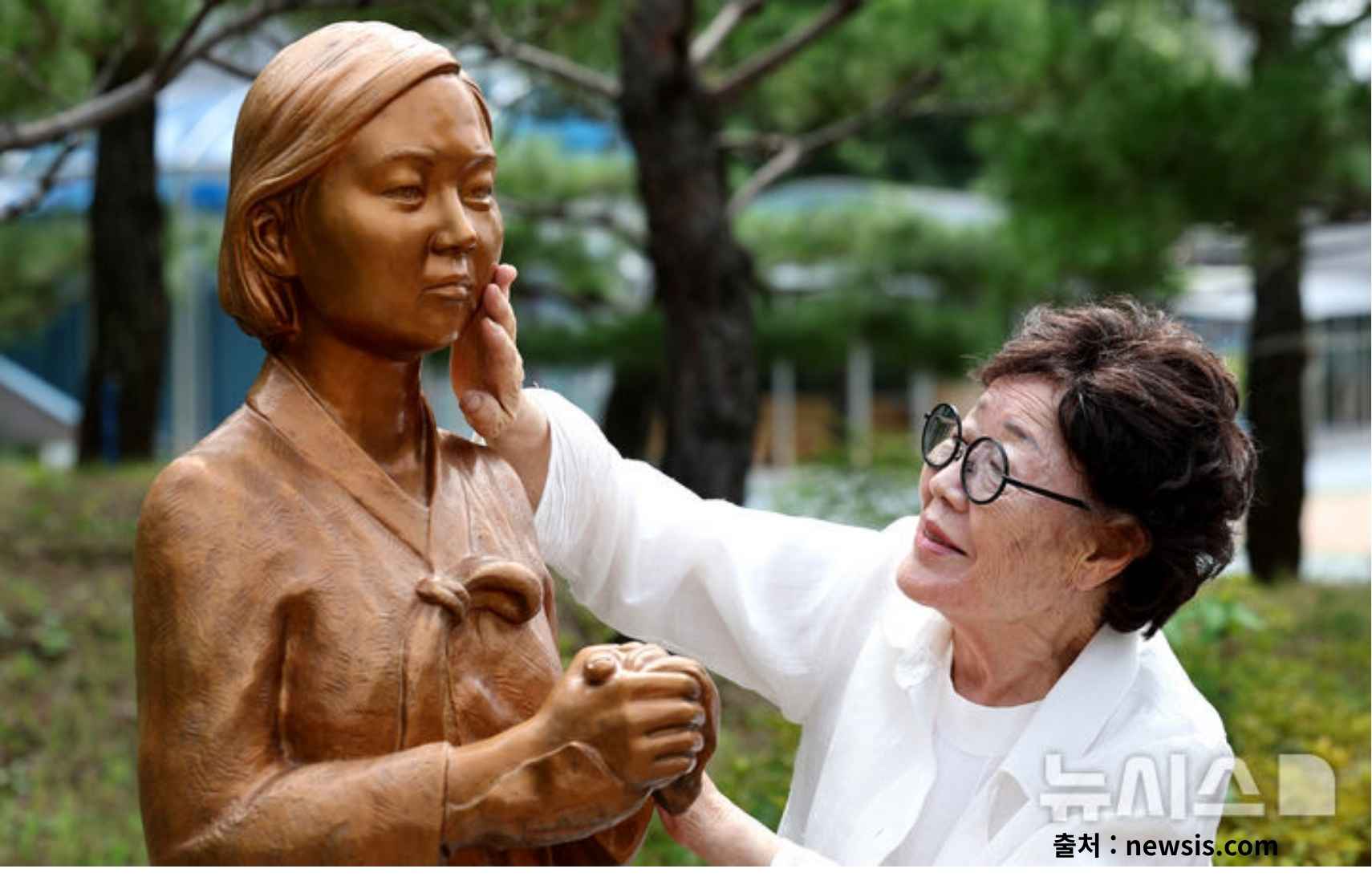
In front of the Japanese Embassy in Seoul, there is a Statue of a Girl (소녀상) — a statue made to remember the “comfort women” victims. The long-running gatherings there quietly say that this problem is not over yet.

Korean Liberation Day Statue of a Girl

Legal fights also continue. One side wants to remember, the other side wants to erase. Even now, the two countries’ views have not come closer.

There is another situation to watch carefully — the Sado Mine (사도광산). This is a mine where about 1,500 Korean people were taken by force and made to work hard during the occupation. In 2024, Japan listed it as a UNESCO World Heritage site and promised to properly explain the “whole history,” including the forced labor. But in the actual exhibition, the word “forced” was missing, and both Koreans and Japanese were described as just “all workers.” So in 2026, UNESCO again asked Japan to tell the history properly.

Because things like this happen, in Korea, remembering itself is seen as an effort and a responsibility. If there is a force trying to erase, there must also be a force trying to keep.

Korea keeps this history in films

This is why so many films about painful history are made in Korea — to not forget, and to keep a record. If you are interested, you could start with these:

  • 아이 캔 스피크 I Can Speak” (2017) — The story of a survivor of Japanese Military Sexual Slavery (known as the “Comfort Women”) who learns English to testify before the U.S. Congress. Its light, approachable tone makes it a good starting point for anyone new to this history.
  • 귀향 Spirits’ Homecoming” (2016) — A film that faces the “Japanese Military comfort women” history directly. It was hard to get funding, so it was completed with support from many ordinary citizens.
  • 군함도 The Battleship Island” (2017) — The story of Koreans forced to work in the Hashima Island coal mine. Good to watch together with the Sado Mine story above.
  • 허스토리 Herstory” (2018) — Based on the true “Kanpu Trial,” where survivors in the 1990s stood up in a Japanese court themselves.

So, do Koreans still dislike Japan?

When you live in Korea, foreigners often ask this question. But the answer is not that simple.

Today, Korea and Japan are close neighbors. Many people travel between them and enjoy each other’s food, films, and music. Not many Koreans see each Japanese person living today as the same as the old Japanese empire.

But many Koreans also do not think the past is completely finished. So feelings toward Japan are often split into two hearts.

On one side is the feeling, “I want to get along well with Japanese people today.” On the other side is the feeling, “The wrongs of the past should be remembered clearly and resolved.” These two are not fighting each other — they are more like two feelings sitting side by side inside one person.

When history shows up in daily life — the Korea–Japan match

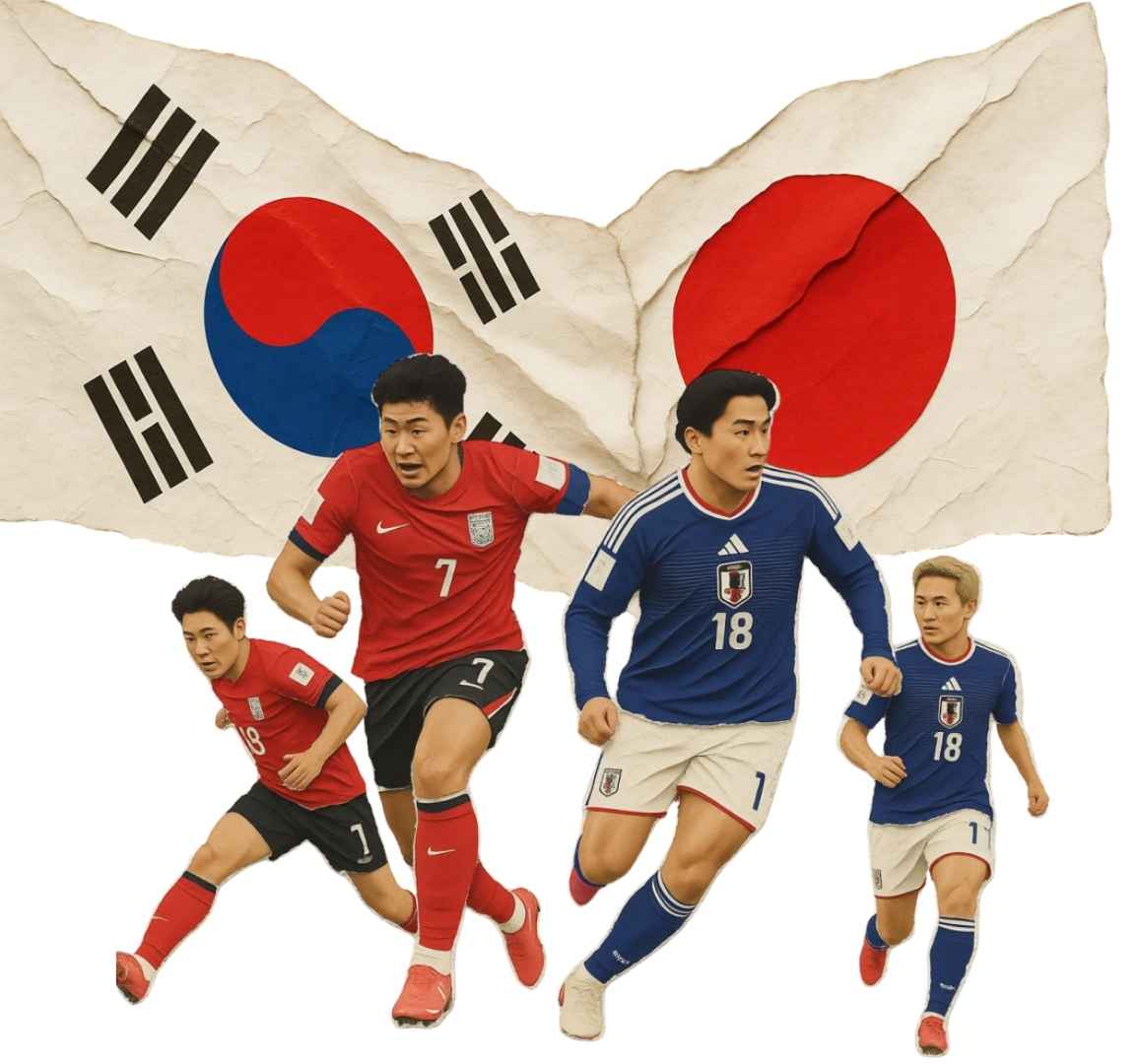
This subtle feeling sometimes jumps out at unexpected moments. A famous example is the Korea–Japan match (한일전), a sports game between Korea and Japan.

Whether it’s soccer or baseball, when the opponent is Japan, even people who usually don’t care about sports gather in front of the TV. In Korea, there is a half-joking saying: “We can lose to other countries, but we can’t lose to Japan.”

To a foreigner, this may look a little too much. But this heat is not really “hate” — it is closer to “pride that doesn’t want to lose.” After the game, most people go back to normal life, plan a trip to Japan, and eat Japanese ramen.

Speaking of travel — when Gwangbokjeol comes near, some people say, “Do I really have to travel to Japan on this exact day?” In reality, some Koreans do go to Japan even on this day. It just means that, on this one day, actions connected to Japan feel a little heavier than usual. If you are a foreigner, just knowing this feeling will help you understand Korean society much more deeply.

Remembering does not mean hating

When I talk about Gwangbokjeol, this is the part I most want to share.

The reason we remember history should not be to hate Japanese people today. But we should also be careful with the words, “For the future, let’s just forget the past.”

One country taking another by force. Taking people away to war and hard labor. Crushing the dignity of women. Trying to erase a people’s language. These things need to be remembered clearly. Remembering is not the same word as hating. It is closer to a promise: that such things must never happen again.

Today, I think about “Gwangbokjeol” once more

81 years ago, the people who met liberation came out to the streets and waved the Korean flag. It must have been the joy of getting their country back.

Some went to prison for shouting for independence. Some had their names taken away. Some were dragged to battlefields and factories. And some quietly studied Hangeul, made dictionaries, and passed the Korean language to the next generation.

Today, we speak and write Korean without a second thought, and people all over the world learn this language. If those people could see it, how would they feel? Maybe a little surprised — and maybe a little happy.

Gwangbokjeol is not a history only for Koreans. If you are learning Korean, then for just this one day, it would be nice to remember what kind of time this language passed through to reach you.

Gwangbokjeol. The day the light came back. And a day to quietly promise not to forget the time when that light was lost.

If your country has a similar day, please tell me in the comments~! I’d love to know, too.

See you in the next story. 안녕! 👋

📢 Want to learn more about Korean culture? 👉 [ Korean Culture ] 

📖 Key words in this story

WordMeaning
Wianbu (위안부)Japanese Military ‘Comfort Women’ — victims of Japanese Military Sexual Slavery during the colonial period; an issue that remains unresolved today.
Sonyeosang (소녀상)The “Statue of a Girl,” made to remember the “comfort women” victims.
Hanil Cheonggugwon Hyeopjeong (한일청구권협정)The 1965 agreement between Korea and Japan about compensation.
Sado Gwangsan (사도광산)A Japanese mine where Koreans were forced to work. Controversial after its UNESCO listing.
Haniljeon (한일전)A sports match between Korea and Japan.
Taegeukgi (태극기)The national flag of South Korea.

DAY 7: Politics Vocabulary – 20 Essential TOPIK II Words

TOPIK Politics Vocabulary

Welcome to DAY 7! Today’s topic is essential Politics Vocabulary for the TOPIK II exam. Politics-related vocabulary is a bit difficult, but if you want to improve your score, it’s definitely good to know it.

First, try the vocabulary game. Then check the [내 단어장] you missed.

Click 오늘의 학습 시작 🚀

단어 로켓 · 정치 DAY 7
🚀단어 로켓
Lv.1 🔥 0
중급 입문0 / 150 XP
TOPIK II

중급 필수 어휘
끝까지 정복하기

주제별로 하나씩 클리어하며 시험에 나오는 핵심 어휘를 내 것으로 만드세요.

🚀
0
마스터한 단어
0
클리어한 주제
0
최고 콤보
✏️
문장 빈칸 채우기
문맥에 맞는 단어 고르기 · TOPIK 유형
🔗
비슷한 말 · 반대말
유의어 · 반의어로 뜻 익히기
📖
뜻풀이 보고 단어 맞히기
쉬운 한국어 설명 + 작은 영어 힌트
주제 목차
TOPIK II 중급 어휘 25개 주제 · 순서대로 정복해 보세요.
0/23
🔥2 콤보! XP 1.5배

🎉 쇼핑 클리어!

모든 단어를 맞혔어요
0%
정확도
0
마스터
0
최고 콤보
+0 XP
내 단어장
틀렸던 단어가 모여요. 복습으로 완전히 내 것으로 만드세요.
🔎 한국어로 공부하고 싶어요? 👉 [ TOPIK II 필수 어휘 ② 인간관계·감정 ]

Master Essential TOPIK II Politics Vocabulary

Do not memorize only the English meaning. Try to understand who does the action and in what situation the word is used.

단어English쉬운 한국어 풀이예문
각계각층all walks of life사회의 모든 다른 분야나 여러 신분의 사람들각계각층의 인사들이 동참하고 있습니다.
(People from all walks of life are participating.)
강화reinforcement힘이나 세력을 더 강하고 튼튼하게 만드는 것경쟁력을 강화하려면 제도를 개선해야 합니다.
(To strengthen competitiveness, we need to improve the system.)
경쟁하다compete이기거나 앞서기 위해 서로 겨루고 싸우다다른 정당과 경쟁하는 과정에서 다툼이 발생했다.
(A dispute occurred during the process of competing with other political parties.)
공정fairness어느 한쪽으로 치우치지 않고 올바르고 똑바름공직자에게 무엇보다 중요한 덕목은 공정이다.
(The most important virtue for a public official is fairness.)
과반수majority전체에서 반(50%)이 넘는 수과반수의 인원이 반대하여 계획이 취소되었다.
(The plan was canceled because the majority of people opposed it.)
대응하다respond어떤 일이나 변화에 알맞게 맞서서 행동하다잘못된 보도에 기자 회견으로 대응하다.
(We respond to false reports with a press conference.)
민주화democratization정치나 사회를 국민이 주인이 되는 상태로 만드는 것민주화를 이루어 낸 것은 정치적으로 의미가 있다.
(Achieving democratization is politically meaningful.)
백성subjects옛날에 왕이 다스리던 나라의 일반 국민왕은 백성의 어려움을 해결해 주고자 했다.
(The king wanted to solve the difficulties of his people.)
보수적conservative새로운 변화보다 옛날부터 내려오는 전통이나 제도를 지키려는 것보수적인 정치로 장년층의 인기를 끌고 있다.
(It is gaining popularity among older people with conservative politics.)
유권자voter선거에서 투표를 할 수 있는 권리를 가진 사람유권자에게 투표에 참여할 것을 강하게 권했다.
(We strongly urged voters to participate in voting.)
유세하다campaign선거 후보자가 자신의 생각이나 공약을 유권자들에게 알리다선거 후보자가 유세하는 곳에 유권자들이 몰려들다.
(Voters gathered where the election candidate was campaigning.)
이행하다implement약속이나 계획, 선거 공약 등을 실제로 행동으로 지키다이행하지 못할 공약을 내세워서는 안 된다.
(You should not make campaign pledges that you cannot fulfill.)
정복하다conquer다른 나라나 영토를 힘으로 싸워 이겨서 자기 것으로 만들다정복한 곳에서 원주민과 영토 분쟁이 있었다.
(There was a land dispute with the native people in the conquered place.)
중립neutrality어느 한쪽 편을 들지 않고 중간의 입장을 지키는 것여전히 중립을 유지하는 국회 의원들이 있다.
(There are still members of National Assembly who remain neutral.)
지배하다rule권력이나 힘을 가지고 사람이나 사회를 다스리다사회를 지배하는 시대정신을 파악해야 한다.
(We must understand the spirit of the times that rules society.)
지지하다endorse어떤 사람이나 의견이 맞다고 생각하여 돕거나 찬성하다지지하는 국회 의원에게 정치 후원금을 보내다.
(I send political donations to the member of National Assembly I support.)
진보적progressive전통을 지키기보다 사회를 새롭고 더 나은 방향으로 바꾸려는 성향진보적인 정치인과 보수적인 정치인이 다투다.
(Progressive politicians and conservative politicians are arguing.)
추진하다push ahead어떤 목표를 향해 일을 밀고 나가며 실행하다이 일을 추진할 때의 장단점을 고려할 것이다.
(I will consider the pros and cons of pushing ahead with this work.)
출마하다run for선거에서 후보자로 나서다대통령 선거에 출마하려면 재산을 공개해야 한다.
(To run for the presidential election, one must disclose their assets.)
투표하다vote선거에서 마음에 드는 사람이나 의견에 표를 던져 선택하다투표하는 장소는 동네의 공공 기관들입니다.
(The places to vote are public institutions in the neighborhood.)

Learn Words by Situation

Politics words are easier when you learn them in groups.

Election Words

유권자 · 유세하다 · 출마하다 · 투표하다
  • A person 출마하다 in an election.
  • The candidate 유세하다 and meets 유권자.
  • Then voters 투표하다.

This is a useful order to remember.

Support and Opinion

지지하다 · 중립 · 보수적 · 진보적
  • 지지하다 means to support a person or idea.
  • 중립 means not taking one side.
  • 보수적 and 진보적 show different ways of thinking about social or political change.

You do not need to agree with the idea. Just understand the meaning of the word in the sentence.

Words You Should Not Confuse

이행하다 vs. 추진하다

이행하다 means to carry out something that was promised or planned.

  • 공약을 이행하다
    (carry out a campaign promise)

추진하다 means to move a plan or project forward.

  • 새로운 정책을 추진하다
    (push forward a new policy)

강화 vs. 대응하다

강화 means making something stronger.

  • 경쟁력을 강화하다

대응하다 means taking action when something happens.

  • 문제에 대응하다

TOPIK Study Tip 💡

Learn short word groups, not single words.

  • 과반수를 얻다
  • 공정을 지키다
  • 유권자에게 지지를 받다
  • 선거에 출마하다
  • 유세를 하다
  • 투표에 참여하다
  • 공약을 이행하다
  • 정책을 추진하다
  • 경쟁력을 강화하다

TOPIK questions often use these words inside a longer sentence. If you know the words that often appear together, you can understand the sentence faster.

Try the DAY 7 Quiz Again! 🚀

Think about these situations:

  • A person becomes a candidate. → 출마하다
  • A candidate talks to voters. → 유세하다
  • People choose a candidate. → 투표하다
  • A politician keeps a campaign promise. → 이행하다

If you can understand these differences, you learned the key points of DAY 7. Now check the words you missed in [내 단어장] and try the game one more time!

Questions are always welcome in the comments below! 🥰

🔎 Learn more about TOPIK Ⅱ writing 👉 [ TOPIK writing ]


<Latest Posts>

DAY 6: Health Vocabulary – 20 Essential TOPIK II Words

Health Vocabulary

Welcome to DAY 6 of our TOPIK II series! Today, we will focus on essential Health Vocabulary to help you pass the TOPIK II exam.

First, try the vocabulary game above. If you miss some words, check the word list [내 단어장] and example sentences again.

Click 오늘의 학습 시작 🚀

단어 로켓 · 건강 DAY 6
🚀단어 로켓
Lv.1 🔥 0
중급 입문0 / 150 XP
TOPIK II

중급 필수 어휘
끝까지 정복하기

주제별로 하나씩 클리어하며 시험에 나오는 핵심 어휘를 내 것으로 만드세요.

🚀
0
마스터한 단어
0
클리어한 주제
0
최고 콤보
✏️
문장 빈칸 채우기
문맥에 맞는 단어 고르기 · TOPIK 유형
🔗
비슷한 말 · 반대말
유의어 · 반의어로 뜻 익히기
📖
뜻풀이 보고 단어 맞히기
쉬운 한국어 설명 + 작은 영어 힌트
주제 목차
TOPIK II 중급 어휘 25개 주제 · 순서대로 정복해 보세요.
0/23
🔥2 콤보! XP 1.5배

🎉 쇼핑 클리어!

모든 단어를 맞혔어요
0%
정확도
0
마스터
0
최고 콤보
+0 XP
내 단어장
틀렸던 단어가 모여요. 복습으로 완전히 내 것으로 만드세요.


🔎 한국어로 공부하고 싶어요? 👉 [ TOPIK II 필수 어휘 ② 인간관계·감정 ]

Essential TOPIK II Health Vocabulary

단어English쉬운 한국어 풀이예문
내쉬다exhale숨을 몸 밖으로 내보내다팔을 높이 들며 숨을 크게 내쉬다.
(Raise your arms high and breathe out deeply.)
노화aging나이가 들어서 몸이 늙어 가는 것노화는 막을 수 없다.
(We cannot stop aging.)
멍들다get a bruise부딪혀서 피부 밑에 피가 고여 퍼렇게 되다넘어지는 바람에 무릎에 퍼렇게 멍이 들었다.
(Because I fell, I got a blue bruise on my knee.)
성인병adult disease어른들이 주로 걸리는 몸의 병 (고혈압, 당뇨 등)성인병은 각종 합병증을 유발할 수 있어 위험하다.
(Adult diseases are dangerous because they can cause various complications.)
시리다ache; sensitive몸의 일부가 차가워서 아프거나 시린 느낌이 들다이가 시리면 가능한 한 빨리 치과에 가는 것이 좋다.
(If your teeth are sensitive, it is good to go to the dentist as soon as possible.)
악화deteriorate; worsen일이나 건강 상태가 이전보다 더 나빠지는 것증상이 악화되지 않도록 식단을 관리해야 한다.
(We must manage our diet so that symptoms do not get worse.)
알레르기allergy특정 음식이나 먼지 때문에 몸이 가렵거나 기침이 나는 반응알레르기 반응이 심하면 호흡이 곤란해진다.
(If the allergic reaction is severe, breathing becomes difficult.)
앓다be sick몸이나 마음에 병이 생겨 아프고 고통을 느끼다마음의 병을 앓을 때 상담을 받아 보는 것이 좋다.
(It is good to get counseling when you suffer from an illness of the mind.)
어지럽다dizzy머리가 빙빙 도는 느낌이 나고 서 있기 힘들다갑자기 일어섰더니 어지러웠다.
(When I stood up suddenly, I felt dizzy.)
위급하다urgent상황이 매우 급하고 위험하다중환자실은 상태가 위급한 환자가 가는 곳이다.
(The intensive care unit is where patients in urgent conditions go.)
위독하다critical병이 아주 깊어져서 목숨이 위험한 상태이다친구 어머니의 병세가 위독하여 걱정이 된다.
(I am worried because my friend’s mother is in critical condition.)
장기organ심장, 위, 간처럼 몸 안에서 특별한 일을 하는 기관가공식품은 장기에 지방이 많이 쌓이게 만든다.
(Processed foods cause a lot of fat to accumulate in the organs.)
전염infection병이 다른 사람에게 옮아가는 것코로나 바이러스 감염증은 사람의 침 등으로 전염이 되는 질병이다.
(COVID-19 is a disease transmitted through people’s saliva.)
접종vaccination병에 걸리지 않으려고 미리 주사(백신)를 맞는 것겨울이 되면 독감 예방 주사 접종을 합니다.
(When winter comes, we get a flu vaccination.)
지치다be exhausted힘든 일을 많이 해서 힘이 하나도 없다지치고 피곤할 때는 스트레칭으로 건강을 관리한다.
(When exhausted and tired, manage your health with stretching.)
진료to see a doctor의사가 환자를 보고 아픈 곳을 확인하며 치료하는 일우리 병원은 평일 야간에도 진료를 합니다.
(Our hospital also provides medical treatment at night on weekdays.)
체질constitution태어날 때부터 가지고 있는 몸의 성질이나 건강 상태체질에 맞는 음식을 섭취하는 것이 몸에 이롭다.
(Eating food that fits your body constitution is beneficial to your health.)
치료하다treat병이나 다친 상처를 고치다암을 치료하는 신약이 개발되었다는 소식입니다.
(This is news that a new drug to treat cancer has been developed.)
칼로리calorie음식이 몸 안에서 만드는 에너지의 양성인은 하루에 2,000칼로리 정도를 섭취하면 적절하다.
(It is appropriate for an adult to consume about 2,000 calories a day.)
해롭다harmful몸이나 마음에 나쁜 영향을 주어 나쁘다 (이롭다의 반대)흡연은 건강에 해로우므로 금연을 권장합니다.
(Smoking is harmful to health, so quitting smoking is recommended.)

Some Words Look Similar

위급하다 and 위독하다 are similar, but they are not the same.

- 위급하다 means the situation is very urgent and dangerous.
- 위독하다 means a person is very sick and their life may be in danger.
  • 환자의 상태가 위급하다.
  • 환자의 병세가 위독하다.
    (The patient is in a critical condition.)

Also remember 악화.

악화 means a condition becomes worse.

증상이 악화되다
→ The symptoms get worse.

Learn Words Together 💡

It is easier to remember health words in small groups.

  • 병을 앓다
  • 증상이 악화되다
  • 예방 접종을 하다
  • 병원에서 진료를 받다
  • 병을 치료하다
  • 건강에 해롭다
  • 알레르기 반응이 나타나다

Also, 진료 and 치료 are different.

- 진료 means a doctor checks a patient and gives medical care.
- 치료 means making a sickness or injury better.

💡Here is one small tip!

One of today’s words, 장기, has more than one meaning. In this lesson, 장기 means an organ inside the body, such as the heart, stomach, or liver. But the same word can also mean long-term (as in 장기간), or even a traditional board game called janggi (Korean chess). So when you read 장기, look at the whole sentence to find the correct meaning. In the game below, each word comes with an example sentence, so the meaning becomes clear and easy to remember.

Try the Game Again! 🚀

Think about the situation before you choose the word.

  • The sickness gets worse. → 악화
  • You see a doctor at a hospital. → 진료
  • You make the sickness better. → 치료하다

If you can understand these differences, you learned the most important points of DAY 6.

Check the words you missed in [내 단어장] and try the game one more time!


🔎 Learn more about TOPIK Ⅱ writing 👉 [ TOPIK writing ]


<Latest Posts>

DAY 5: Art Vocabulary – 20 Essential TOPIK II Words

art vocabulary

Mastering essential TOPIK II Art Vocabulary will boost your exam score!

Do you enjoy movies, music, books, exhibitions, or musicals?

In DAY 5 of our 25-Day TOPIK II Vocabulary Challenge, you will learn 20 important Korean words about art, literature, performances, and creative works. These words can appear in TOPIK II reading and listening questions about exhibitions, performances, books, artists, and reviews.

First, try the vocabulary game above. Then come back and review the words you missed in 내 단어장.

Click 오늘의 학습 시작 🚀

단어 로켓 · 예술 DAY 5
🚀단어 로켓
Lv.1 🔥 0
중급 입문0 / 150 XP
TOPIK II

중급 필수 어휘
끝까지 정복하기

주제별로 하나씩 클리어하며 시험에 나오는 핵심 어휘를 내 것으로 만드세요.

🚀
0
마스터한 단어
0
클리어한 주제
0
최고 콤보
✏️
문장 빈칸 채우기
문맥에 맞는 단어 고르기 · TOPIK 유형
🔗
비슷한 말 · 반대말
유의어 · 반의어로 뜻 익히기
📖
뜻풀이 보고 단어 맞히기
쉬운 한국어 설명 + 작은 영어 힌트
주제 목차
TOPIK II 중급 어휘 25개 주제 · 순서대로 정복해 보세요.
0/23
🔥2 콤보! XP 1.5배

🎉 쇼핑 클리어!

모든 단어를 맞혔어요
0%
정확도
0
마스터
0
최고 콤보
+0 XP
내 단어장
틀렸던 단어가 모여요. 복습으로 완전히 내 것으로 만드세요.

🔎 한국어로 공부하고 싶어요? 👉 [ TOPIK II 필수 어휘 ② 인간관계·감정 ]

Master Essential TOPIK II Art Vocabulary

This time, pay attention to one important question: Is the word about creating art, seeing art, or describing your feeling about art?

That will make the words much easier to remember.

단어English쉬운 한국어 풀이예문
감동하다be moved; be touched아름다운 그림이나 글, 친절한 행동 등을 보고 마음이 깊게 움직이다가사가 담고 있는 의미에 ​감동했다.
(I was moved by the meaning of the song lyrics.)
개최되다be held회의, 모임, 전시회, 대회 등의 행사가 열리다동양화 전시가 한 달 동안 ​개최된다.
(An exhibition of traditional Asian paintings will be held for one month.)
고전classic옛날에 만들어졌지만 지금까지 가치가 있고 널리 사랑받는 문학이나 예술 작품고전은 현대의 삶에도 많은 영향을 미친다.
(Classics still have a strong influence on modern life.)
관람viewing; watching영화, 연극, 전시, 운동 경기 등을 직접 가서 보는 것어떤 공연을 ​관람하면 좋을지 고민하고 있다.
(I am thinking about which performance to watch.)
글쓴이writer; author글이나 책을 직접 쓴 사람글쓴이는 행복의 기준이 사람마다 다름을 강조하였다.
(The writer stressed that each person has a different idea of happiness.)
등장인물character영화, 소설, 연극, 드라마 등에 나오는 사람등장인물은 무대 한복판에서 독백을 이어 갔다.
(The character continued speaking alone in the middle of the stage.)
문학literature시, 소설, 수필처럼 사람의 생각과 감정을 글로 표현하는 예술문학 작품에는 시, 소설, 수필 등의 장르가 있다.
(Literary works include poetry, novels, and essays.)
뮤지컬musical배우들이 노래, 춤, 연기를 함께 보여 주는 무대 공연뮤지컬은 노래와 춤, 연기가 함께 있는 공연 예술이다.
(A musical is a performance that includes songs, dance, and acting.)
비극적이다tragic매우 슬프고 불행한 일이 일어나 마음이 아픈 느낌이 들다셰익스피어는 비극적인 이야기를 쓰기도 했다.
(Shakespeare also wrote tragic stories.)
생동감liveliness; sense of life진짜 살아 움직이는 것처럼 활기차게 느껴지는 느낌그림에 생동감이 있어서 실제 모습처럼 느껴진다.
(The painting feels very real because it is full of life.)
섬세하다delicate; detailed아주 작고 세밀한 부분까지 꼼꼼하고 자세하다화가는 옷의 무늬까지 섬세하게 표현했다.
(The artist showed even the patterns on the clothes in great detail.)
손꼽다consider one of the best여러 사람이나 것 중에서 특별히 뛰어나다고 생각하다많은 사람들이 이 영화를 올해 최고의 작품으로 손꼽는다.
(Many people consider this one of the best movies of the year.)
손꼽히다be considered one of the best여러 사람이나 것 중에서 아주 뛰어나다고 인정받다이 연극은 올해 최고의 작품 중 하나로 손꼽힌다.
(This play is considered one of the best works of the year.)
음악music목소리나 악기 소리를 이용하여 표현하는 예술전통 음악을 배우려는 젊은 사람들이 늘고 있다.
(More young people are learning traditional music.)
응용하다apply; adapt이미 배운 지식이나 기술을 다른 상황에 맞게 바꾸어 사용하다전통 그림의 표현 방법을 현대 디자인에 응용했다.
(The artist applied traditional painting methods to modern design.)
인상적이다impressive; memorable어떤 모습이나 일이 마음에 강하게 남아 오래 기억되다배우가 조용히 우는 장면이 가장 인상적이었다.
(The scene where the actor cried quietly was the most memorable.)
전시exhibition; display사람들이 볼 수 있도록 그림이나 작품 등을 보여 주는 것전시는 8월 1일부터 한 달 동안 이어집니다.
(The exhibition will continue for one month from August 1.)
조각sculpture나무, 돌, 금속 등을 깎거나 다듬어서 만든 미술 작품조각 속에 여러 동물과 식물이 표현되어 있었다.
(Many animals and plants were shown in the sculpture.)
조화롭다harmonious여러 가지가 서로 잘 어울려 자연스럽고 보기 좋다배우들의 연기가 조화로워서 영화에 몰입할 수 있었다.
(The actors worked well together, so I could focus on the movie.)
창작하다create새로운 생각이나 방법으로 작품을 새롭게 만들어 내다새로운 작품을 창작하는 과정은 힘들지만 즐겁다.
(Creating a new work is difficult, but the process is enjoyable.)

Learn the Words by Situation

You do not need to memorize all 20 words separately. Try putting them into three groups.

1. Creating Art

창작하다 · 응용하다 · 문학 · 음악 · 조각

An artist can 창작하다 a new work.
They can also 응용하다 an old idea or technique in a new way.

2. Seeing and Enjoying Art

전시 · 관람 · 개최되다 · 뮤지컬

An exhibition is 개최되다.
You go there and 관람하다 the exhibition.

3. Talking About Your Reaction

감동하다 · 인상적이다 · 생동감 · 섬세하다 · 조화롭다

These words are useful when you describe what you saw, read, or heard.

Learning vocabulary by situation can help you understand TOPIK passages faster.

⚠️ Do Not Confuse These Words

감동하다 vs. 인상적이다

These two words may look similar, but the feeling is different.

감동하다
→ Your heart or emotions are strongly moved.

  • 영화를 보고 감동했다.
    (I was moved by the movie.)

인상적이다
→ Something stays strongly in your memory.

  • 마지막 장면이 인상적이었다.
    (The last scene was memorable.)

Something can be 인상적이다 without making you emotional.


전시 vs. 관람

전시 is something that people can go and see.

  • 미술관에서 사진 전시가 열린다.
    (A photo exhibition is being held at the art museum.)

관람 is the action of going and seeing it.

  • 주말에 사진전을 관람했다.
    (I visited and viewed the photo exhibition on the weekend.)

Think:

전시가 개최되다 → 전시를 관람하다


손꼽다 vs. 손꼽히다

This pair is especially important.

손꼽다
→ Someone considers a person or thing one of the best.

  • 사람들은 이 작품을 최고의 영화로 손꼽는다.

손꼽히다
→ A person or thing is considered one of the best.

  • 이 작품은 최고의 영화로 손꼽힌다.

The meaning is similar, but the sentence structure is different.

TOPIK Study Tip 💡

For TOPIK II, do not memorize only:

  • 개최되다 = be held
  • 관람 = viewing
  • 감동하다 = be moved

Learn the words that often appear together:

  • 전시가 개최되다
  • 공연을 관람하다
  • 작품을 창작하다
  • 기술을 응용하다
  • 감동적인 이야기
  • 인상적인 장면
  • 생동감이 있다
  • 섬세하게 표현하다
  • 최고의 작품으로 손꼽히다

TOPIK questions often give you the situation first and ask you to choose the correct word. If you remember these small word groups, finding the answer becomes much easier.

Can You Remember All 20 Art Words? 🚀

Before you leave, try this:

  • What word means “your heart was deeply moved”?
  • What word means “something stayed strongly in your memory”?
  • And what is the difference between 손꼽다 and 손꼽히다?

If you can answer these questions, you already understand some of the trickiest words from DAY 5. Now go back to the vocabulary game and try again for long-term memory.

Do not worry about getting every answer right the first time. Learn from the words you miss, play again, and build your TOPIK II vocabulary one topic at a time.

See you in DAY 6! 🚀


🔎 Learn more about TOPIK Ⅱ writing 👉 [ TOPIK writing ]


<Latest Posts>

TOPIK Writing Explained: 4 Questions, 100 Points, Where to Start (Part 1)

TOPIK writing

🔎 한국어로 읽고 싶어요? 👉 [한국어로 읽기]

Hello. Today, let’s learn about the TOPIK writing test. TOPIK writing is too hard, isn’t it?

Almost every student says this.

“I can read, but I can’t write. Can I just skip writing?”

Writing feels hard — I know that feeling well. But here is the good news: with a few simple methods, you can write much more easily. Why? Because TOPIK writing is not a test for people who are “very good at Korean.”

It is a test for people who write by the rules. So we will not start with difficult grammar. We will solve your problems one by one, slowly.

One thing first: this is an intermediate test (TOPIK II). If levels 1–2 still feel hard, review beginner words and grammar first. If your basic grammar is wrong, every sentence becomes wrong — and a good score becomes very hard. 🔎 Review the basics first 👉 [TOPIK I study]

Today, in Part 1, you only need to learn one thing: What kind of test is TOPIK writing?

How many questions are on the TOPIK writing test?

The TOPIK II writing test has 4 questions, and you have 50 minutes.

QuestionWhat you writeLengthPoints
51Two short sentences in a short text (message, notice)Short10
52Two sentences in an explanation textShort10
53A description of a graph or chart200–300 characters30
54A long essay about a topic (your opinion)600–700 characters50

Together, the four questions are 100 points.

What should you study first?

Look at the points again.

Question 53 (30 points) + Question 54 (50 points) = 80 points. 

That is 80 of the 100 writing points in just two questions.

So we will not study in order from Question 51. We will start with Question 53, because it follows a clear pattern. Even a student who just finished the beginner level can write it well with practice.

This is our first promise: start with the easiest points, one by one.

Don’t worry: a low writing score is okay

Many students think: “Do I need level 3 in writing?” No. There is no “writing level 3” in TOPIK.

Your level comes from the total of listening + reading + writing.

LevelTotal score (out of 300)
Level 3120 or more
Level 4150 or more
Level 5190 or more
Level 6230 or more

There is also no minimum score for one section. So even if your writing is a little weak, you can still reach your level with points from listening and reading.

Don’t be afraid. Our goal is not “perfect writing.” Our goal is to get the points you can get in writing. With this idea, you are already halfway there.

Test writing is different from speaking

One more important thing. In TOPIK writing, you do not write the way you speak.

· Speaking: 사람이 많아요. → Writing: 사람이 많다.


· Speaking:
시간이 필요해요. → Writing: 시간이 필요하다.

This writing style is called 문어체 (written style). It looks difficult, but the rule is simple.

For today, just remember: test sentences end with “-다.” We will practice this easily in Part 2.

(You may see people online say you must write with “-습니다.” But for TOPIK 53 and 54, the “-다” written style is standard. More on this in Part 2.)

How this series works

  • Part 1 (today): What kind of test is TOPIK writing? ✅
  • Part 2: Make test sentences (“-아요/어요” → “-다”)
  • Part 3: How to use the answer sheet and count characters
  • Part 4: What graders look at when they give points in TOPIK writing.
  • After that: Question 53 → 51·52 → 54, one step at a time!

Follow slowly. You do not need to do everything well at once.

Summary

  • TOPIK writing has 4 questions, 50 minutes, 100 points.
  • Question 53 + 54 = 80 points → start here.
  • Your level comes from the total score. A low writing score is okay.
  • Write with “-다” (written style).

Great job today! Practice slowly, one step at a time, and you can reach the level you want.

If you have a question, leave a comment. 🥰

See you in Part 2! 🌱

🔎 Still finding levels 1–2 hard? Review the basics first 👉 [ TOPIK I study ]

❓ FAQ

Q: How many questions are on the TOPIK writing test, and how many points?

A: There are 4 questions, 50 minutes, and 100 points in total. Questions 53 and 54 are worth 80 points, so they matter the most.

Q: Which question should I study first?

A: Start with Question 53 (the biggest points), then 51 and 52, and Question 54 last.

Q: If my writing score is low, can I still get a level?

A: Yes. Your level comes from the total of listening, reading, and writing, and there is no minimum score for a single section. Even if writing is weak, you can reach your level with points from listening and reading.

Q: Can I write test sentences the way I speak?

A: No. Write in the written style that ends with “-다” (for example, 많아요 → 많다), not the speaking style. We practice this in Part 2.


<Latest Posts>

TOPIK I Reading 34–39 ⑤: 9 Korean Particles for the Blank (에 / 에서 · 을/를)

TOPIK I Reading

📌 한국말로 공부하고 싶어요? 👉 [한국어]

Do small Korean particles like 에, 에서, and 을 feel tricky in TOPIK I reading? 😊 Here is the secret: each particle has one clear role. Learn the roles, and these questions become easy!

In questions 34–39, a particle blank tests one small word after a noun. Each TOPIK I reading question is worth 2 points.

Try each one first, then open the answer to check.

① Remember just one thing


A particle attaches to a noun and gives it a role.
Read the sentence, and choose the role it needs.

e.g. 밥 (    ) 먹어요 → “eat WHAT?” → 을 (object)

② Particle card

ParticleRoleExample
이/가subject (who / what)친구가 와요
을/를object (what)밥을 먹어요
place you go to / time학교에 가요
에서place of action / from식당에서 먹어요
하고 (와/과)and, with빵하고 우유
also (too)저도 가요
only물만 마셔요
에게 (한테)to a person친구에게 줘요
of (possession)동생의 가방
📌 -에 vs -에서: 가다 / 오다 → -에 (학교에 가요) · do something → -에서 (학교에서 공부해요)

📌 -을/를: after a final consonant → -을 (밥을) · after a vowel → -를 (사과를)
💡Do you want to study more in detail [-에 vs-에서]? Check this 👉 [ -에 vs -에서 ]

Practice: TOPIK I reading particle blanks

Try each TOPIK I reading question first.

Read the sentence, choose the particle, then open the box to check.

Question 1

저는 베트남(       ) 왔습니다.

① 이② 의③ 에서④ 하고


🔽 See the answer (Question 1)

Q: 저는 베트남( ) 왔습니다.
(I came ( ) Vietnam.)
👉 Came FROM where? (starting place)

A: ✅③ 에서 → “~에서 오다” means “come from ~”. From Vietnam!

① 이 = subject marker (-이/가).

② 의 = of (possession).

④ 하고 = and / with.


💡 Tip: come/came from a country or place → ~에서!


Question 2

형은 학생입니다. 저(       ) 학생입니다.

① 만② 에③ 를④ 도


🔽 See the answer (Question 2)

Q: 형은 학생입니다. 저( ) 학생입니다.
(My older brother is a student. I am ( ) a student.)
👉 Brother is, and I am → “also”?

A: ✅④ 도 → “-도” means “also / too”. I am also a student!

① 만 = only.

② 에 = to a place / time.

③ 를 = object marker (-을/를); a verb should follow.


💡 Tip: same as before (“also”) → -도!


Question 3

시장에서 사과(       ) 배를 삽니다.

① 하고② 만③ 까지④ 에서


🔽 See the answer (Question 3)

Q: 시장에서 사과( ) 배를 삽니다.
(At the market, I buy apples ( ) pears.)
👉 apples “and” pears?

A: ✅① 하고 → “-하고” means “and / with”. Apples and pears!

② 만 = only.

③ 까지 = up to / until.

④ 에서 = at a place / from.


💡 Tip: A ( ) B (both) → -하고 (= -와/과)!


Question 4

친구 생일입니다. 친구(       ) 선물을 줍니다.

① 도② 를③ 에서④ 에게


🔽 See the answer (Question 4)

Q: 친구 생일입니다. 친구( ) 선물을 줍니다.
(It is my friend’s birthday. I give a gift ( ) my friend.)
👉 Give TO whom? (a person)

A: ✅④ 에게 → For a person, use “-에게”. To my friend!

① 도 = also.

② 를 = object marker (-을/를).

③ 에서 = at a place / from.


💡 Tip: a person + give/send → -에게 (= -한테)!


Question 5

다른 것은 없습니다. 물(       ) 있습니다.

① 을② 만③ 도④ 로


🔽 See the answer (Question 5)

Q: 다른 것은 없습니다. 물( ) 있습니다.
(There is nothing else. There is ( ) water.)
👉 Nothing else, water “only”?

A: ✅② 만 → “-만” means “only”. Only water!

① 을 = object marker (-을/를); a verb should follow.

③ 도 = also.

④ 로 = by / with (a way or tool).


💡 Tip: only one thing → -만!


Question 6

이것은 제 것이 아닙니다. 동생(       ) 가방입니다.

① 도② 만③ 의④ 을


🔽 See the answer (Question 6)

Q: 이것은 제 것이 아닙니다. 동생( ) 가방입니다.
(This is not mine. It is my sibling’s ( ) bag.)
👉 Whose bag?

A: ✅③ 의 → “의” means “of (possession)”. My sibling’s bag!

① 도 = also.

② 만 = only.

④ 을 = object marker (-을/를); a verb should follow.


💡 Tip: whose thing (possession) → -의!


Question 7

방이 덥습니다. 그래서 창문(       ) 엽니다.

① 에② 의③ 을④ 이


🔽 See the answer (Question 7)

Q: 방이 덥습니다. 그래서 창문( ) 엽니다.
(The room is hot. So I open the window ( ).)
👉 Open WHAT? (object)

A: ✅③ 을 → “-을/를” marks the object (what). Open the window!

① 에 = to a place / time.

② 의 = of (possession).

④ 이 = subject marker (-이/가).


💡 Tip: do something to WHAT → -을/를! (“창문” ends in a consonant, so -을)


Question 8

저는 아침에 학교(       ) 갑니다.

① 에② 에서③ 을④ 도


🔽 See the answer (Question 8)

Q: 저는 아침에 학교( ) 갑니다.
(In the morning I go ( ) school.)
👉 Go TO where? (destination)

A: ✅① 에 → “~에 가다” means the place you go to. To school!

② 에서 = the place of an action (학교에서 공부해요); not used with 가다.

③ 을 = object marker (-을/를).

④ 도 = also.


💡 Tip: -에 vs -에서! 가다·오다 → -에 (학교에 가요) · do something → -에서 (학교에서 공부해요)

③ How to memorize the particles easily

Now you have practiced, here is the fastest way to grow your TOPIK I reading vocabulary.

  1. Learn each particle by its role. 을/를 (what), 에 (to a place), 에서 (place of action), 에게 (to a person), 의 (whose).
  2. Focus on the tricky pair: 에 ↔ 에서. (가다 → 에, do something → 에서)
  3. 을/를 rule: after a consonant → 을, after a vowel → 를.
  4. Read out loud. Your ear will learn the natural particle.

🤖Practice with AI: a Korean particle game

You can practice TOPIK I reading alone with AI — and grow your Korean speaking too!

First, turn on the AI’s voice (read-aloud).

Then answer out loud in Korean. The game is played only in Korean.🗣️

“Let’s play a Korean particle game. Please speak only in Korean during the game — no English. You read a short sentence with one blank in Korean (for example: 학교 ( ) 갑니다), and I say the correct particle out loud in Korean (for example: 에). Give me 10 quickly, then tell me my score in Korean. Use only beginner words.”

⚠️ AI can make mistakes.

Always check with real past exams at the end. AI is for practice; the past exams are the answer key.

Summary

  • A particle gives a noun its role. Read the sentence and choose the role.
  • Always split 에 (go to) vs 에서 (do something / from).
  • 을/를 depends on the final letter: 밥을 / 사과를.

Well done! Keep practicing, and you can all pass TOPIK Level 2. 🎉

Have a question? Please leave a comment.

See you in the next lesson!

📢 want to practice TOPIKⅠ Listening next? 👉 [ TOPIKⅠ Listening ] 

FAQ

Q: What are TOPIK I reading questions 34–39?

A: They ask you to fill a blank with the right word — a particle, noun, verb, adjective, or adverb. Each question is worth 2 points.

Q: How do I choose the right particle?

A: Each particle has a role. Read the sentence and pick the role it needs: object (을/를), destination (에), place of action (에서), to a person (에게), or possession (의).

Q: What is the difference between 에 and 에서?

A: Use 에 for the place you go to (학교에 가요). Use 에서 for the place where you do something (학교에서 공부해요) or “from.”

TOPIK I Reading 34–39 ④: 7 Adverbs to Fill the Blank (아주 · 자주 · 같이)

TOPIK I Reading

📌 한국말로 공부하고 싶어요? 👉 [한국어]

Do adverbs like 아주, 자주, and 가끔 look confusing in TOPIK I reading? 😊

The trick is simple: each adverb has one clear meaning. Learn 7 of them, and these questions become easy!

In questions 34–39, an adverb blank asks how much, how often, or how. Each TOPIK I reading question is worth 2 points.

Try each one first, then open the answer to check.

① Remember just one thing

Choose an adverb by its meaning, and read the other sentence for the clue.
e.g. 날씨가 (    ) 춥습니다 → How cold? → 아주 (very)
e.g. 좋아해서 (    ) 마십니다 → How often? → 자주 (often)

② Adverb card

MeaningAdverb
very much (degree)아주 (very)
many times (often)자주 (often)
sometimes, a little가끔 (sometimes)
together (with someone)같이 (together)
for the first time처음 (first time)
before something else먼저 (first / before)
quickly빨리 (quickly)
📌 Pair to remember: 자주 (often) ↔ 가끔 (sometimes).
📌 아주 often comes before an adjective. (아주 춥다 · 아주 맛있다)

Practice: TOPIK I reading adverb blanks

Try each TOPIK I reading question first.

Read the two sentences, choose the adverb, then open the box to check.

Question 1

오늘은 날씨가 (       ) 춥습니다. 그래서 옷을 많이 입습니다.

① 아주② 자주③ 가끔④ 먼저


🔽 See the answer (Question 1)

Q: 오늘은 날씨가 ( ) 춥습니다.
(Today the weather is ( ) cold.)
👉 How cold? (degree)

A: ✅① 아주 (very) → It is very cold, so I wear many clothes!

② 자주 = often (many times).

③ 가끔 = sometimes.

④ 먼저 = first / before.


💡 Tip: before an adjective (춥다 · 덥다 · 맛있다), for “how much” → 아주 (very)!


Question 2

저는 커피를 좋아합니다. 그래서 (       ) 마십니다.

① 자주② 가끔③ 먼저④ 아까


🔽 See the answer (Question 2)

Q: 저는 커피를 좋아합니다. 그래서 ( ) 마십니다.
(I like coffee. So I drink it ( ).)
👉 I like it — how often?

A: ✅① 자주 (often) → If you like it, you drink it often!

② 가끔 = sometimes (a little).

③ 먼저 = first / before.

④ 아까 = a while ago.


💡 Tip: like it, so many times → 자주 (often)! (opposite: 가끔)


Question 3

저는 보통 걸어서 갑니다. (       ) 버스를 탑니다.

① 가끔② 아주③ 같이④ 빨리


🔽 See the answer (Question 3)

Q: 저는 보통 걸어서 갑니다. ( ) 버스를 탑니다.
(I usually walk. ( ) I take the bus.)
👉 Usually walk — the bus is how often?

A: ✅① 가끔 (sometimes) → I usually walk, but sometimes I take the bus!

② 아주 = very (much).

③ 같이 = together.

④ 빨리 = quickly.


💡 Tip: usually A, and ( ) B → “B sometimes” → 가끔!


Question 4

친구를 만났습니다. 우리는 (       ) 밥을 먹었습니다.

① 가장② 아직③ 같이④ 별로


🔽 See the answer (Question 4)

Q: 친구를 만났습니다. 우리는 ( ) 밥을 먹었습니다.
(I met my friend. We ate ( ).)
👉 “We” — did it together?

A: ✅③ 같이 (together) → We ate together with the friend!

① 가장 = most.

② 아직 = still / not yet.

④ 별로 = not really.


💡 Tip: “우리는 (we)” + ( ) → 같이 (together)!


Question 5

저는 그 사람을 모릅니다. 내일 (       ) 만납니다.

① 처음② 보통③ 제일④ 항상


🔽 See the answer (Question 5)

Q: 저는 그 사람을 모릅니다. 내일 ( ) 만납니다.
(I don’t know that person. Tomorrow I meet them ( ).)
👉 Don’t know them — which meeting is it?

A: ✅① 처음 (first time) → You don’t know them, so tomorrow is the first time!

② 보통 = usually.

③ 제일 = most.

④ 항상 = always.


💡 Tip: meet a person you don’t know → 처음 (first time)!


Question 6

이 케이크가 (       ) 맛있습니다. 그래서 매일 먹습니다.

① 아주② 가끔③ 먼저④ 아까


🔽 See the answer (Question 6)

Q: 이 케이크가 ( ) 맛있습니다.
(This cake is ( ) delicious.)
👉 How delicious? (degree)

A: ✅① 아주 (very) → It is very delicious, so I eat it every day!

② 가끔 = sometimes.

③ 먼저 = first / before.

④ 아까 = a while ago.


💡 Tip: before an adjective (맛있다), for “how much” → 아주 (very)!


Question 7

저는 아침에 (       ) 세수를 합니다. 그리고 밥을 먹습니다.

① 먼저② 가끔③ 아주④ 같이


🔽 See the answer (Question 7)

Q: 저는 아침에 ( ) 세수를 합니다. 그리고 밥을 먹습니다.
(In the morning I wash my face ( ). Then I eat.)
👉 Wash → eat: which order?

A: ✅① 먼저 (first) → I wash my face first, then I eat!

② 가끔 = sometimes.

③ 아주 = very.

④ 같이 = together.


💡 Tip: do A ( ), then B → “A first” → 먼저!


Question 8

시간이 없습니다. 그래서 (       ) 갑니다.

① 빨리② 같이③ 처음④ 가끔


🔽 See the answer (Question 8)

Q: 시간이 없습니다. 그래서 ( ) 갑니다.
(I have no time. So I go ( ).)
👉 No time — how do you go?

A: ✅① 빨리 (quickly) → If you have no time, you go quickly!

② 같이 = together.

③ 처음 = first time.

④ 가끔 = sometimes.


💡 Tip: no time → 빨리 (quickly)!

③ How to memorize the adverbs easily

Now you have practiced, here is the fastest way to grow your TOPIK I reading vocabulary.

  1. Group by meaning. degree (아주), how often (자주 · 가끔), together (같이).
  2. Learn the pair. 자주 (often) ↔ 가끔 (sometimes). They are opposites.
  3. Read the OTHER sentence and ask: how much? how often? how?
  4. Quiz yourself. See a meaning, and say the adverb. (many times → ?)

🤖Practice with AI: a Korean adverb speed game

You can practice TOPIK I reading alone with AI — and grow your Korean speaking too!

First, turn on the AI’s voice (read-aloud).

Then answer out loud in Korean. The game is played only in Korean.

🗣️”Let’s play a Korean adverb speed game. Please speak only in Korean during the game — no English. You say a short situation in Korean (for example: 좋아해서 여러 번 마셔요), and I say the adverb in Korean out loud (for example: 자주). Give me 10 quickly, then tell me my score in Korean. Use only beginner words.”

⚠️ AI can make mistakes.

Always check with real past exams at the end. AI is for practice; the past exams are the answer key.

Summary

  • Choose an adverb by its meaning, and read the other sentence for the clue.
  • 아주 (degree) · 자주 / 가끔 (how often) · 같이 (together) · 처음 / 먼저 (order) · 빨리 (quickly).
  • Learn 자주 ↔ 가끔 as a pair to erase wrong choices fast.

Good Job! Keep practicing, and you can all pass TOPIK Level 2. 🎉

Have a question? Please leave a comment.

See you in the next lesson!

📢 want to practice TOPIKⅠ Listening next? 👉 [ TOPIKⅠ Listening ] 

FAQ

Q: What are TOPIK I reading questions 34–39?

A: They ask you to fill a blank with the right word — a particle, noun, verb, adjective, or adverb. Each question is worth 2 points.

Q: How do I choose the right adverb for the blank?

A: Choose by meaning and read the other sentence. Ask: how much (아주), how often (자주 · 가끔), or how (같이 · 빨리)?

Q: Where does 아주 usually go?

A: 아주 (very) usually comes before an adjective, like 아주 춥다 (very cold) or 아주 맛있다 (very delicious).

TOPIK I Reading 34–39 ③: 8 Adjective Blanks & 5 Opposite Pairs

TOPIK I Reading

📌 한국말로 공부하고 싶어요? 👉 [한국어]

Do you keep mixing up 쉽다 (easy) and 어렵다 (hard) in TOPIK I reading? 😊

Don’t worry — the other sentence always tells you which one. Just read it first!

In questions 34–39, an adjective blank asks about a state — how something is (아프다, 바쁘다, 가깝다…). Each TOPIK I reading question is worth 2 points.

Try each one first, then open the answer to check.

① Remember just one thing

An adjective describes a state (how something is).
Read the other sentence — the reason or result — and choose the state that fits.
e.g. 약을 먹어요 (take medicine) → 아프다 (sick/hurt).
And learn opposite pairs (쉽다 ↔ 어렵다) to erase wrong choices fast.

② Adjective card

When you see this situation…Use this adjective
약을 먹어요 / 병원에 가요아프다 (sick / hurt)
시간이 없어요 / 일이 많아요바쁘다 (busy)
늦게까지 일했어요피곤하다 (tired)
집 앞에 있어요 / 걸어가요가깝다 (close / near)
시험을 잘 봤어요쉽다 (easy)
점수가 나빴어요어렵다 (difficult)
발이 아파요 (신발)작다 (small)
📌 Learn opposite pairs together — then you can erase the wrong choice fast.
많다 ↔ 적다 (many ↔ few) · 크다 ↔ 작다 (big ↔ small) · 가깝다 ↔ 멀다 (near ↔ far) · 쉽다 ↔ 어렵다 (easy ↔ hard) · 싸다 ↔ 비싸다 (cheap ↔ expensive)

Practice: TOPIK I reading adjective blanks

Try each TOPIK I reading question first.

Read the two sentences, choose the adjective, then open the box to check.

Question 1

이가 (       ). 그래서 치과에 갑니다.

① 아픕니다② 예쁩니다③ 짧습니다④ 좋습니다


🔽 See the answer (Question 1)

Q: 이가 ( ). 그래서 치과에 갑니다.
(My tooth ( ). So I go to the dentist.)
👉 The other sentence: “치과에 갑니다 (go to the dentist)”.

A: ✅① 아픕니다 (hurt) → If your tooth hurts, you go to the dentist!

② 예쁘다 = pretty.

③ 짧다 = short.

④ 좋다 = good / nice.


💡 Tip: go to a dentist/hospital / take medicine → 아프다 (hurt)!


Question 2

요즘 일이 많습니다. 그래서 아주 (       ).

① 조용합니다② 바쁩니다③ 가볍습니다④ 깨끗합니다


🔽 See the answer (Question 2)

Q: 요즘 일이 많습니다. 그래서 아주 ( ).
(These days I have a lot of work. So I am very ( ).)
👉 The other sentence: “일이 많습니다 (a lot of work)”.

A: ✅② 바쁩니다 (busy) → A lot of work makes you busy!

① 조용하다 = quiet.

③ 가볍다 = light (not heavy).

④ 깨끗하다 = clean.


💡 Tip: a lot of work / no time → 바쁘다 (busy)!


Question 3

학교가 집 앞에 있습니다. 그래서 아주 (       ).

① 큽니다② 비쌉니다③ 가깝습니다④ 깨끗합니다


🔽 See the answer (Question 3)

Q: 학교가 집 앞에 있습니다. 그래서 아주 ( ).
(The school is in front of my house. So it is very ( ).)
👉 The other sentence: “집 앞에 있습니다 (in front of the house)”.

A: ✅③ 가깝습니다 (close) → If it is in front of your house, it is close!

① 크다 = big.

② 비싸다 = expensive.

④ 깨끗하다 = clean.


💡 Tip: in front of the house / walk there → 가깝다 (near)! (opposite: 멀다 far)


Question 4

오늘 늦게까지 일했습니다. 그래서 조금 (       ).

① 작습니다② 무겁습니다③ 피곤합니다④ 비쌉니다


🔽 See the answer (Question 4)

Q: 오늘 늦게까지 일했습니다. 그래서 조금 ( ).
(Today I worked until late. So I am a little ( ).)
👉 The other sentence: “늦게까지 일했습니다 (worked until late)”.

A: ✅③ 피곤합니다 (tired) → Working late makes you tired!

① 작다 = small.

② 무겁다 = heavy.

④ 비싸다 = expensive.


💡 Tip: worked a lot / didn’t sleep → 피곤하다 (tired)!


Question 5

도서관에 갔습니다. 책이 아주 (       ).

① 넓습니다② 많습니다③ 쉽습니다④ 짧습니다


🔽 See the answer (Question 5)

Q: 도서관에 갔습니다. 책이 아주 ( ).
(I went to the library. There are very ( ) books.)
👉 The other sentence: “도서관 (library)”, “책 (books)”.

A: ✅② 많습니다 (many) → A library has many books!

① 넓다 = wide (a place is big).

③ 쉽다 = easy.

④ 짧다 = short.


💡 Tip: a big number of ~ → 많다 (many)! (opposite: 적다 few)


Question 6

시험 공부를 많이 했습니다. 그래서 시험이 (       ).

① 나빴습니다② 작았습니다③ 쉬웠습니다④ 재미없었습니다


🔽 See the answer (Question 6)

Q: 시험 공부를 많이 했습니다. 그래서 시험이 ( ).
(I studied a lot for the test. So the test was ( ).)
👉 The other sentence: “공부를 많이 했습니다 (studied a lot)”.

A: ✅③ 쉬웠습니다 (easy) → If you study a lot, the test feels easy!

① 나쁘다 = bad.

② 작다 = small.

④ 재미없다 = not fun.


💡 Tip: did well / studied a lot → 쉽다 (easy)! (opposite: 어렵다 hard)


Question 7

이 신발이 (       ). 그래서 발이 아픕니다.

① 큽니다② 작습니다③ 많습니다④ 좋습니다


🔽 See the answer (Question 7)

Q: 이 신발이 ( ). 그래서 발이 아픕니다.
(These shoes are ( ). So my feet hurt.)
👉 The other sentence: “발이 아픕니다 (feet hurt)”.

A: ✅② 작습니다 (small) → If shoes are small, your feet hurt!

① 크다 = big (big shoes don’t hurt your feet).

③ 많다 = many.

④ 좋다 = good / nice.


💡 Tip: shoes are small → feet hurt! (opposite: 크다 big)


Question 8

한국어 시험이 (       ). 그래서 점수가 나빴습니다.

① 쉬웠습니다② 어려웠습니다③ 짧았습니다④ 많았습니다


🔽 See the answer (Question 8)

Q: 한국어 시험이 ( ). 그래서 점수가 나빴습니다.
(The Korean test was ( ). So my score was bad.)
👉 The other sentence: “점수가 나빴습니다 (bad score)”.

A: ✅② 어려웠습니다 (difficult) → If the test is difficult, the score is bad!

① 쉽다 = easy (easy test → good score).

③ 짧다 = short.

④ 많다 = many.


💡 Tip: Q6 is 쉽다 (easy), Q8 is 어렵다 (hard).
Look at the RESULT (did well? / bad score?) to decide!

③ How to memorize the adjectives easily

Now you have practiced, here is the fastest way to grow your TOPIK I reading vocabulary.

  1. Learn situation ↔ adjective as a pair. (medicine → 아프다, a lot of work → 바쁘다)
  2. Learn opposite pairs together. (쉽다 ↔ 어렵다, 크다 ↔ 작다) You can erase the wrong choice fast.
  3. Read the OTHER sentence first — look at the reason or result. (feet hurt → shoes are small)
  4. Quiz yourself. See a situation, and say the adjective. (no time → ?)

🤖Practice with AI: a Korean opposite-word battle

You can practice TOPIK I reading alone with AI — and grow your Korean speaking too!

First, turn on the AI’s voice (read-aloud).

Then answer out loud in Korean. The game is played only in Korean.

🗣️”Let’s play a Korean opposite-word battle. Please speak only in Korean during the game — no English. You say an adjective in Korean (for example: 쉽다), and I say the opposite in Korean out loud (for example: 어렵다). Give me 10 quickly, then tell me my score in Korean. Use only beginner words.”

⚠️ AI can make mistakes.

Always check with real past exams at the end. AI is for practice; the past exams are the answer key.

Summary

  • An adjective is a state. Read the other sentence (reason or result) and match it.
  • Learn opposite pairs (쉽다 ↔ 어렵다) to erase wrong choices fast.
  • Same words, different result? Decide by the result. (good score → easy / bad score → hard)

Well done! Keep practicing, and you can all pass TOPIK Level 2. 🎉

Have a question? Please leave a comment.

See you in the next lesson!

📢 want to practice TOPIKⅠ Listening next? 👉 [ TOPIKⅠ Listening ] 

FAQ

Q: What are TOPIK I reading questions 34–39?

A: They ask you to fill a blank with the right word — a particle, noun, verb, adjective, or adverb. Each question is worth 2 points.

Q: How do I choose the right adjective for the blank?

A: Read the other sentence — the reason or the result — and pick the state that fits. (feet hurt → shoes are small)

Q: Why do opposite pairs help?

A: If you know 쉽다 ↔ 어렵다, you can quickly erase the wrong one and decide by the result (good score or bad score).

error: Content is protected !!