What Is TOPIK Question 53? What to Look At and What to Write

TOPIK question 53
Prefer to study in Korean? 👉 [ 한국어로 읽기 ]

Welcome back! 😊

In Part 4, we learned the TOPIK writing scoring criteria. Today we finally start TOPIK Question 53.

Question 53 has a graph and numbers, so it can look hard at first. But don’t worry. Question 53 is not a question where you write your own free opinion.

💡 Remember just this:

Question 53 asks you to look at the given data, pick only the important points, and describe them in 200–300 characters. You describe the data, not your opinion.

1. What Is TOPIK Question 53?

Question 53
Points30
Length200–300 characters
You writea text that describes the data (graph/chart)
You don’t writea title, or your free opinion

2. Let’s look at a real question (60th test)
TOPIK Question 53
[한국어능력시험 60회 TOPIK2 1교시 쓰기 문제]

The prompt begins like this:

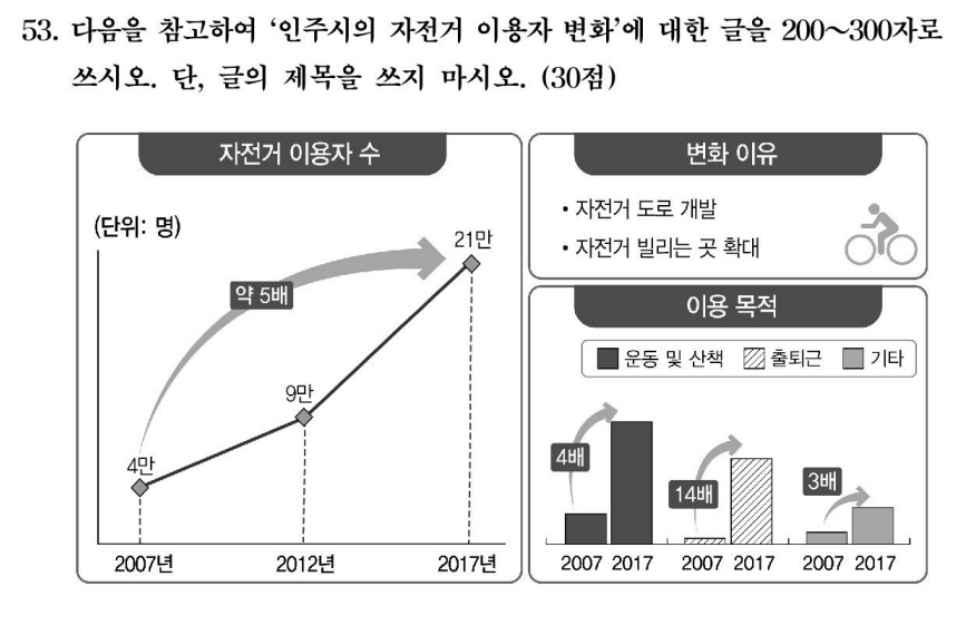
다음을 참고하여 ‘인주시의 자전거 이용자 변화’에 대한 글을 200~300자로 쓰십시오. 단, 글의 제목을 쓰지 마십시오.

Write about “the change in bicycle users in Inju City” in 200–300 characters. Do not write a title.

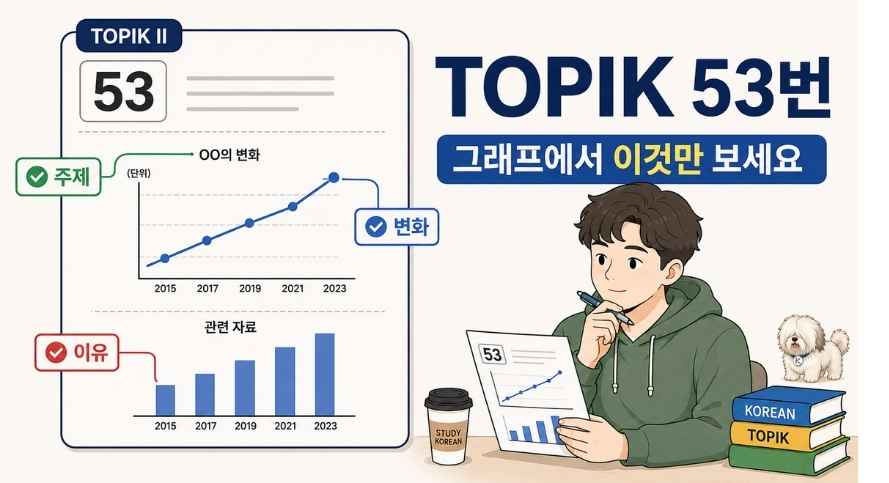
The first thing to look at is not the graph — it’s the TOPIC.

주제 = ‘인주시의 자전거 이용자 변화’

Topic = the change in bicycle users in Inju City

So we write only about this topic. Don’t write your own story like “저는 자전거를 좋아합니다”

3. Break the data into 3 parts

Looking at the whole graph and writing right away is hard. First split it, and find just one key point in each part.

DataWhat you seeThe key point
① 자전거 이용자 수2007년 4만 → 2012년 9만 → 2017년 21만 명5배 늘었다
② 변화 이유자전거 도로 개발 / 빌리는 곳 확대이유 두 가지
③ 이용 목적운동·산책 4배 / 출퇴근 14배 / 기타 3배출퇴근이 14배로 가장 많이 늘었다

You don’t write every number. Just catch the biggest feature of each part.

4. See how those 3 parts become a real answer

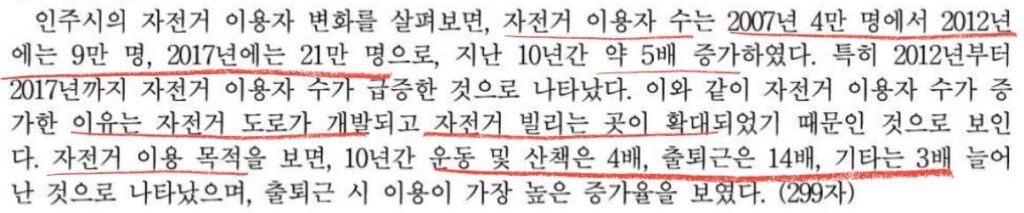
Here is a real model answer for this question (299 characters). Notice how the three parts of the data simply become sentences — nothing extra is added.
TOPIK Question 53

Data partIn the model answer
① 자전거 이용자 수“…2007년 4만 명 … 2017년 21만 명 … 약 5배 증가하였다”
② 변화 이유“…자전거 도로가 개발되고 자전거 빌리는 곳이 확대되었기 때문…”
③ 이용 목적“…운동 및 산책은 4배, 출퇴근은 14배 … 출퇴근 시 이용이 가장 높은 증가율…”

Three quick things to notice:

✅ It follows the order: overall change → reason → purpose.
✅ Every sentence ends in written style (증가하였다, 보인다, 나타났으며) — no “-요/-습니다”.
✅ It is 299 characters — right inside 200–300. It picks the key points and adds nothing from outside the data.

5. Five things to be careful about

① Write the data, not your opinion. (I like bicycles ❌)
② Don’t write every number — only the key features. (about 5×, commuting 14×)
③ Don’t write anything not in the data. (e.g., “because of health” — not in the data ❌)
Don’t write a title. Start with the body.
⑤ Use written style “-다,” not speaking style. (늘었어요 ❌ → 늘었다 ✅)

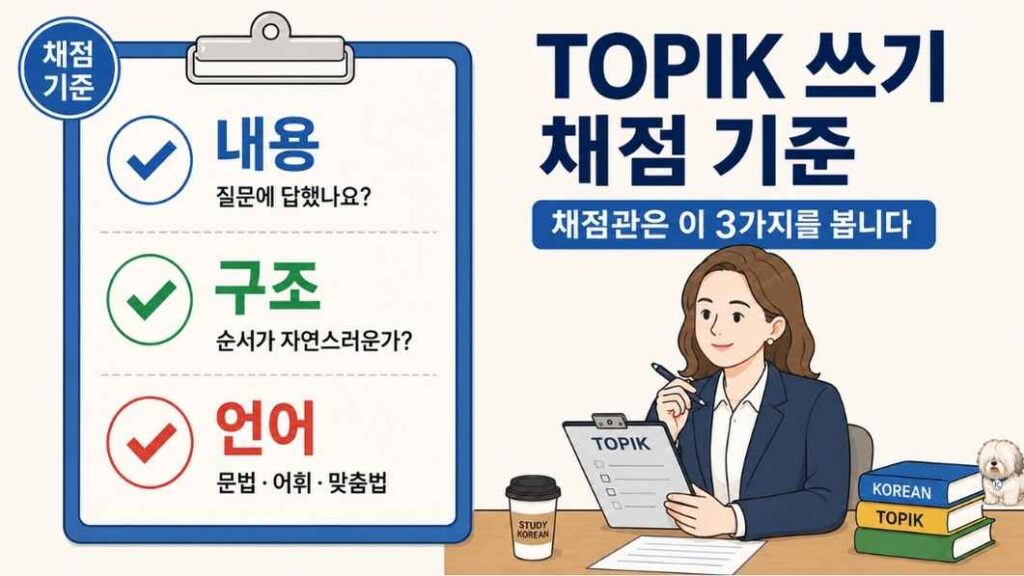
And remember from Part 4: graders check content, structure, and language — did you write on topic, in order, and in accurate written style? (For more details on grading 👉 Part 4)

6. Today’s practice — just read the data

You don’t need to write 200–300 characters yet. Just look at the graph and answer the six questions below in written style (“-다”). Click each one to check.

1. 이 문제의 주제는 무엇인가요?

🔽 See the answer Q: What is the topic of this question?

A:이 문제의 주제는 인주시의 자전거 이용자 변화이다.
The topic is the change in bicycle users in Inju City.

2. 2007년 자전거 이용자는 몇 명이었나요?

🔽 See the answer Q: How many bicycle users were there in 2007?

A:2007년에는 4만 명이었다.
There were 40,000 in 2007.

3. 2017년에는 몇 명이었나요?

🔽 See the answer Q: How many were there in 2017?

A:2017년에는 21만 명이었다.
There were 210,000 in 2017.

4. 약 몇 배 늘었나요?

🔽 See the answer Q: About how many times did it increase?

A:약 5배 늘었다.
It increased about 5 times.

5. 변화 이유는 무엇인가요?

🔽 See the answer Q: What are the reasons for the change?

A:변화 이유는 자전거 도로 개발과 자전거 빌리는 곳 확대이다.
The reasons are new bike roads and more rental places.

6.이용 목적 중 가장 많이 늘어난 것은?

🔽 See the answer Q: Which purpose of use increased the most?

A: 출퇴근 목적이 가장 많이 늘었다. Commuting increased the most.

Summary 🌱

Question 53 asks you to describe the given data in 200–300 characters — not your own opinion.

Look at the topic first → split the data into 3 parts → pick only the key feature of each → don’t add outside info or a title → write in written style “-다”.

Don’t try to finish a full answer from the start. Begin by writing one accurate sentence from the data.

Next time, we learn the first training before writing Question 53: how to read a graph (marking it before you write).

See you in the next lesson!

🔎 Still finding levels 1–2 hard? Review the basics first 👉 [ TOPIK I study ]

❓ FAQ

Q: Can I write my own opinion in Question 53?
A: No. You describe the data. Only a very short summary at the end is okay.

Q: Do I have to write every number?
A: No. Pick only the key features (increased about 5×; commuting rose 14×).

Q: Do I write a title?
A: No. Question 53 has no title — start with the body.

Q: Can I write “늘었어요”?
A: No. Use the written style “늘었다.”


<Latest Posts>
DAY 7: Politics Vocabulary – 20 Essential TOPIK II Words

TOPIK Politics Vocabulary

Welcome to DAY 7! Today’s topic is essential Politics Vocabulary for the TOPIK II exam. Politics-related vocabulary is a bit difficult, but if you want to improve your score, it’s definitely good to know it.

First, try the vocabulary game. Then check the [내 단어장] you missed.

Click 오늘의 학습 시작 🚀

단어 로켓 · 정치 DAY 7
🚀단어 로켓
Lv.1 🔥 0
중급 입문0 / 150 XP
TOPIK II

중급 필수 어휘
끝까지 정복하기

주제별로 하나씩 클리어하며 시험에 나오는 핵심 어휘를 내 것으로 만드세요.

🚀
0
마스터한 단어
0
클리어한 주제
0
최고 콤보
✏️
문장 빈칸 채우기
문맥에 맞는 단어 고르기 · TOPIK 유형
🔗
비슷한 말 · 반대말
유의어 · 반의어로 뜻 익히기
📖
뜻풀이 보고 단어 맞히기
쉬운 한국어 설명 + 작은 영어 힌트
주제 목차
TOPIK II 중급 어휘 25개 주제 · 순서대로 정복해 보세요.
0/23
🔥2 콤보! XP 1.5배

🎉 쇼핑 클리어!

모든 단어를 맞혔어요
0%
정확도
0
마스터
0
최고 콤보
+0 XP
내 단어장
틀렸던 단어가 모여요. 복습으로 완전히 내 것으로 만드세요.
🔎 한국어로 공부하고 싶어요? 👉 [ TOPIK II 필수 어휘 ② 인간관계·감정 ]

Master Essential TOPIK II Politics Vocabulary

Do not memorize only the English meaning. Try to understand who does the action and in what situation the word is used.

단어English쉬운 한국어 풀이예문
각계각층all walks of life사회의 모든 다른 분야나 여러 신분의 사람들각계각층의 인사들이 동참하고 있습니다.
(People from all walks of life are participating.)
강화reinforcement힘이나 세력을 더 강하고 튼튼하게 만드는 것경쟁력을 강화하려면 제도를 개선해야 합니다.
(To strengthen competitiveness, we need to improve the system.)
경쟁하다compete이기거나 앞서기 위해 서로 겨루고 싸우다다른 정당과 경쟁하는 과정에서 다툼이 발생했다.
(A dispute occurred during the process of competing with other political parties.)
공정fairness어느 한쪽으로 치우치지 않고 올바르고 똑바름공직자에게 무엇보다 중요한 덕목은 공정이다.
(The most important virtue for a public official is fairness.)
과반수majority전체에서 반(50%)이 넘는 수과반수의 인원이 반대하여 계획이 취소되었다.
(The plan was canceled because the majority of people opposed it.)
대응하다respond어떤 일이나 변화에 알맞게 맞서서 행동하다잘못된 보도에 기자 회견으로 대응하다.
(We respond to false reports with a press conference.)
민주화democratization정치나 사회를 국민이 주인이 되는 상태로 만드는 것민주화를 이루어 낸 것은 정치적으로 의미가 있다.
(Achieving democratization is politically meaningful.)
백성subjects옛날에 왕이 다스리던 나라의 일반 국민왕은 백성의 어려움을 해결해 주고자 했다.
(The king wanted to solve the difficulties of his people.)
보수적conservative새로운 변화보다 옛날부터 내려오는 전통이나 제도를 지키려는 것보수적인 정치로 장년층의 인기를 끌고 있다.
(It is gaining popularity among older people with conservative politics.)
유권자voter선거에서 투표를 할 수 있는 권리를 가진 사람유권자에게 투표에 참여할 것을 강하게 권했다.
(We strongly urged voters to participate in voting.)
유세하다campaign선거 후보자가 자신의 생각이나 공약을 유권자들에게 알리다선거 후보자가 유세하는 곳에 유권자들이 몰려들다.
(Voters gathered where the election candidate was campaigning.)
이행하다implement약속이나 계획, 선거 공약 등을 실제로 행동으로 지키다이행하지 못할 공약을 내세워서는 안 된다.
(You should not make campaign pledges that you cannot fulfill.)
정복하다conquer다른 나라나 영토를 힘으로 싸워 이겨서 자기 것으로 만들다정복한 곳에서 원주민과 영토 분쟁이 있었다.
(There was a land dispute with the native people in the conquered place.)
중립neutrality어느 한쪽 편을 들지 않고 중간의 입장을 지키는 것여전히 중립을 유지하는 국회 의원들이 있다.
(There are still members of National Assembly who remain neutral.)
지배하다rule권력이나 힘을 가지고 사람이나 사회를 다스리다사회를 지배하는 시대정신을 파악해야 한다.
(We must understand the spirit of the times that rules society.)
지지하다endorse어떤 사람이나 의견이 맞다고 생각하여 돕거나 찬성하다지지하는 국회 의원에게 정치 후원금을 보내다.
(I send political donations to the member of National Assembly I support.)
진보적progressive전통을 지키기보다 사회를 새롭고 더 나은 방향으로 바꾸려는 성향진보적인 정치인과 보수적인 정치인이 다투다.
(Progressive politicians and conservative politicians are arguing.)
추진하다push ahead어떤 목표를 향해 일을 밀고 나가며 실행하다이 일을 추진할 때의 장단점을 고려할 것이다.
(I will consider the pros and cons of pushing ahead with this work.)
출마하다run for선거에서 후보자로 나서다대통령 선거에 출마하려면 재산을 공개해야 한다.
(To run for the presidential election, one must disclose their assets.)
투표하다vote선거에서 마음에 드는 사람이나 의견에 표를 던져 선택하다투표하는 장소는 동네의 공공 기관들입니다.
(The places to vote are public institutions in the neighborhood.)

Learn Words by Situation

Politics words are easier when you learn them in groups.

Election Words

유권자 · 유세하다 · 출마하다 · 투표하다
  • A person 출마하다 in an election.
  • The candidate 유세하다 and meets 유권자.
  • Then voters 투표하다.

This is a useful order to remember.

Support and Opinion

지지하다 · 중립 · 보수적 · 진보적
  • 지지하다 means to support a person or idea.
  • 중립 means not taking one side.
  • 보수적 and 진보적 show different ways of thinking about social or political change.

You do not need to agree with the idea. Just understand the meaning of the word in the sentence.

Words You Should Not Confuse

이행하다 vs. 추진하다

이행하다 means to carry out something that was promised or planned.

  • 공약을 이행하다
    (carry out a campaign promise)

추진하다 means to move a plan or project forward.

  • 새로운 정책을 추진하다
    (push forward a new policy)

강화 vs. 대응하다

강화 means making something stronger.

  • 경쟁력을 강화하다

대응하다 means taking action when something happens.

  • 문제에 대응하다

TOPIK Study Tip 💡

Learn short word groups, not single words.

  • 과반수를 얻다
  • 공정을 지키다
  • 유권자에게 지지를 받다
  • 선거에 출마하다
  • 유세를 하다
  • 투표에 참여하다
  • 공약을 이행하다
  • 정책을 추진하다
  • 경쟁력을 강화하다

TOPIK questions often use these words inside a longer sentence. If you know the words that often appear together, you can understand the sentence faster.

Try the DAY 7 Quiz Again! 🚀

Think about these situations:

  • A person becomes a candidate. → 출마하다
  • A candidate talks to voters. → 유세하다
  • People choose a candidate. → 투표하다
  • A politician keeps a campaign promise. → 이행하다

If you can understand these differences, you learned the key points of DAY 7. Now check the words you missed in [내 단어장] and try the game one more time!

Questions are always welcome in the comments below! 🥰

🔎 Learn more about TOPIK Ⅱ writing 👉 [ TOPIK writing ]


<Latest Posts>

DAY 3: Learn 20 Essential TOPIK II Appearance Words

Appearance words

Welcome to DAY 3 of our TOPIK II series! In DAY 3, you will learn 20 important Korean appearance words with clothes, and style.

These words can appear in TOPIK II reading and listening questions. First, play the vocabulary game above. Then review the words you missed with the chart below.

Try not to memorize only the English meaning. Look at the Korean explanation and example sentence too. This will help you understand the word when it appears in a TOPIK question.

Click 오늘의 학습 시작 🚀

단어 로켓 · 외모 DAY 3
🚀단어 로켓
Lv.1 🔥 0
중급 입문0 / 150 XP
TOPIK II

중급 필수 어휘
끝까지 정복하기

주제별로 하나씩 클리어하며 시험에 나오는 핵심 어휘를 내 것으로 만드세요.

🚀
0
마스터한 단어
0
클리어한 주제
0
최고 콤보
✏️
문장 빈칸 채우기
문맥에 맞는 단어 고르기 · TOPIK 유형
🔗
비슷한 말 · 반대말
유의어 · 반의어로 뜻 익히기
📖
뜻풀이 보고 단어 맞히기
쉬운 한국어 설명 + 작은 영어 힌트
주제 목차
TOPIK II 중급 어휘 25개 주제 · 순서대로 정복해 보세요.
0/23
🔥2 콤보! XP 1.5배

🎉 쇼핑 클리어!

모든 단어를 맞혔어요
0%
정확도
0
마스터
0
최고 콤보
+0 XP
내 단어장
틀렸던 단어가 모여요. 복습으로 완전히 내 것으로 만드세요.

🔎 한국어로 공부하고 싶어요? 👉 [ TOPIK II 필수 어휘 ② 인간관계·감정 ]

If you missed any words, open “내 단어장” (My Wordbook) and review them one more time.

Master Essential TOPIK II Appearance Words

단어English쉬운 한국어 풀이예문
갈아입다change clothes입고 있는 옷을 벗고 다른 옷을 입다입고 있던 외출복을 평상복으로 갈아입었다.
(I changed from my outdoor clothes into comfortable clothes.)
건장하다strong; well-built몸이 아주 튼튼하고 크다그는 건장한 육체를 가진 사람이다.
(He has a strong and well-built body.)
겉보기appearance사람이나 사물을 겉으로만 보는 모습겉보기와 달리 그의 성격은 차분하다.
(Unlike his appearance, he has a calm personality.)
곱다beautiful; pretty모양이나 색이 아주 아름답고 예쁘다가을이 되자 산에 단풍이 곱게 물들었다.
(In autumn, the mountain leaves turned beautiful colors.)
꾸미다decorate모양을 더 예쁘고 보기 좋게 만들다새로운 집의 곳곳을 예쁘게 꾸몄다.
(I decorated different parts of my new home beautifully.)
단정하다neat옷차림이나 모습이 아주 깔끔하고 깨끗하다중요한 자리에 갈 때는 옷을 단정하게 입어야 한다.
(You should dress neatly when you go to an important event.)
똑같다exactly the same두 개 이상이 모양이나 크기에서 다른 점이 없다그녀와 그녀의 동생은 쌍둥이처럼 외모가 똑같다.
(She and her younger sister look exactly the same, like twins.)
매력적attractive사람의 마음을 끄는 아름다운 힘이 있다매력적인 사람은 주변인의 관심을 끈다.
(An attractive person gets people’s attention.)
모양shape; form물건이나 사람의 겉모습이나 형태새로 산 구두의 모양이 독특하다.
(The shape of my new shoes is unique.)
복장clothing; attire사람이 입고 있는 옷이나 옷차림직업에 따라 복장이 서로 다르다.
(People wear different clothing depending on their jobs.)
비슷하다similar서로 거의 같거나 조금만 다르다잠수함은 대체로 그 모양이 물고기의 모습과 비슷하다.
(A submarine usually has a shape similar to a fish.)
사이즈size옷이나 신발 등의 크기체형에 맞는 사이즈의 옷을 입어야 한다.
(You should wear clothes in the right size for your body.)
생기liveliness; energy힘차고 건강한 느낌이나 기운좋은 일이 있는지 그의 얼굴에 생기가 있다.
(His face looks full of life, as if something good happened.)
생김새appearance; looks사람이나 사물이 생겨난 모습사람마다 생김새가 다르듯이 생각도 다르다.
(Just as people look different, they also think differently.)
세련되다stylish; sophisticated모습이나 행동이 촌스럽지 않고 아주 멋있다세련된 디자인의 옷들이 진열되어 있다.
(Clothes with stylish designs are on display.)
스타일style옷을 입는 방법이나 개성적인 모양그 가수는 자신만의 독특한 스타일로 옷을 입는다.
(The singer dresses in their own unique style.)
유행trend; fashion많은 사람들이 한동안 아주 좋아하고 따르는 것요즘 짧은 머리 모양이 큰 유행이다.
(Short hairstyles are very popular these days.)
착용wearing모자, 옷, 안경, 안전띠 등을 몸에 쓰거나 입는 것차를 탈 때에는 반드시 안전띠를 ​착용해야 한다.
(You must wear a seat belt when you are in a car.)
평범하다ordinary특별한 것이 없고 보통이다평범한 옷차림의 아저씨가 가게로 들어왔다.
(An ordinary-looking man walked into the store.)
화려하다colorful; fancy색이나 장식이 아주 밝고 예쁘며 눈에 잘 띄다그 가구는 장식이 굉장히 화려하다.
(The furniture has very fancy decorations.)

Learn Similar Words Together

Some appearance words have similar meanings. Learning them together can make them much easier to remember.

건장하다 → 튼튼하다 : Both can describe a strong and healthy body.

곱다 → 아름답다 : Both can mean “beautiful,” but 곱다 is often used for beautiful colors, skin, sounds, or a gentle appearance.

단정하다 → 깔끔하다 : Both describe a neat appearance.

겉보기 → 겉모습 : Both are related to how someone or something looks from the outside.

복장 → 옷차림 : Both describe the clothes a person is wearing.

사이즈 → 크기 : Both tell us how big or small something is.

생김새 → 외모 : Both can describe how a person looks.

⚠️ Do Not Confuse These Words

똑같다 vs. 비슷하다

똑같다 means there is almost no difference.

  • 두 가방의 모양이 똑같다.
    (The two bags look exactly the same.)

비슷하다 means they are almost the same, but there may be some differences.

  • 두 가방의 모양이 비슷하다.
    (The two bags look similar.)

This difference is important in TOPIK questions.

복장 vs. 스타일

복장 means the clothes a person is wearing, especially in a certain situation.

회사 복장 / 작업 복장 / 면접 복장

스타일 is more about a person’s own way of dressing or looking.

자신만의 스타일 / 독특한 스타일

단정하다 · 세련되다 · 화려하다

These words can all describe appearance, but they are not the same.

단정하다 → clean and neat
세련되다 → stylish and modern
화려하다 → bright, colorful, or highly decorated

TOPIK Vocabulary Tip 💡

Do not study only: 단정하다 = neat

Study a short expression too:

  • 단정하게 입다
  • 세련된 디자인
  • 화려한 옷
  • 유행을 따르다
  • 안전띠를 착용하다
  • 옷을 갈아입다

TOPIK II usually shows vocabulary inside a sentence or passage. If you learn the words that are commonly used together, you can understand the meaning more quickly.

💡 Key Exam Tip for TOPIK II Appearance Vocabulary

In the TOPIK II listening and reading passages, appearance words are frequently used in descriptive contexts, personal profiles, and fashion or lifestyle questions. Pay close attention to action verbs used with clothing and accessories—such as 갈아입다 (to change clothes) or 착용하다 (to wear/put on)—as well as descriptive adjectives like 세련되다 (stylish) and 단정하다 (neat). Recognizing these nuances will help you answer reading comprehension questions much faster.

Ready to Try the Game Again? 🚀

Which words were difficult for you?

Was it 똑같다 vs. 비슷하다?
Or 복장 vs. 스타일?

Go back to the game and try DAY 3 one more time. This time, do not only remember the English meaning. Think about the situation and the words that are often used together.

A few minutes of review can make a big difference.

Keep going—one topic a day, one step closer to your TOPIK goal!


🔎 Learn more about TOPIK Ⅱ writing 👉 [ TOPIK writing ]


<Latest Posts>

error: Content is protected !!