
TOPIK I Reading 34–39 ⑤: 9 Korean Particles for the Blank (에 / 에서 · 을/를)

TOPIK I Reading

📌 한국말로 공부하고 싶어요? 👉 [한국어]

Do small Korean particles like 에, 에서, and 을 feel tricky in TOPIK I reading? 😊 Here is the secret: each particle has one clear role. Learn the roles, and these questions become easy!

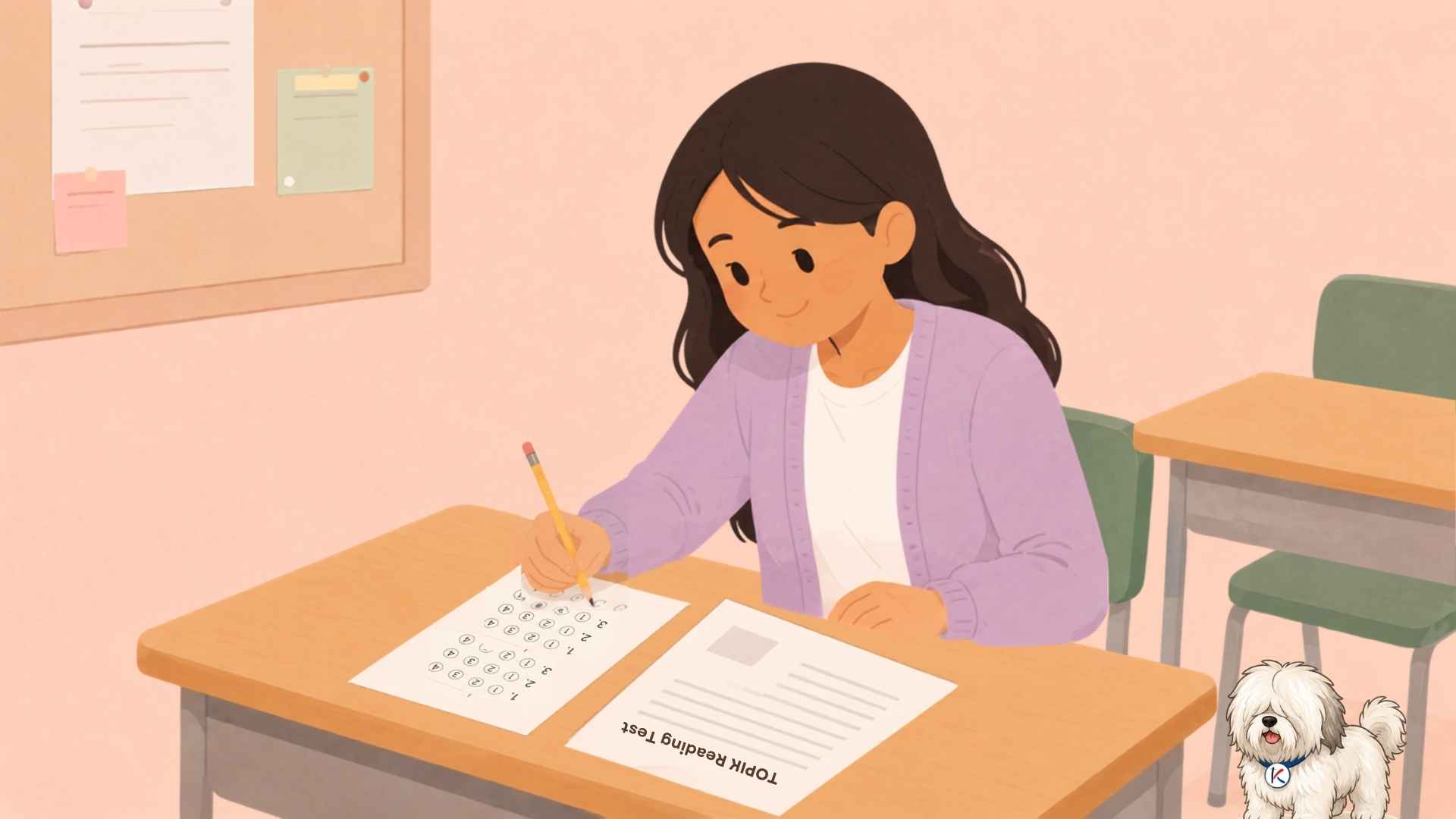
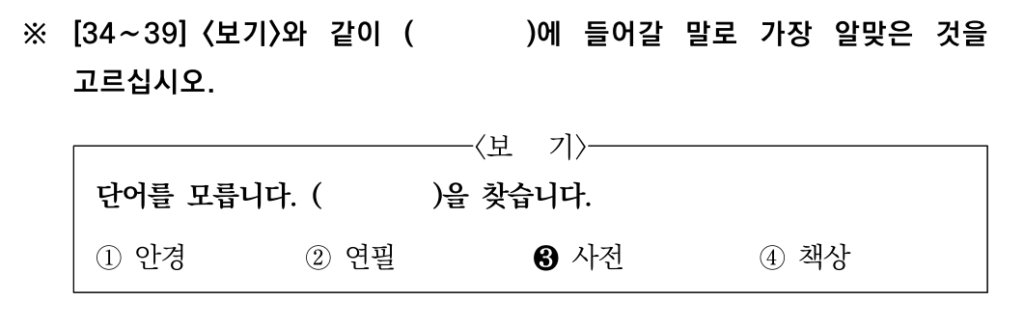
In questions 34–39, a particle blank tests one small word after a noun. Each TOPIK I reading question is worth 2 points.

Try each one first, then open the answer to check.

① Remember just one thing


A particle attaches to a noun and gives it a role.
Read the sentence, and choose the role it needs.

e.g. 밥 (    ) 먹어요 → “eat WHAT?” → 을 (object)

② Particle card

ParticleRoleExample
이/가subject (who / what)친구가 와요
을/를object (what)밥을 먹어요
place you go to / time학교에 가요
에서place of action / from식당에서 먹어요
하고 (와/과)and, with빵하고 우유
also (too)저도 가요
only물만 마셔요
에게 (한테)to a person친구에게 줘요
of (possession)동생의 가방
📌 -에 vs -에서: 가다 / 오다 → -에 (학교에 가요) · do something → -에서 (학교에서 공부해요)

📌 -을/를: after a final consonant → -을 (밥을) · after a vowel → -를 (사과를)
💡Do you want to study more in detail [-에 vs-에서]? Check this 👉 [ -에 vs -에서 ]

Practice: TOPIK I reading particle blanks

Try each TOPIK I reading question first.

Read the sentence, choose the particle, then open the box to check.

Question 1

저는 베트남(       ) 왔습니다.

① 이② 의③ 에서④ 하고


🔽 See the answer (Question 1)

Q: 저는 베트남( ) 왔습니다.
(I came ( ) Vietnam.)
👉 Came FROM where? (starting place)

A: ✅③ 에서 → “~에서 오다” means “come from ~”. From Vietnam!

① 이 = subject marker (-이/가).

② 의 = of (possession).

④ 하고 = and / with.


💡 Tip: come/came from a country or place → ~에서!


Question 2

형은 학생입니다. 저(       ) 학생입니다.

① 만② 에③ 를④ 도


🔽 See the answer (Question 2)

Q: 형은 학생입니다. 저( ) 학생입니다.
(My older brother is a student. I am ( ) a student.)
👉 Brother is, and I am → “also”?

A: ✅④ 도 → “-도” means “also / too”. I am also a student!

① 만 = only.

② 에 = to a place / time.

③ 를 = object marker (-을/를); a verb should follow.


💡 Tip: same as before (“also”) → -도!


Question 3

시장에서 사과(       ) 배를 삽니다.

① 하고② 만③ 까지④ 에서


🔽 See the answer (Question 3)

Q: 시장에서 사과( ) 배를 삽니다.
(At the market, I buy apples ( ) pears.)
👉 apples “and” pears?

A: ✅① 하고 → “-하고” means “and / with”. Apples and pears!

② 만 = only.

③ 까지 = up to / until.

④ 에서 = at a place / from.


💡 Tip: A ( ) B (both) → -하고 (= -와/과)!


Question 4

친구 생일입니다. 친구(       ) 선물을 줍니다.

① 도② 를③ 에서④ 에게


🔽 See the answer (Question 4)

Q: 친구 생일입니다. 친구( ) 선물을 줍니다.
(It is my friend’s birthday. I give a gift ( ) my friend.)
👉 Give TO whom? (a person)

A: ✅④ 에게 → For a person, use “-에게”. To my friend!

① 도 = also.

② 를 = object marker (-을/를).

③ 에서 = at a place / from.


💡 Tip: a person + give/send → -에게 (= -한테)!


Question 5

다른 것은 없습니다. 물(       ) 있습니다.

① 을② 만③ 도④ 로


🔽 See the answer (Question 5)

Q: 다른 것은 없습니다. 물( ) 있습니다.
(There is nothing else. There is ( ) water.)
👉 Nothing else, water “only”?

A: ✅② 만 → “-만” means “only”. Only water!

① 을 = object marker (-을/를); a verb should follow.

③ 도 = also.

④ 로 = by / with (a way or tool).


💡 Tip: only one thing → -만!


Question 6

이것은 제 것이 아닙니다. 동생(       ) 가방입니다.

① 도② 만③ 의④ 을


🔽 See the answer (Question 6)

Q: 이것은 제 것이 아닙니다. 동생( ) 가방입니다.
(This is not mine. It is my sibling’s ( ) bag.)
👉 Whose bag?

A: ✅③ 의 → “의” means “of (possession)”. My sibling’s bag!

① 도 = also.

② 만 = only.

④ 을 = object marker (-을/를); a verb should follow.


💡 Tip: whose thing (possession) → -의!


Question 7

방이 덥습니다. 그래서 창문(       ) 엽니다.

① 에② 의③ 을④ 이


🔽 See the answer (Question 7)

Q: 방이 덥습니다. 그래서 창문( ) 엽니다.
(The room is hot. So I open the window ( ).)
👉 Open WHAT? (object)

A: ✅③ 을 → “-을/를” marks the object (what). Open the window!

① 에 = to a place / time.

② 의 = of (possession).

④ 이 = subject marker (-이/가).


💡 Tip: do something to WHAT → -을/를! (“창문” ends in a consonant, so -을)


Question 8

저는 아침에 학교(       ) 갑니다.

① 에② 에서③ 을④ 도


🔽 See the answer (Question 8)

Q: 저는 아침에 학교( ) 갑니다.
(In the morning I go ( ) school.)
👉 Go TO where? (destination)

A: ✅① 에 → “~에 가다” means the place you go to. To school!

② 에서 = the place of an action (학교에서 공부해요); not used with 가다.

③ 을 = object marker (-을/를).

④ 도 = also.


💡 Tip: -에 vs -에서! 가다·오다 → -에 (학교에 가요) · do something → -에서 (학교에서 공부해요)

③ How to memorize the particles easily

Now you have practiced, here is the fastest way to grow your TOPIK I reading vocabulary.

  1. Learn each particle by its role. 을/를 (what), 에 (to a place), 에서 (place of action), 에게 (to a person), 의 (whose).
  2. Focus on the tricky pair: 에 ↔ 에서. (가다 → 에, do something → 에서)
  3. 을/를 rule: after a consonant → 을, after a vowel → 를.
  4. Read out loud. Your ear will learn the natural particle.

🤖Practice with AI: a Korean particle game

You can practice TOPIK I reading alone with AI — and grow your Korean speaking too!

First, turn on the AI’s voice (read-aloud).

Then answer out loud in Korean. The game is played only in Korean.🗣️

“Let’s play a Korean particle game. Please speak only in Korean during the game — no English. You read a short sentence with one blank in Korean (for example: 학교 ( ) 갑니다), and I say the correct particle out loud in Korean (for example: 에). Give me 10 quickly, then tell me my score in Korean. Use only beginner words.”

⚠️ AI can make mistakes.

Always check with real past exams at the end. AI is for practice; the past exams are the answer key.

Summary

  • A particle gives a noun its role. Read the sentence and choose the role.
  • Always split 에 (go to) vs 에서 (do something / from).
  • 을/를 depends on the final letter: 밥을 / 사과를.

Well done! Keep practicing, and you can all pass TOPIK Level 2. 🎉

Have a question? Please leave a comment.

See you in the next lesson!

📢 want to practice TOPIKⅠ Listening next? 👉 [ TOPIKⅠ Listening ] 

FAQ

Q: What are TOPIK I reading questions 34–39?

A: They ask you to fill a blank with the right word — a particle, noun, verb, adjective, or adverb. Each question is worth 2 points.

Q: How do I choose the right particle?

A: Each particle has a role. Read the sentence and pick the role it needs: object (을/를), destination (에), place of action (에서), to a person (에게), or possession (의).

Q: What is the difference between 에 and 에서?

A: Use 에 for the place you go to (학교에 가요). Use 에서 for the place where you do something (학교에서 공부해요) or “from.”

Why Does Korean “Hello” Have a Question Mark? (1 Secret)

Korean Hello
📌 한국어가 쉬워요? 여기를 보세요.👉 [한국어 blog]

Hello? Bonjour? Hola? 你好? السلام عليكم? नमस्ते? Здравствуйте?

Does the greeting in your language have a question in it? How do you say Hello in Korean?

You say “안녕하세요?” (an-nyeong-ha-se-yo?), right?

But look closely — there is a question mark (?) at the end. Open any Korean textbook, and it is always there.

Korean Hello

So why does the “Korean Hello” sound like a question? Let me tell you a little story.

What does Korean Hello “안녕?” really mean?

When learning Korean Hello “안녕(an-nyeong)?“, Most students never even notice this little question mark — but once you do, the first question is simple: what does “안녕” actually mean?

안녕 (安寧)” comes from Chinese characters. A long time ago, before King Sejong created Hangul, Korean people spoke Korean but wrote with Chinese characters. Even today, many Korean words still come from them. (We’ll talk more about this in another story.)

They mean a state of being calm and safe, with nothing wrong.” In English, it is close to “peace or well-being“.

So if we translate “안녕하세요?” word by word, it sounds like this:

“Are you at peace? Are you doing well, with nothing wrong?”

Is it the same as “How are you?” then? Almost.

In Korean, “How are you?” is usually “잘 지내세요?” (jal- ji-nae-se-yo?).

When you add a “question mark(?)” to the greeting “안녕하세요”, it becomes a soft way of asking about someone. If you really want to ask how they are, you write “안녕하세요?“. If it is just a light hello, you write “안녕하세요.

And honestly, when you speak, the sound matters more than the mark. Raise your voice a little at the end, and it feels like a question. Keep it flat, and it feels like a greeting.

Wait — Why do Korean keep asking about my life?

When you come to Korea, you will hear these too:

“밥 먹었어요?” (bap meo-geos-seo-yo?)Did you eat?

“어디 가세요?” (eo-di ga-se-yo?)Where are you going?

At first, this can feel strange.

Why do they want to know if I ate, or where I am going?”

But Korean people are not really trying to look into your private life. These are like cousins of “안녕하세요?”.

It is closer to a warm “You doing okay? Nothing wrong?”

Why do Koreans ask if you are okay?

Here comes the old story.

Long ago in Korea, neighbors lived close together and helped each other. They farmed together, and they got through hard times together.

Because of where Korea sits on the map, it was invaded by other countries many times through history. So there were many poor and hungry years. In times of war, or when people were dying of hunger, the first thing you wondered each morning was simple: Is my neighbor safe? Did anything bad happen in the night?

So when people met, they greeted each other like this:

“Are you at peace? Are you doing well?”
“You are not going hungry, are you?”

In years when many people were hungry, “밥 먹었어요? (Did you eat?)” really meant “Are you okay? Did you get enough to eat?” That caring feeling still lives inside today’s “안녕하세요?”.

Of course, this is not a proven history. But when you think of it this way, doesn’t a simple daily greeting start to feel a little warmer?

So remember just one thing: in Korean, a question-shaped greeting is not really asking for information. It is a way to start a conversation and to check in with each other.

How do I know what these greetings really mean?

It depends on the situation. Take “밥 먹었어? (Did you eat?)”:

  • From an adult or a friend you have not seen in a while → it means How have you been?”
  • Right before a meal time → it might mean “Want to eat together?”
  • After a meal time → it might really be asking if you ate

You can answer simply.

“네, 먹었어요. (Yes, I ate.)” or “아직요. ○○ 씨는요? (Not yet. How about you?)” is enough.

어디 가세요? (Where are you going?)” works the same way.

If you do not want to explain, you can just say “잠깐 볼일 보러 가요. (I’m just going out for a bit.)”

And “안녕하세요?” can feel like “How are you?”, but most of the time you do not need a long answer.

Just saying “안녕하세요?” back is perfect.

Who do I say it to?

When using Korean Hello in daily life, greetings have different levels of politeness.

They change a little depending on who you are talking to.

  • 안녕? (an-nyeong?) → a close friend, a child, or someone you already speak casually with
  • 안녕하세요? (an-nyeong-ha-se-yo?) → someone you just met, and most everyday situations (the safest choice)
  • 안녕하십니까? (an-nyeong-ha-sim-ni-kka?) → very formal places, like a presentation, an interview, or an official event

Remember one thing. With a child, “안녕?” feels natural.

But with an adult who looks a little younger than you, or with someone you just met, “안녕하세요?” is the safe choice — no matter their age.

The key is not age. It is your relationship.

One last thing

“안녕하세요?” is not just “Hello”. Inside it is an old, kind wish: I hope you are doing well.

So next time you greet someone with “안녕하세요?“, remember this little story. You are greeting them in a very old way, quietly saying:

“I hope you’re doing well today.”

Does “안녕하세요?” make a little more sense now?

So when you meet a Korean person on the street, let’s greet them properly — not just “안녕”, but “안녕하세요?

Does your language have a greeting that looks like a question? Tell me in the comments. I would love to know.🥰

See you again!

💡 Want to study more Korean expressions with detailed explanations? Check This 👉 [Korean culture!]


📝 Just remember this

SituationSay this
A close friend안녕? / 안녕! (annyeong)
Someone you just met, most situations안녕하세요? (annyeonghaseyo — safest)
Presentation, interview, formal event안녕하십니까? (annyeonghasimnikka)