Are you preparing for TOPIK Level 3 or 4? In DAY 4, you will learn 20 important Korean jobs vocabulary words.
These words often appear in TOPIK reading and listening questions about 채용 (recruitment), 지원하다 (to apply), 경력 (career), and working life.
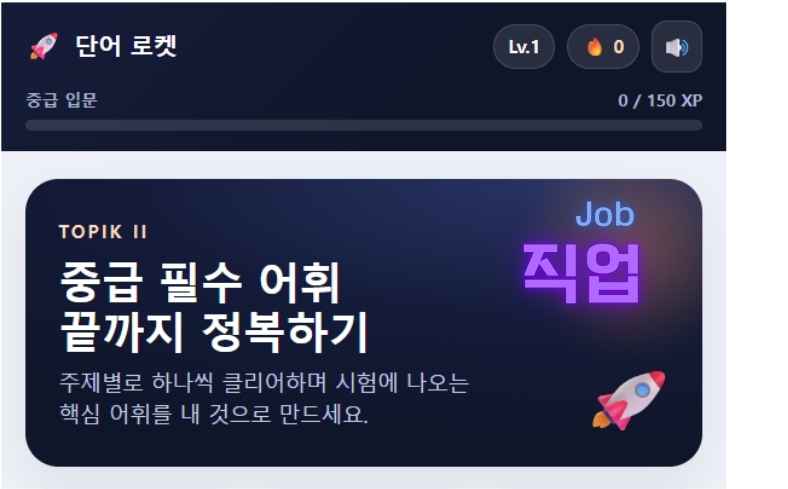
First, try the vocabulary game above. Then check the words you missed in the chart below. You do not need to memorize everything at once. Try to understand how each word is used in a real situation.
Click 오늘의 학습 시작 🚀
중급 필수 어휘
끝까지 정복하기
주제별로 하나씩 클리어하며 시험에 나오는 핵심 어휘를 내 것으로 만드세요.
🚀🎉 쇼핑 클리어!
🔎 한국어로 공부하고 싶어요? 👉 [ TOPIK II 필수 어휘 ② 인간관계·감정 ]
Essential TOPIK II Vocabulary: Jobs and Employment
| 단어 | English | 쉬운 한국어 풀이 | 예문 |
|---|---|---|---|
| 갖추다 | have; be equipped with | 필요한 물건, 조건, 능력 등을 모두 준비해서 가지다 | 취업하려면 필요한 자격과 실력을 갖추어야 한다. (To get a job, you need the right qualifications and skills.) |
| 검사 | prosecutor | 범죄 사건을 조사하고 법원에 재판을 요청하는 법률 전문가 | 검사는 범죄 사건을 조사하고 법원에 재판을 요청한다. (A prosecutor investigates crimes and asks the court to hold a trial.) |
| 경력 | work experience; career | 지금까지 어떤 일을 해 온 경험 | 이 회사는 관련 분야에서 2년 이상 경력이 있는 사람을 찾고 있다. (This company is looking for someone with at least two years of work experience in the field.) |
| 과학자 | scientist | 과학을 전문적으로 연구하는 사람 | 그는 새로운 에너지를 연구하는 과학자가 되고 싶어 한다. (He wants to become a scientist who studies new energy.) |
| 구하다 | look for; find | 필요한 일자리나 직장을 찾다 | 졸업 후에 전공과 관련된 직장을 구하고 있다. (I am looking for a job related to my major after graduation.) |
| 기사 | driver | 버스, 택시, 트럭 등의 차를 운전하는 일을 하는 사람 | 택시 기사가 손님을 안전하게 목적지까지 데려다 주었다. (The taxi driver took the passenger safely to the destination.) |
| 농부 | farmer | 농사를 지어 곡식, 채소, 과일 등을 기르는 사람 | 농부들은 날씨를 확인하며 농작물을 관리한다. (Farmers check the weather and take care of their crops.) |
| 담당하다 | be in charge of | 어떤 일을 책임지고 맡아서 하다 | 저는 회사에서 외국인 고객 상담을 담당하고 있다. (I am in charge of helping foreign customers at my company.) |
| 대기업 | large company | 직원과 자본이 많고 규모가 큰 회사 | 많은 취업 준비생이 대기업 채용 공고에 관심을 보인다. (Many job seekers are interested in job openings at large companies.) |
| 보유하다 | have; possess | 물건, 기술, 자격, 능력 등을 가지고 있다 | 이 회사는 다양한 기술을 보유하고 있다. (This company has many different technologies.) |
| 실직 | job loss; unemployment | 다니던 직장을 잃어 일이 없는 상태 | 회사가 문을 닫으면서 많은 직원이 실직했다. (Many workers lost their jobs when the company closed.) |
| 운영하다 | run; operate | 가게, 회사, 기관 등을 관리하며 이끌어 가다 | 그는 작은 식당을 직접 운영하고 있다. (He runs a small restaurant himself.) |
| 전문성 | expertise | 어떤 분야를 잘 알고 일을 잘할 수 있는 전문적인 지식이나 능력 | 이 일을 잘하려면 높은 전문성이 필요하다. (You need strong professional knowledge and skills to do this job well.) |
| 지원자 | applicant | 회사, 학교, 프로그램 등에 들어가려고 신청한 사람 | 이번 채용의 지원자는 모두 100명이 넘는다. (There are more than 100 applicants for this job.) |
| 지원하다 | apply | 회사나 기관에 들어가려고 신청하다 | 저는 한국 회사의 마케팅 직무에 지원했다. (I applied for a marketing job at a Korean company.) |
| 채용 | hiring; recruitment | 회사가 필요한 사람을 골라 직원으로 뽑는 것 | 회사는 다음 달부터 신입 사원 채용을 시작한다. (The company will start hiring new employees next month.) |
| 추천하다 | recommend | 좋다고 생각하는 사람이나 것을 다른 사람에게 소개하다 | 선생님은 제 경력에 맞는 회사를 추천해 주셨다. (My teacher recommended a company that fits my work experience.) |
| 취직하다 | get a job | 직장을 얻어 회사나 기관에서 일을 시작하다 | 졸업 후 전공과 관련된 회사에 취직했다. (I got a job at a company related to my major after graduation.) |
| 퇴사하다 | leave a company; quit a job | 다니던 회사를 그만두고 나오다 | 그는 새로운 일을 시작하기 위해 회사를 퇴사했다. (He left his company to start a new job.) |
| 파업하다 | go on strike | 노동자들이 요구를 알리기 위해 함께 일을 멈추다 | 노동자들은 근무 조건을 바꾸기 위해 파업했다. (The workers went on strike to change their working conditions.) |
Learn the Words as a Job Story
Instead of memorizing each word alone, connect the words to one situation:
채용 공고 → 지원하다 → 지원자 → 취직하다 → 경력을 쌓다
A company announces a 채용.
You 지원하다 and become a 지원자.
If the company chooses you, you 취직하다.
After working for some time, you have more 경력.
This kind of connection can help you remember TOPIK vocabulary for a longer time.
⚠️ Words You Should Not Confuse
검사 and 기사 — has more than one meaning.
- 검사 can mean prosecutor (a job in law). But the same word also means a test or an inspection (검사하다).
- 기사 can mean driver (for example, a bus or taxi driver). But the same word can also mean a news article, or a technical engineer.
In this lesson, 기사 means a driver, as in 택시 기사 or 버스 기사. Always check the words around it.
- 지원하다 can also mean “to support.”
- 회사에 지원하다 = to apply to a company
- 학생을 지원하다 = to support a student
Also remember:
- 퇴사하다 → You decide to leave your company.
- 실직하다 → You lose your job.
Understanding the situation is more important than memorizing only the English meaning.
💡Key Exam Tip for TOPIK II Jobs Vocabulary
In the TOPIK II listening and reading sections, jobs vocabulary frequently appears in recruitment announcements, interviews, and workplace stories. Pay close attention to verbs related to employment—such as 지원하다 (to apply), 채용하다 (to hire), and 퇴사하다 (to quit)—as well as nouns like 경력 (work experience) and 전문성 (expertise). Understanding how these words function in sentence contexts will help you answer questions with confidence.
TOPIK Study Tip 💡
TOPIK II often tests vocabulary inside a sentence or a longer passage. You may know the English meaning but still choose the wrong answer if you do not know how the word is used.
When you study a new word, remember one common expression with it:
경력을 쌓다 · 직장을 구하다 · 업무를 담당하다 · 전문성을 갖추다 · 채용 공고 · 회사에 지원하다
Learning words in these small groups will make TOPIK reading much easier.
Ready for Another Round? 🚀
How many DAY 4 words can you remember now? Go back to the vocabulary game and try it one more time for long-term memory.
Do not worry if you make mistakes. Check the [내 단어장] difficult words, understand the example sentence, and try again.
One topic at a time, your TOPIK II vocabulary will keep growing.
See you in DAY 5!
🔎 Learn more about TOPIK Ⅱ writing 👉 [ TOPIK writing ]
<Latest Posts>