
📌 한국말로 공부하고 싶어요? 👉 [한국어]
Do small Korean particles like 에, 에서, and 을 feel tricky in TOPIK I reading? 😊 Here is the secret: each particle has one clear role. Learn the roles, and these questions become easy!
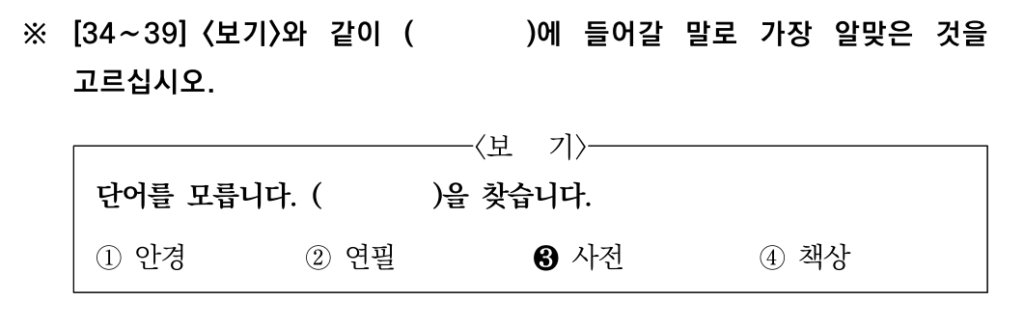
In questions 34–39, a particle blank tests one small word after a noun. Each TOPIK I reading question is worth 2 points.
Try each one first, then open the answer to check.
① Remember just one thing
Read the sentence, and choose the role it needs.
e.g. 밥 ( ) 먹어요 → “eat WHAT?” → 을 (object)
② Particle card
| Particle | Role | Example |
|---|---|---|
| 이/가 | subject (who / what) | 친구가 와요 |
| 을/를 | object (what) | 밥을 먹어요 |
| 에 | place you go to / time | 학교에 가요 |
| 에서 | place of action / from | 식당에서 먹어요 |
| 하고 (와/과) | and, with | 빵하고 우유 |
| 도 | also (too) | 저도 가요 |
| 만 | only | 물만 마셔요 |
| 에게 (한테) | to a person | 친구에게 줘요 |
| 의 | of (possession) | 동생의 가방 |
📌 -을/를: after a final consonant → -을 (밥을) · after a vowel → -를 (사과를)
💡Do you want to study more in detail [-에 vs-에서]? Check this 👉 [ -에 vs -에서 ]
Practice: TOPIK I reading particle blanks
Try each TOPIK I reading question first.
Read the sentence, choose the particle, then open the box to check.
Question 1
저는 베트남( ) 왔습니다.
① 이② 의③ 에서④ 하고
🔽 See the answer (Question 1)
Q: 저는 베트남( ) 왔습니다.
(I came ( ) Vietnam.) 👉 Came FROM where? (starting place)
A: ✅③ 에서 → “~에서 오다” means “come from ~”. From Vietnam!
① 이 = subject marker (-이/가).
② 의 = of (possession).
④ 하고 = and / with.
💡 Tip: come/came from a country or place → ~에서!
Question 2
형은 학생입니다. 저( ) 학생입니다.
① 만② 에③ 를④ 도
🔽 See the answer (Question 2)
Q: 형은 학생입니다. 저( ) 학생입니다.
(My older brother is a student. I am ( ) a student.) 👉 Brother is, and I am → “also”?
A: ✅④ 도 → “-도” means “also / too”. I am also a student!
① 만 = only.
② 에 = to a place / time.
③ 를 = object marker (-을/를); a verb should follow.
💡 Tip: same as before (“also”) → -도!
Question 3
시장에서 사과( ) 배를 삽니다.
① 하고② 만③ 까지④ 에서
🔽 See the answer (Question 3)
Q: 시장에서 사과( ) 배를 삽니다.
(At the market, I buy apples ( ) pears.) 👉 apples “and” pears?
A: ✅① 하고 → “-하고” means “and / with”. Apples and pears!
② 만 = only.
③ 까지 = up to / until.
④ 에서 = at a place / from.
💡 Tip: A ( ) B (both) → -하고 (= -와/과)!
Question 4
친구 생일입니다. 친구( ) 선물을 줍니다.
① 도② 를③ 에서④ 에게
🔽 See the answer (Question 4)
Q: 친구 생일입니다. 친구( ) 선물을 줍니다.
(It is my friend’s birthday. I give a gift ( ) my friend.) 👉 Give TO whom? (a person)
A: ✅④ 에게 → For a person, use “-에게”. To my friend!
① 도 = also.
② 를 = object marker (-을/를).
③ 에서 = at a place / from.
💡 Tip: a person + give/send → -에게 (= -한테)!
Question 5
다른 것은 없습니다. 물( ) 있습니다.
① 을② 만③ 도④ 로
🔽 See the answer (Question 5)
Q: 다른 것은 없습니다. 물( ) 있습니다.
(There is nothing else. There is ( ) water.) 👉 Nothing else, water “only”?
A: ✅② 만 → “-만” means “only”. Only water!
① 을 = object marker (-을/를); a verb should follow.
③ 도 = also.
④ 로 = by / with (a way or tool).
💡 Tip: only one thing → -만!
Question 6
이것은 제 것이 아닙니다. 동생( ) 가방입니다.
① 도② 만③ 의④ 을
🔽 See the answer (Question 6)
Q: 이것은 제 것이 아닙니다. 동생( ) 가방입니다.
(This is not mine. It is my sibling’s ( ) bag.) 👉 Whose bag?
A: ✅③ 의 → “의” means “of (possession)”. My sibling’s bag!
① 도 = also.
② 만 = only.
④ 을 = object marker (-을/를); a verb should follow.
💡 Tip: whose thing (possession) → -의!
Question 7
방이 덥습니다. 그래서 창문( ) 엽니다.
① 에② 의③ 을④ 이
🔽 See the answer (Question 7)
Q: 방이 덥습니다. 그래서 창문( ) 엽니다.
(The room is hot. So I open the window ( ).) 👉 Open WHAT? (object)
A: ✅③ 을 → “-을/를” marks the object (what). Open the window!
① 에 = to a place / time.
② 의 = of (possession).
④ 이 = subject marker (-이/가).
💡 Tip: do something to WHAT → -을/를! (“창문” ends in a consonant, so -을)
Question 8
저는 아침에 학교( ) 갑니다.
① 에② 에서③ 을④ 도
🔽 See the answer (Question 8)
Q: 저는 아침에 학교( ) 갑니다.
(In the morning I go ( ) school.) 👉 Go TO where? (destination)
A: ✅① 에 → “~에 가다” means the place you go to. To school!
② 에서 = the place of an action (학교에서 공부해요); not used with 가다.
③ 을 = object marker (-을/를).
④ 도 = also.
💡 Tip: -에 vs -에서! 가다·오다 → -에 (학교에 가요) · do something → -에서 (학교에서 공부해요)
③ How to memorize the particles easily
Now you have practiced, here is the fastest way to grow your TOPIK I reading vocabulary.
- Learn each particle by its role. 을/를 (what), 에 (to a place), 에서 (place of action), 에게 (to a person), 의 (whose).
- Focus on the tricky pair: 에 ↔ 에서. (가다 → 에, do something → 에서)
- 을/를 rule: after a consonant → 을, after a vowel → 를.
- Read out loud. Your ear will learn the natural particle.
🤖Practice with AI: a Korean particle game
You can practice TOPIK I reading alone with AI — and grow your Korean speaking too!
First, turn on the AI’s voice (read-aloud).
Then answer out loud in Korean. The game is played only in Korean.🗣️
“Let’s play a Korean particle game. Please speak only in Korean during the game — no English. You read a short sentence with one blank in Korean (for example: 학교 ( ) 갑니다), and I say the correct particle out loud in Korean (for example: 에). Give me 10 quickly, then tell me my score in Korean. Use only beginner words.”
⚠️ AI can make mistakes.
Always check with real past exams at the end. AI is for practice; the past exams are the answer key.
Summary
- A particle gives a noun its role. Read the sentence and choose the role.
- Always split 에 (go to) vs 에서 (do something / from).
- 을/를 depends on the final letter: 밥을 / 사과를.
Well done! Keep practicing, and you can all pass TOPIK Level 2. 🎉
Have a question? Please leave a comment.
See you in the next lesson!
📢 want to practice TOPIKⅠ Listening next? 👉 [ TOPIKⅠ Listening ]
FAQ
Q: What are TOPIK I reading questions 34–39?
A: They ask you to fill a blank with the right word — a particle, noun, verb, adjective, or adverb. Each question is worth 2 points.
Q: How do I choose the right particle?
A: Each particle has a role. Read the sentence and pick the role it needs: object (을/를), destination (에), place of action (에서), to a person (에게), or possession (의).
Q: What is the difference between 에 and 에서?
A: Use 에 for the place you go to (학교에 가요). Use 에서 for the place where you do something (학교에서 공부해요) or “from.”