TOPIK I Reading 34–39 ②: 9 Korean “Partner Verbs” for the Blank

TOPIK I Reading

📌 Prefer to read in Korean? 한국어로 공부하고 싶어요?👉 [한국어로 배워요!]

Do you keep choosing the wrong verb in TOPIK I reading? 😊

Here is the secret: Korean has fixed “partner verbs.” Some nouns always go with one special verb. Once you know the pairs, these questions become easy!

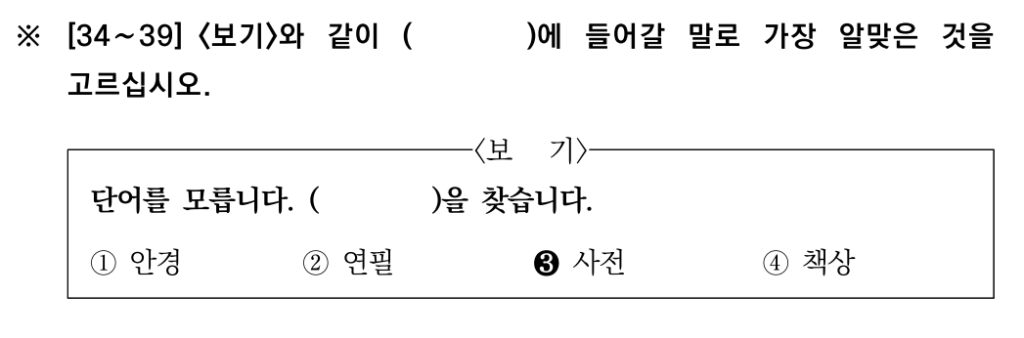
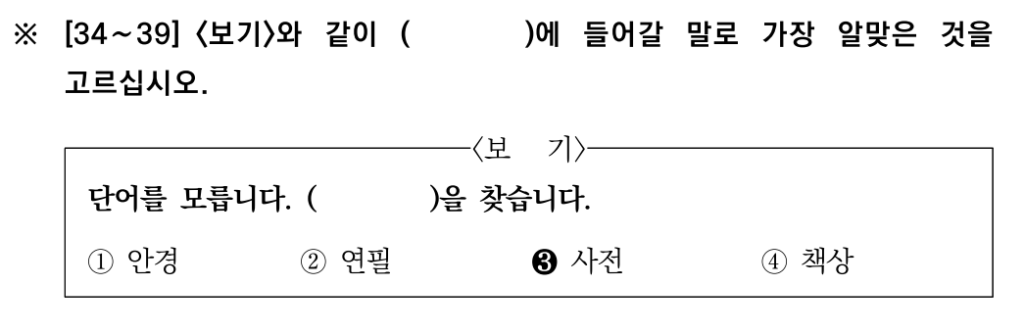
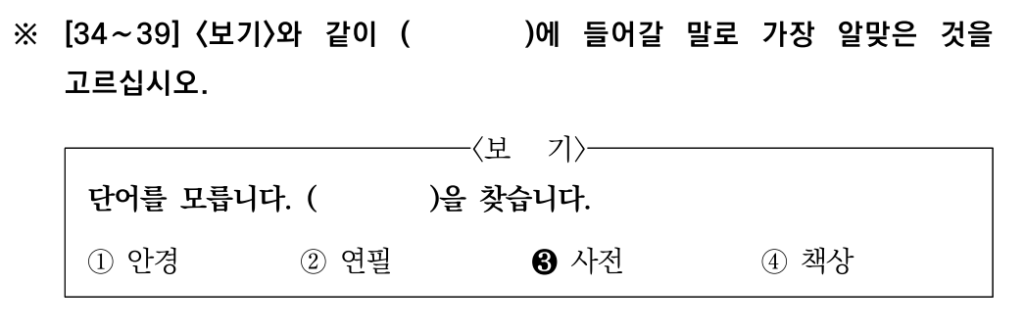
Questions 34–39 give you two short sentences with one blank. Verbs are the most common answer here, so this type is very important. Each TOPIK I reading question is worth 2 points.

Try each one first, then open the answer to check.

① Remember just one thing

Korean uses fixed “partner verbs.”
Some nouns always go with one verb. e.g. 사진을 → 찍다 (take a photo).
And if there is no clear pair, read the other sentence for the situation.

② Partner-verb card

When you see this noun…Use this partner verb
사진을 (a photo)찍다 (take a photo)
춤을 (a dance)추다 (dance)
노래를 (a song)부르다 (sing)
전화를 (a phone call)하다 (make a call)
약을 (medicine)먹다 (take medicine)
책을 (a book)읽다 (read) · 보다 (read/look at)
영화를 (a movie)보다 (watch)
편지를 (a letter)부치다 · 보내다 (send)
선물을 (a gift)주다 (give) · 받다 (receive)

📌 No clear pair? Read the other sentence for the situation.

  • Sleep at night → wake up in the morning
  • tired → rest
  • not here yet → wait

Practice: TOPIK I reading verb blanks

Try each TOPIK I reading question first.

Read the two sentences, choose the verb, then open the box to check.

Question 1

생일 파티입니다. 우리는 사진을 (       ).

① 삽니다② 찍습니다③ 읽습니다④ 만납니다


🔽 See the answer (Question 1)

Q: 생일 파티입니다. 우리는 사진을 ( ). (It is a birthday party. We ( ) photos.) 👉 What verb goes with “사진을 (photos)”?

A: ✅② 찍습니다 → In Korean, photos go with “찍다 (take)”.

① 사다 = to buy.

③ 읽다 = to read (books).

④ 만나다 = to meet (people).


💡 Tip: 사진 (photo) always goes with 찍다! (English says “take,” but learn the Korean pair.)


Question 2

저는 음악을 좋아합니다. 매일 노래를 (     ).

① 봅니다② 씁니다③ 부릅니다④ 탑니다


🔽 See the answer (Question 2)

Q: 저는 음악을 좋아합니다. 매일 노래를 ( ). (I like music. Every day I ( ) songs.) 👉 What verb goes with “노래를 (songs)”?

A: ✅③ 부릅니다 → A song goes with “부르다 (sing)”.

① 보다 = to watch / see.

② 쓰다 = to write.

④ 타다 = to ride (a bus).


💡 Tip: 노래 (song) → 부르다 (sing)!


Question 3

밤 열한 시에 잡니다. 아침 여섯 시에 (      ).

① 삽니다② 옵니다③ 일어납니다④ 입습니다


🔽 See the answer (Question 3)

Q: 밤 열한 시에 잡니다. 아침 여섯 시에 ( ). (I sleep at 11 pm. At 6 am I ( ).) 👉 Other sentence: “잡니다 (sleep)”.

A: ✅③ 일어납니다 → After sleeping, in the morning you “일어나다 (wake up)”.

① 사다 = to buy.

② 오다 = to come.

④ 입다 = to wear.


💡 Tip: 자다 (sleep) ↔ 일어나다 (wake up). Read the other sentence!


Question 4

오늘 아주 피곤합니다. 그래서 집에서 (      ).

① 쉽니다② 됩니다③ 찾습니다④ 자릅니다


🔽 See the answer (Question 4)

Q: 오늘 아주 피곤합니다. 그래서 집에서 ( ). (I am very tired today. So at home I ( ).) 👉 Other sentence: “피곤합니다 (tired)”.

A: ✅① 쉽니다 → When you are tired, you “쉬다 (rest)”.

② 되다 = to become.

③ 찾다 = to find / look for.

④ 자르다 = to cut.


💡 Tip: 피곤하다 (tired) → 쉬다 (rest)!


Question 5

배가 아픕니다. 그래서 약을 (      ).

① 봅니다② 먹습니다③ 만납니다④ 씁니다


🔽 See the answer (Question 5)

Q: 배가 아픕니다. 그래서 약을 ( ). (My stomach hurts. So I ( ) medicine.) 👉 What verb goes with “약을 (medicine)”?

A: ✅② 먹습니다 → In Korean, medicine goes with “먹다 (take/eat)”.

① 보다 = to watch.

③ 만나다 = to meet.

④ 쓰다 = to write / to wear.


💡 Tip: 약 (medicine) → 먹다! (Even liquid medicine uses 먹다 in Korean.)


Question 6

오늘은 제 생일입니다. 친구들을 집에 (      ).

① 초대합니다② 가르칩니다③ 구경합니다④ 좋아합니다


🔽 See the answer (Question 6)

Q: 오늘은 제 생일입니다. 친구들을 집에 ( ). (Today is my birthday. I ( ) my friends to my house.) 👉 Other sentence: “생일 (birthday)”.

A: ✅① 초대합니다 → On your birthday, you “초대하다 (invite)” friends.

② 가르치다 = to teach.

③ 구경하다 = to look around / go sightseeing.

④ 좋아하다 = to like.


💡 Tip: 생일 (birthday) + 친구 (friends) → 초대하다 (invite)!


Question 7

친구가 아직 안 왔습니다. 그래서 친구를 (      ).

① 입니다② 보냅니다③ 기다립니다④ 가르칩니다


🔽 See the answer (Question 7)

Q: 친구가 아직 안 왔습니다. 그래서 친구를 ( ). (My friend has not come yet. So I ( ) my friend.) 👉 Other sentence: “아직 안 왔습니다 (not come yet)”.

A: ✅③ 기다립니다 → If someone has not come, you “기다리다 (wait)”.

① 이다 = to be.

② 보내다 = to send.

④ 가르치다 = to teach.


💡 Tip: 아직 안 왔습니다 (not here yet) → 기다리다 (wait)!


Question 8

동생은 춤을 좋아합니다. 춤을 아주 잘 (      ).

① 씁니다② 춥니다③ 탑니다④ 칩니다


🔽 See the answer (Question 8)

Q: 동생은 춤을 좋아합니다. 춤을 아주 잘 ( ).
(My sibling likes dancing. He/she ( ) very well.)
👉 What verb goes with “춤을 (a dance)”?

A: ✅ ② 춥니다 → A dance goes with “추다”.

① 쓰다 = to write.

③ 타다 = to ride.

④ 치다 = to play (piano/guitar) / to hit.


💡 Tip: 춤 (dance) → 추다! (추다 is used only for dancing.)

③ How to memorize the verbs easily

Now you have practiced, here is the fastest way to grow your TOPIK I reading vocabulary.

  1. Learn noun + verb as a pair. (사진–찍다, 춤–추다, 노래–부르다) Not one by one.
  2. Watch out — the pair is different from English! English says “take a photo,” but Korean says 사진을 찍다.
  3. Read the OTHER sentence for the situation. (tired → rest / not here yet → wait)
  4. Quiz yourself. See a noun, and say the verb. (사진을 → ?)

🤖Practice with AI: a Korean speaking game

You can practice TOPIK I reading alone with AI — and grow your Korean speaking too!
First, turn on the AI’s voice (read-aloud).
Then answer out loud in Korean, not by typing. The game is played only in Korean.

🗣️ “Let’s play a Korean partner-verb speed game. Please speak only in Korean slowly during the game — no English. You say a noun in Korean (for example: 사진을), and I answer the partner verb in Korean out loud (for example: 찍습니다). Give me 10 quickly, then tell me my score in Korean. Use only beginner words.”
⚠️ AI can make mistakes. Always check with real past exams at the end. AI is for practice; the past exams are the answer key.

Summary

  • Korean has fixed partner verbs — learn noun + verb as a pair.
  • No clear pair? Read the other sentence for the situation.
  • Remember: the Korean pair can be different from English (take a photo → 사진을 찍다).

Well done! Keep practicing, and you can all pass TOPIK Level 2. 🎉
Have a question? Please leave a comment.

See you in the next lesson!

📢 want to practice TOPIKⅠ Listening next? 👉 [ TOPIKⅠ Listening ] 

<FAQ>

Q: What are TOPIK I reading questions 34–39?

A: They ask you to fill a blank with the right word — a particle, noun, verb, adjective, or adverb. Each question is worth 2 points.

Q: How do I choose the right verb for the blank?

A: Look at the object noun and use its partner verb (사진을 → 찍다). If there is no clear pair, read the other sentence for the situation (tired → rest).

Q: Why is the Korean verb different from English?

A: Korean uses fixed “partner verbs.” English says “take a photo,” but Korean says 사진을 찍다. Learn the Korean pair as one set.

1 Simple Rule: Korean Place Particles -에 vs -에서 (Easy Guide)

Korean place particles

📌 한국말로 공부하고 싶어요? 👉 [한국어]

Hi! Let me guess. You wrote something like

“저는 학교 공부해요.”

You felt good about it. And then your teacher (or your app) said: “Almost! It should be -에서.”

And you thought: “But… they’re BOTH after 학교! They’re both places! Why?!” 😤

If that’s you, take a breath. You’re not bad at Korean — this is genuinely one of the most confusing things for beginners.

In this guide, we will learn about Korean place particles -에 vs -에서 and how to use them easily.

And today, in about three minutes, that confusion is going to disappear. Let’s do it. 😊

(New here? A “particle” is a tiny word added after a noun. In Korean, particles do the job of English words like “at, in, to.”)


The one question that fixes everything

Here’s the secret.

Whenever you’re stuck between -에 and -에서, don’t think about grammar rules.

Just ask yourself one question:

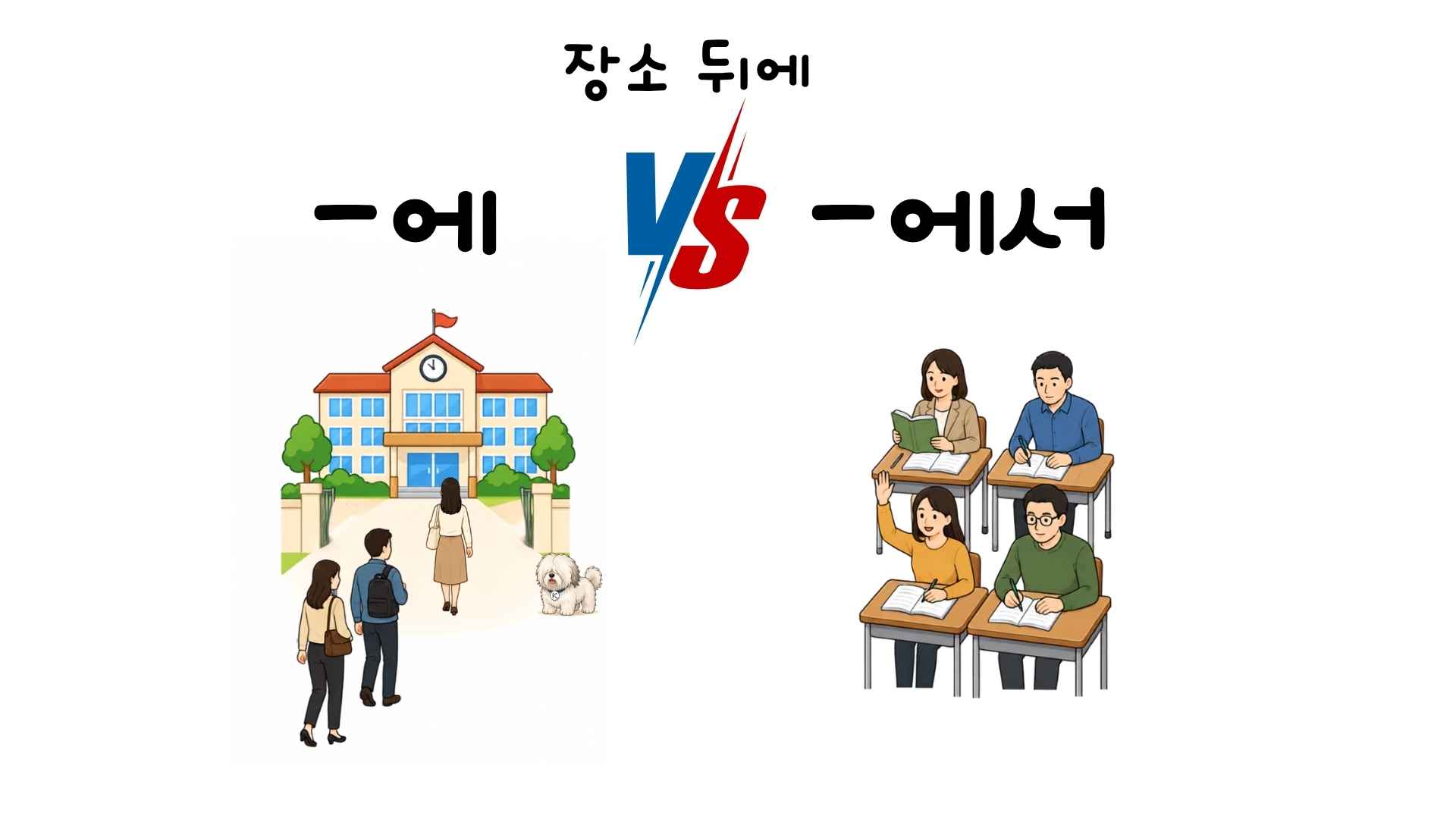
📍 “Am I just AT the place, or GOING to it?” → -에 (e)

🏃 “Am I DOING something at the place?” → -에서 (eseo)

That’s it. That’s the whole trick.

Everything below is just showing you why this works — and once you see it, you won’t forget it.


📍 Korean place particles: When to use -에

Sometimes you’re not doing anything at a place. You’re simply there, or you’re on your way there. That’s ‘-에’.

It comes in two cases:

① Where something IS / ISN’T (existence, location) 👉 –에 + 있다 / 없다

  • 앤디가 한국 있어요. — Andy is in Korea.
  • 우유가 냉장고 없어요. — There’s no milk in the fridge.

② Where you’re GOING / COMING / ATTENDING (destination) 👉 –에 + 가다 / 오다 / 다니다

  • 학교 가요. — I go to school.
  • 와요. — I come home.
  • 학교 다녀요. — I attend school.

💡 다니다 = to go somewhere regularly (school, work, church). It’s about going, so → 에.

⚠️ Careful! 다니다 is only for places you go to on a regular schedule — 학교에 다녀요 (school), 회사에 다녀요 (work). You can’t use it for your own home or room. ❌ 집에 다녀요 / ❌ 방에 다녀요 don’t work, because your home isn’t a place you “attend.” For home, just use 가다/오다 → 집에 가요, 집에 와요.


🏃 -에서 — something is HAPPENING here

This is another essential rule for Korean place particles. Now picture a place full of action.

Eating. Studying. Playing. Meeting.

When stuff is happening at a place, that’s 에서.

  • 학교에서 공부해요. — I study at school. (action: studying!)
  • 식당에서 밥을 먹어요. — I eat at a restaurant. (action: eating!)
  • 운동장에서 축구를 해요. — I play soccer on the field. (action: playing!)
  • 카페에서 친구를 만나요. — I meet a friend at a café. (action: meeting!)

Feel the difference?

These places are busy. Something is going on. 👉 Any action — 공부하다, 먹다, 만나다, 하다 — grabs 에서.


Here’s the “아하! aha!” moment

Ready for the part that makes it all click?

Watch the exact same place — 학교 — change its particle:

SentenceWhat’s happening?Particle
저는 학교 가요Not there yet — I’m heading to the place
저는 학교 있어요Nothing — I’m just there
저는 학교에서 공부해요I’m doing something (studying)에서

So the place was never the point. The particle isn’t about the place — it’s about what you’re DOING there. 🤯

That’s the thing nobody told you. Once you see it, you can’t unsee it.


⚠️ The one trap that catches everyone

Okay, one warning — because this is where even good students slip. This trap happens often when learning Korean place particles.

있다 (to be) and 없다 (to not be) FEEL like actions, right? Like you’re “doing” being-there.

But nope! — they just mean something exists in a place.

So they take –, not -에서.

There’s a student in the classroom.

교실 학생이 있어요. ⭕

교실에서 학생이 있어요. ❌

Burn this one into your memory: 📢 있다 · 없다 → always 에.


Can you fix these?

Each sentence below is wrong. Can you feel why?

Wrong ❌Why?Correct ⭕
저는 학교에서 있어요있다 = just being there → 에저는 학교 있어요
냉장고에서 우유가 있어요있다 = just being there → 에냉장고 우유가 있어요
운동장 축구를 해요하다 = action! → 에서운동장에서 축구를 해요
식당 밥을 먹어요먹다 = action! → 에서식당에서 밥을 먹어요

Your turn — trust the question!

Fill in or 에서. Before each one, ask: am I just there, or doing something?

  1. 저는 집___ 있어요. (I ___ at home.)
  2. 저는 집___ 밥을 먹어요. (I eat ___ home.)
  3. 친구가 한국___ 살아요. (My friend lives ___ Korea.)
  4. 학생들이 교실___ 공부해요. (Students study ___ the classroom.)
  5. 저는 내일 학교___ 가요. (I go ___ school tomorrow.)

How many did you get?

If you missed one, don’t worry — just ask “the question” again and it’ll make sense. 💪


Just remember this!

Mastering Korean place particles (-에 vs -에서) takes a bit of practice, but keeping this simple rule in mind will help you every time!

Ask yourself…ParticleExample
Am I just there? (있다/없다)-에 있어요
Am I going / coming? (가다/오다/다니다)-에학교 가요
Am I doing something?-에서식당에서 밥을 먹어요

📢 One line to rule them all:

Just being there or going →

Doing something there → 에서

Good job!

Hope this guide makes Korean place particles crystal clear for you!

Have a question? Please leave a comment.

See you in the next lesson!

📢 Want to practice TOPIKⅠ next? 👉 [ TOPIKⅠ Practice ] 

TOPIK Ⅰ Reading [34–39] ①: Noun (Place & Object) Blanks

TOPIK I Reading

📌 Prefer to read in Korean? 한국어로 공부하고 싶어요? 👉 [한국어로 배워요!]

Welcome! 😊

In TOPIK Ⅰ Reading, questions 34–39 ask you to fill in the blank.
Each question is worth 2 points.

These TOPIK Ⅰ Reading questions mix different word types — particles, nouns, verbs, adjectives, and adverbs. So we will study them one type at a time. Today is the first type: noun blanks — especially places and objects.

Try each question first, then open the answer to check.

① Remember just one thing

If the blank is a place or a thing, read the other sentence first.
The activity in that sentence tells you the answer.
e.g. “책을 삽니다 (I buy books)” → Where do you buy books? → 서점 (bookstore)!

② Place & object card

When you see this activity…The answer is this place / thing
돈을 찾다 (get money)은행 (bank)
밥을 먹다 (eat a meal)식당 (restaurant)
책을 사다 (buy books)서점 (bookstore)
책을 빌리다 (borrow books)도서관 (library)
편지·소포를 보내다 (send a letter/parcel)우체국 (post office)
약을 사다 (buy medicine)약국 (pharmacy)
영화를 보다 (watch a movie)극장 (theater)
공부하다 (study)학교 (school)
아프다 (be sick)병원 (hospital)
비가 오다 (it rains) → thing우산 (umbrella)
눈이 나쁘다 (bad eyesight) → thing안경 (glasses)

Practice: TOPIK Ⅰ Reading noun blanks

Try each TOPIK Ⅰ Reading question first.


Read the two sentences, choose the answer, then open the box to check.

Question 1

(       )에 갑니다. 돈을 찾습니다.

① 학교② 은행③ 극장④ 식당


🔽 See the answer (Question 1)

Q: ( )에 갑니다. 돈을 찾습니다. (I go to the ( ). I get money.) 👉 The other sentence: “돈을 찾습니다 (get money)”.

A: ✅② 은행 (bank) → You get money at the bank!

① 학교 (school) = a place to study.

③ 극장 (theater) = a place to watch movies.

④ 식당 (restaurant) = a place to eat.

💡 Tip: get / put money → 은행 (bank)!


Question 2

점심시간입니다. (       )에서 밥을 먹습니다.

① 은행② 서점③ 식당④ 약국


🔽 See the answer (Question 2)

Q: 점심시간입니다. ( )에서 밥을 먹습니다. (It is lunchtime. I eat at the ( ).) 👉 The other sentence: “밥을 먹습니다 (eat a meal)”.

A: ✅③ 식당 (restaurant) → You eat at a restaurant!

① 은행 (bank, money) / ② 서점 (bookstore, books) / ④ 약국 (pharmacy, medicine) = not a place to eat.

💡 Tip: eat a meal → 식당 (restaurant)!


Question 3

(       )에 갑니다. 책을 빌립니다.

① 도서관② 시장③ 공항④ 병원


🔽 See the answer (Question 3)

Q: ( )에 갑니다. 책을 빌립니다. (I go to the ( ). I borrow books.) 👉 The other sentence: “책을 빌립니다 (borrow books)”.

A: ✅① 도서관 (library) → You borrow books at the library!

② 시장 / ③ 공항 / ④ 병원 = not a place to borrow books.

💡 Tip: BUY books → 서점 (bookstore) / BORROW books → 도서관 (library)! (Don’t mix them up.)


Question 4

머리가 아픕니다. (       )에서 약을 삽니다.

① 약국② 학교③ 극장④ 우체국


🔽 See the answer (Question 4)

Q: 머리가 아픕니다. ( )에서 약을 삽니다. (I have a headache. I buy medicine at the ( ).) 👉 The other sentence: “약을 삽니다 (buy medicine)”.

A: ✅① 약국 (pharmacy) → You buy medicine at a pharmacy!

② 학교 / ③ 극장 / ④ 우체국 = not a place to buy medicine.

💡 Tip: buy medicine → 약국 (pharmacy)!


Question 5

비가 많이 옵니다. 그래서 (       )을 씁니다.

① 지갑② 안경③ 우산④ 사전


🔽 See the answer (Question 5)

Q: 비가 많이 옵니다. 그래서 ( )을 씁니다. (It is raining a lot. So I use a ( ).) 👉 The other sentence: “비가 옵니다 (it rains)”.

A: ✅③ 우산 (umbrella) → When it rains, you use an umbrella!

① 지갑 / ② 안경 / ④ 사전 = not for rain.

💡 Tip: it rains → 우산 (umbrella)!


Question 6

눈이 나쁩니다. 그래서 (       )을 씁니다.

① 모자② 안경③ 시계④ 가방


🔽 See the answer (Question 6)

Q: 눈이 나쁩니다. 그래서 (       )을 씁니다. (My eyes are bad. So I wear ( ).) 👉 The other sentence: “눈이 나쁩니다 (bad eyes)”.

A: ✅② 안경 (glasses) → If your eyes are bad, you wear glasses!

① 모자 / ③ 시계 / ④ 가방 = not for your eyes.

💡 Tip: The verb “쓰다” works for umbrella, glasses, AND hat. So don’t look only at “쓰다” — look at the situation: is it rain? or bad eyes?


Question 7

(       )에서 영화를 봅니다. 아주 재미있습니다.

① 극장② 은행③ 서점④ 병원


🔽 See the answer (Question 7)

Q: ( )에서 영화를 봅니다. 아주 재미있습니다. (I watch a movie at the ( ). It is very fun.) 👉 The other sentence: “영화를 봅니다 (watch a movie)”.

A: ✅① 극장 (theater) → You watch movies at a theater!

② 은행 / ③ 서점 / ④ 병원 = not a place to watch movies.

💡 Tip: watch a movie → 극장 (theater)!


Question 8

편지를 씁니다. (       )에서 부칩니다.

① 시장② 우체국③ 학교④ 식당


🔽 See the answer (Question 8)

Q: 편지를 씁니다. ( )에서 부칩니다. (I write a letter. I send it at the ( ).) 👉 The other sentence: “편지를 부칩니다 (send a letter)”.

A: ✅② 우체국 (post office) → You send letters at the post office!

① 시장 / ③ 학교 / ④ 식당 = not a place to send letters.

💡 Tip: send a letter / parcel → 우체국 (post office)!

③ How to memorize the words easily

Now you have practiced, here is the fastest way to grow your TOPIK Ⅰ Reading vocabulary.

  1. Learn activity ↔ place as pairs. (buy books–bookstore, buy medicine–pharmacy) Not one by one.
  2. For each place, say one sentence: “What do you do there?” (bank → “I get money.”)
  3. Read the OTHER sentence first. Look at the sentence without the blank first.
  4. Quiz yourself. See an activity, and say the place. (eat a meal → ?)

🤖Practice with AI

You can practice TOPIK Ⅰ Reading alone with AI.— and grow your Korean speaking too!
This drill trains the main skill of this type: reading the activity and finding the place.
Copy the message below and send it to an AI (like ChatGPT or Claude).

or turn on the AI’s voice (read-aloud). Then answer out loud in Korean. The game is played only in Korean.

🗣️“Please give me a place quiz. Use only in Korean during the game — no English. Give me an activity (for example, ‘책을 삽니다’), and I will say the place (for example, ‘서점’). Then tell me if I am right in Korean. Please keep going with beginner place words.”

⚠️ AI can make mistakes. Always check with real past exams at the end. AI is for practice; the past exams are the answer key.

Summary

  • If the blank is a place or a thing, read the other sentence first.
  • The activity tells you the answer. (buy books → bookstore)
  • For verbs like “쓰다” used in many ways, decide by the situation.

Well done!
Keep practicing, and you can all pass TOPIK Level 2. 🎉
Have a question? Please leave a comment.

See you in the next lesson!

📢 want to practice TOPIKⅠ Listening next? 👉 [ TOPIKⅠ Listening ] 

FAQ

Q: What are TOPIK I reading questions 34–39?

A: You fill a blank with the right word — a particle, noun, verb, adjective, or adverb. Each question is worth 2 points.

Q: How do I choose the right place or object?

A: Read the other sentence. Its activity tells you the answer (책을 삽니다 / buy books → 서점 / bookstore).

Q: Why can the verb 쓰다 have different answers?

A: 쓰다 works for umbrella, glasses, and hat. Don’t pick by the verb alone — decide by the situation (rain? or bad eyes?).

Why Do Koreans Ask your Age When You First Meet?

ask age
💡 한국어로 읽고 싶어요? 👉 [ 여기에서 쉬운 한국어로 읽어 보세요! ]

Welcome! 😃

Let me ask a question first. If you watch Korean dramas, you have probably seen this. Two people meet for the first time. And right after saying hello, one of them asks:

“How old are you, if you don’t mind?”

Why do Koreans ask age when you first meet? For a Korean learner, this can feel a little strange.

“Why do they want to know my age already? Isn’t that rude?”

But there is an interesting secret behind ask age. Let me tell you the story.

Don’t worry — at first, you don’t need to know

Let’s start with the most reassuring part.

When you meet someone for the first time, you don’t need to know their age. Before you ask age, Remember the polite speech from our earlier stories, like “안녕하세요? (an-nyeong-ha-se-yo?)” With someone you just met — older or younger — you can simply use polite speech (존댓말, jon-daen-mal).

💡If you want to see the previous post, 👉 [ Click here ] 

That is always safe.

  • Someone who looks younger than you → polite speech
  • Someone who looks about your age → polite speech
  • Someone who looks older than you → polite speech

So you don’t have to worry, “I can’t talk to them because I don’t know their age.” Polite speech works for everyone at the start.

So when does age matter?

Then why do Korean people ask age so often? Age becomes important not at the first meeting, but a little later, once you get closer.

Think about English. The word you stays the same whether the person is 5 or 80.

Korean is a little different. After you become close, the ending of your sentences and the way you call each other can change.

🙇‍♂️ Keep polite speech "어디 가세요?(eo-di ga-se-yo?)" — (Where are you going?)
🙋‍♂️Or switch to casual speech "어디 가?(eo-di ga?)"— (Where are you going?)

So age is not really about “I’m curious how old you are.” It helps answer, “Should we keep using polite speech, or can we speak casually now?” And even then, age is not the only thing that matters. It is just one of many.

If you want to know a title, ask this — not their age

Korean also has special words to call someone. Among close people, you might call someone a little older than you:

  • 오빠 (oppa) — a woman calling an older man
  • 형 (hyeong) — a man calling an older man
  • 언니 (eonni) — a woman calling an older woman
  • 누나 (nuna) — a man calling an older woman

But here’s the thing: you don’t call someone “오빠” or “언니” just because they’re older, right after meeting them. These words are for people you’ve already become close to.

So when you’re not sure how to address someone, there’s a better question than to ask age:

“제가 어떻게 불러 드리면 될까요? (je-ga eo-tteo-ke bul-leo deu-ri-myeon dwael-kka-yo?)”

“What should I call you?”

This one sentence is very handy. It doesn’t ask the person to reveal their age, but it tells you exactly what you want to know. And if you’re still unsure, just saying “○○ 씨 (ssi)” with their name is always safe.

Same age? It’s easy to become friends

There’s a fun case, too — when you’re the same age. When two people learn they are the same age, it feels friendly. So they might say, “Oh, we’re the same age! Should we speak casually?” They stop using polite speech and start speaking comfortably.

This is called “말을 놓다(Mal-eul no-da)” or “말을 트다(Mal-eul teu-da)”

But remember one thing. Being the same age doesn’t mean you can just start using casual speech. Casual speech begins not because of age, but because both people agree to it.

So they ask:

괜찮으면 우리 말 놓을까요? (gwaen-cha-neu-myeon u-ri mal no-eul-kka-yo?)”

“If it’s okay, shall we speak casually?”

When both people say “yes”, that’s when the comfortable friendship begins.

🔎 Wait — what about Korean age?

The official age is your international age.

But to check if you’re the same age, people often ask

몇 년생이에요? (myeot nyeon-saeng-i-e-yo?)”

— “What year were you born?”

You might be wondering why Koreans ask the year instead of the age. There’s an interesting reason.

In the past, Korea had its own way of counting age. A baby was already counted from the moment the mother became pregnant — so when the baby was born, they were already one year old. Because of this, Korean age was usually one or two years higher than international age.

But in 2023, this old system was officially dropped. Now everyone officially uses their international age. Still, the old Korean-age culture hasn’t fully disappeared from daily life. That’s why, to be more exact, many people ask what year you were born — “몇 년생이에요? (myeot nyeon-saeng-i-e-yo?)” — rather than age.

But is it okay to ask?

Here is something important to know. Don’t simply memorize, “In Korea, it’s fine to ask someone’s age.”

The truth is, not every Korean feels comfortable with the age question either. When it’s fairly natural

  • After you’ve talked enough and become comfortable with each other
  • When the other person brings up their age or birth year first
  • In a group of peers, where age really matters for the group

When it’s better to be careful

  • Asking it as your very first question, right after hello
  • At work, or in a formal setting
  • When the person avoids the answer or looks uncomfortable

So instead of treating “asking age” as a rule, it’s better to first check whether the other person feels okay with it.

That said, don’t be too surprised if an older person on the street asks your age as their very first question. Asking about age is one of Korea’s old traditions, and for many older Koreans, it feels completely natural. It’s not meant to be rude — it’s often just their way of figuring out how to talk to you.😉

If you don’t want to share your age

On the other hand, someone asks your age — but you’d rather not say. You can gently reply:

  • 조금 더 친해지면 말씀드릴게요. (jo-geum deo chi-nae-ji-myeon mal-sseum-deu-ril-ge-yo.) — “I’ll tell you once we’re a bit closer.”
  • 그냥 ○○ 씨라고 불러 주세요. (geu-nyang ○○ ssi-ra-go bul-leo ju-se-yo.)” — “Just call me by my name.”

Saying this is not rude at all. You also have the freedom not to share your age.

One last thing

In Korea, people ask age for many reasons. Sometimes to choose the right speech and title, sometimes to see if you’re the same age, and sometimes just out of curiosity. That feeling isn’t always a bad thing.

Often, there’s a warm wish behind it: “I’d like to get a little closer to you.” But it’s also good to remember that not everyone in Korea enjoys this question. So if you keep these three things in mind, you’ll be safe:

  1. At first, you don’t need their age — just use polite speech.
  2. If you want to know a title, ask “What should I call you?” instead of their age.
  3. Casual speech begins with agreement, not age.

Know these three, and the Korean habit of asking age will feel easy to understand.

In your country, is it rude or normal to ask someone’s age when you first meet? Tell me in the comments. I would love to know.🥰


📝 Just remember this

SituationThe safe choice
Someone you just metPolite speech first, no matter their age
Someone older than youUsually polite speech
A close older friend오빠 / 형 / 언니 / 누나, depending on the relationship
Someone the same ageCasual speech, if you both agree
When you don’t know how to address them“What should I call you?”
When you’d rather not share your age“I’ll tell you once we’re closer”

One-line takeaway: Age can shape speech and titles, but if you’ve just met, polite speech comes before age.


Okay! Well done! If you enjoyed this post, you’ll love my next one too! See you again soon!

Read more 👉 Why Does Korean "Hello" Have a Question Mark? 

<Latest Posts>

Why Does Korean “Hello” Have a Question Mark? (1 Secret)

Korean Hello
📌 한국어가 쉬워요? 여기를 보세요.👉 [한국어 blog]

Hello? Bonjour? Hola? 你好? السلام عليكم? नमस्ते? Здравствуйте?

Does the greeting in your language have a question in it? How do you say Hello in Korean?

You say “안녕하세요?” (an-nyeong-ha-se-yo?), right?

But look closely — there is a question mark (?) at the end. Open any Korean textbook, and it is always there.

Korean Hello

So why does the “Korean Hello” sound like a question? Let me tell you a little story.

What does Korean Hello “안녕?” really mean?

When learning Korean Hello “안녕(an-nyeong)?“, Most students never even notice this little question mark — but once you do, the first question is simple: what does “안녕” actually mean?

안녕 (安寧)” comes from Chinese characters. A long time ago, before King Sejong created Hangul, Korean people spoke Korean but wrote with Chinese characters. Even today, many Korean words still come from them. (We’ll talk more about this in another story.)

They mean a state of being calm and safe, with nothing wrong.” In English, it is close to “peace or well-being“.

So if we translate “안녕하세요?” word by word, it sounds like this:

“Are you at peace? Are you doing well, with nothing wrong?”

Is it the same as “How are you?” then? Almost.

In Korean, “How are you?” is usually “잘 지내세요?” (jal- ji-nae-se-yo?).

When you add a “question mark(?)” to the greeting “안녕하세요”, it becomes a soft way of asking about someone. If you really want to ask how they are, you write “안녕하세요?“. If it is just a light hello, you write “안녕하세요.

And honestly, when you speak, the sound matters more than the mark. Raise your voice a little at the end, and it feels like a question. Keep it flat, and it feels like a greeting.

Wait — Why do Korean keep asking about my life?

When you come to Korea, you will hear these too:

“밥 먹었어요?” (bap meo-geos-seo-yo?)Did you eat?

“어디 가세요?” (eo-di ga-se-yo?)Where are you going?

At first, this can feel strange.

Why do they want to know if I ate, or where I am going?”

But Korean people are not really trying to look into your private life. These are like cousins of “안녕하세요?”.

It is closer to a warm “You doing okay? Nothing wrong?”

Why do Koreans ask if you are okay?

Here comes the old story.

Long ago in Korea, neighbors lived close together and helped each other. They farmed together, and they got through hard times together.

Because of where Korea sits on the map, it was invaded by other countries many times through history. So there were many poor and hungry years. In times of war, or when people were dying of hunger, the first thing you wondered each morning was simple: Is my neighbor safe? Did anything bad happen in the night?

So when people met, they greeted each other like this:

“Are you at peace? Are you doing well?”
“You are not going hungry, are you?”

In years when many people were hungry, “밥 먹었어요? (Did you eat?)” really meant “Are you okay? Did you get enough to eat?” That caring feeling still lives inside today’s “안녕하세요?”.

Of course, this is not a proven history. But when you think of it this way, doesn’t a simple daily greeting start to feel a little warmer?

So remember just one thing: in Korean, a question-shaped greeting is not really asking for information. It is a way to start a conversation and to check in with each other.

How do I know what these greetings really mean?

It depends on the situation. Take “밥 먹었어? (Did you eat?)”:

  • From an adult or a friend you have not seen in a while → it means How have you been?”
  • Right before a meal time → it might mean “Want to eat together?”
  • After a meal time → it might really be asking if you ate

You can answer simply.

“네, 먹었어요. (Yes, I ate.)” or “아직요. ○○ 씨는요? (Not yet. How about you?)” is enough.

어디 가세요? (Where are you going?)” works the same way.

If you do not want to explain, you can just say “잠깐 볼일 보러 가요. (I’m just going out for a bit.)”

And “안녕하세요?” can feel like “How are you?”, but most of the time you do not need a long answer.

Just saying “안녕하세요?” back is perfect.

Who do I say it to?

When using Korean Hello in daily life, greetings have different levels of politeness.

They change a little depending on who you are talking to.

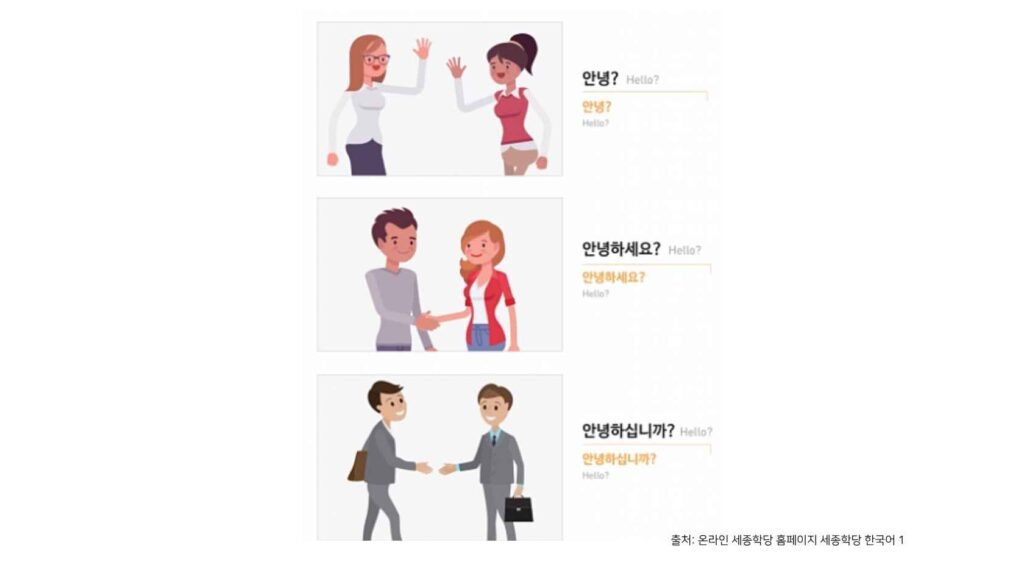
  • 안녕? (an-nyeong?) → a close friend, a child, or someone you already speak casually with
  • 안녕하세요? (an-nyeong-ha-se-yo?) → someone you just met, and most everyday situations (the safest choice)
  • 안녕하십니까? (an-nyeong-ha-sim-ni-kka?) → very formal places, like a presentation, an interview, or an official event

Remember one thing. With a child, “안녕?” feels natural.

But with an adult who looks a little younger than you, or with someone you just met, “안녕하세요?” is the safe choice — no matter their age.

The key is not age. It is your relationship.

One last thing

“안녕하세요?” is not just “Hello”. Inside it is an old, kind wish: I hope you are doing well.

So next time you greet someone with “안녕하세요?“, remember this little story. You are greeting them in a very old way, quietly saying:

“I hope you’re doing well today.”

Does “안녕하세요?” make a little more sense now?

So when you meet a Korean person on the street, let’s greet them properly — not just “안녕”, but “안녕하세요?

Does your language have a greeting that looks like a question? Tell me in the comments. I would love to know.🥰

See you again!

💡 Want to study more Korean expressions with detailed explanations? Check This 👉 [Korean culture!]


📝 Just remember this

SituationSay this
A close friend안녕? / 안녕! (annyeong)
Someone you just met, most situations안녕하세요? (annyeonghaseyo — safest)
Presentation, interview, formal event안녕하십니까? (annyeonghasimnikka)

error: Content is protected !!