
📌 Prefer to read in Korean? 한국어로 공부하고 싶어요?👉 [한국어로 배워요!]
Do you keep choosing the wrong verb in TOPIK I reading? 😊
Here is the secret: Korean has fixed “partner verbs.” Some nouns always go with one special verb. Once you know the pairs, these questions become easy!
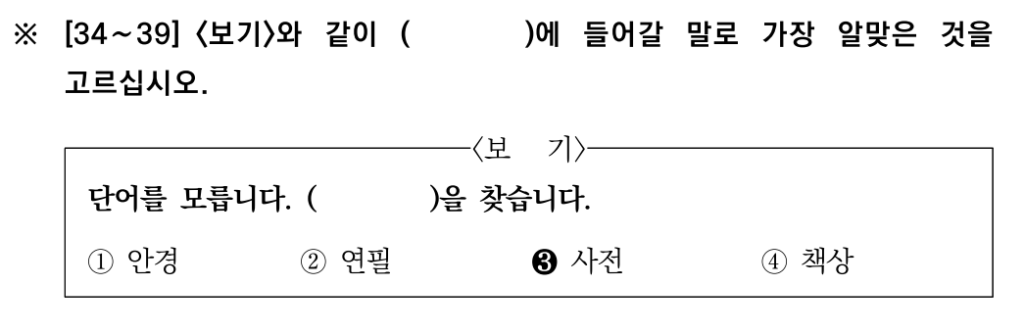
Questions 34–39 give you two short sentences with one blank. Verbs are the most common answer here, so this type is very important. Each TOPIK I reading question is worth 2 points.
Try each one first, then open the answer to check.
① Remember just one thing
Some nouns always go with one verb. e.g. 사진을 → 찍다 (take a photo).
And if there is no clear pair, read the other sentence for the situation.
② Partner-verb card
| When you see this noun… | Use this partner verb |
|---|---|
| 사진을 (a photo) | 찍다 (take a photo) |
| 춤을 (a dance) | 추다 (dance) |
| 노래를 (a song) | 부르다 (sing) |
| 전화를 (a phone call) | 하다 (make a call) |
| 약을 (medicine) | 먹다 (take medicine) |
| 책을 (a book) | 읽다 (read) · 보다 (read/look at) |
| 영화를 (a movie) | 보다 (watch) |
| 편지를 (a letter) | 부치다 · 보내다 (send) |
| 선물을 (a gift) | 주다 (give) · 받다 (receive) |
📌 No clear pair? Read the other sentence for the situation.
- Sleep at night → wake up in the morning
- tired → rest
- not here yet → wait
Practice: TOPIK I reading verb blanks
Try each TOPIK I reading question first.
Read the two sentences, choose the verb, then open the box to check.
Question 1
생일 파티입니다. 우리는 사진을 ( ).
① 삽니다② 찍습니다③ 읽습니다④ 만납니다
🔽 See the answer (Question 1)
Q: 생일 파티입니다. 우리는 사진을 ( ). (It is a birthday party. We ( ) photos.) 👉 What verb goes with “사진을 (photos)”?
A: ✅② 찍습니다 → In Korean, photos go with “찍다 (take)”.
① 사다 = to buy.
③ 읽다 = to read (books).
④ 만나다 = to meet (people).
💡 Tip: 사진 (photo) always goes with 찍다! (English says “take,” but learn the Korean pair.)
Question 2
저는 음악을 좋아합니다. 매일 노래를 ( ).
① 봅니다② 씁니다③ 부릅니다④ 탑니다
🔽 See the answer (Question 2)
Q: 저는 음악을 좋아합니다. 매일 노래를 ( ). (I like music. Every day I ( ) songs.) 👉 What verb goes with “노래를 (songs)”?
A: ✅③ 부릅니다 → A song goes with “부르다 (sing)”.
① 보다 = to watch / see.
② 쓰다 = to write.
④ 타다 = to ride (a bus).
💡 Tip: 노래 (song) → 부르다 (sing)!
Question 3
밤 열한 시에 잡니다. 아침 여섯 시에 ( ).
① 삽니다② 옵니다③ 일어납니다④ 입습니다
🔽 See the answer (Question 3)
Q: 밤 열한 시에 잡니다. 아침 여섯 시에 ( ). (I sleep at 11 pm. At 6 am I ( ).) 👉 Other sentence: “잡니다 (sleep)”.
A: ✅③ 일어납니다 → After sleeping, in the morning you “일어나다 (wake up)”.
① 사다 = to buy.
② 오다 = to come.
④ 입다 = to wear.
💡 Tip: 자다 (sleep) ↔ 일어나다 (wake up). Read the other sentence!
Question 4
오늘 아주 피곤합니다. 그래서 집에서 ( ).
① 쉽니다② 됩니다③ 찾습니다④ 자릅니다
🔽 See the answer (Question 4)
Q: 오늘 아주 피곤합니다. 그래서 집에서 ( ). (I am very tired today. So at home I ( ).) 👉 Other sentence: “피곤합니다 (tired)”.
A: ✅① 쉽니다 → When you are tired, you “쉬다 (rest)”.
② 되다 = to become.
③ 찾다 = to find / look for.
④ 자르다 = to cut.
💡 Tip: 피곤하다 (tired) → 쉬다 (rest)!
Question 5
배가 아픕니다. 그래서 약을 ( ).
① 봅니다② 먹습니다③ 만납니다④ 씁니다
🔽 See the answer (Question 5)
Q: 배가 아픕니다. 그래서 약을 ( ). (My stomach hurts. So I ( ) medicine.) 👉 What verb goes with “약을 (medicine)”?
A: ✅② 먹습니다 → In Korean, medicine goes with “먹다 (take/eat)”.
① 보다 = to watch.
③ 만나다 = to meet.
④ 쓰다 = to write / to wear.
💡 Tip: 약 (medicine) → 먹다! (Even liquid medicine uses 먹다 in Korean.)
Question 6
오늘은 제 생일입니다. 친구들을 집에 ( ).
① 초대합니다② 가르칩니다③ 구경합니다④ 좋아합니다
🔽 See the answer (Question 6)
Q: 오늘은 제 생일입니다. 친구들을 집에 ( ). (Today is my birthday. I ( ) my friends to my house.) 👉 Other sentence: “생일 (birthday)”.
A: ✅① 초대합니다 → On your birthday, you “초대하다 (invite)” friends.
② 가르치다 = to teach.
③ 구경하다 = to look around / go sightseeing.
④ 좋아하다 = to like.
💡 Tip: 생일 (birthday) + 친구 (friends) → 초대하다 (invite)!
Question 7
친구가 아직 안 왔습니다. 그래서 친구를 ( ).
① 입니다② 보냅니다③ 기다립니다④ 가르칩니다
🔽 See the answer (Question 7)
Q: 친구가 아직 안 왔습니다. 그래서 친구를 ( ). (My friend has not come yet. So I ( ) my friend.) 👉 Other sentence: “아직 안 왔습니다 (not come yet)”.
A: ✅③ 기다립니다 → If someone has not come, you “기다리다 (wait)”.
① 이다 = to be.
② 보내다 = to send.
④ 가르치다 = to teach.
💡 Tip: 아직 안 왔습니다 (not here yet) → 기다리다 (wait)!
Question 8
동생은 춤을 좋아합니다. 춤을 아주 잘 ( ).
① 씁니다② 춥니다③ 탑니다④ 칩니다
🔽 See the answer (Question 8)
Q: 동생은 춤을 좋아합니다. 춤을 아주 잘 ( ).
(My sibling likes dancing. He/she ( ) very well.) 👉 What verb goes with “춤을 (a dance)”?
A: ✅ ② 춥니다 → A dance goes with “추다”.
① 쓰다 = to write.
③ 타다 = to ride.
④ 치다 = to play (piano/guitar) / to hit.
💡 Tip: 춤 (dance) → 추다! (추다 is used only for dancing.)
③ How to memorize the verbs easily
Now you have practiced, here is the fastest way to grow your TOPIK I reading vocabulary.
- Learn noun + verb as a pair. (사진–찍다, 춤–추다, 노래–부르다) Not one by one.
- Watch out — the pair is different from English! English says “take a photo,” but Korean says 사진을 찍다.
- Read the OTHER sentence for the situation. (tired → rest / not here yet → wait)
- Quiz yourself. See a noun, and say the verb. (사진을 → ?)
🤖Practice with AI: a Korean speaking game
You can practice TOPIK I reading alone with AI — and grow your Korean speaking too!
First, turn on the AI’s voice (read-aloud).
Then answer out loud in Korean, not by typing. The game is played only in Korean.
🗣️ “Let’s play a Korean partner-verb speed game. Please speak only in Korean slowly during the game — no English. You say a noun in Korean (for example: 사진을), and I answer the partner verb in Korean out loud (for example: 찍습니다). Give me 10 quickly, then tell me my score in Korean. Use only beginner words.”
Summary
- Korean has fixed partner verbs — learn noun + verb as a pair.
- No clear pair? Read the other sentence for the situation.
- Remember: the Korean pair can be different from English (take a photo → 사진을 찍다).
Well done! Keep practicing, and you can all pass TOPIK Level 2. 🎉
Have a question? Please leave a comment.
See you in the next lesson!
📢 want to practice TOPIKⅠ Listening next? 👉 [ TOPIKⅠ Listening ]
<FAQ>
Q: What are TOPIK I reading questions 34–39?
A: They ask you to fill a blank with the right word — a particle, noun, verb, adjective, or adverb. Each question is worth 2 points.
Q: How do I choose the right verb for the blank?
A: Look at the object noun and use its partner verb (사진을 → 찍다). If there is no clear pair, read the other sentence for the situation (tired → rest).
Q: Why is the Korean verb different from English?
A: Korean uses fixed “partner verbs.” English says “take a photo,” but Korean says 사진을 찍다. Learn the Korean pair as one set.