💡 한국어로 읽고 싶어요? 👉 [ 여기에서 쉬운 한국어로 읽어 보세요! ]
Welcome! 😃
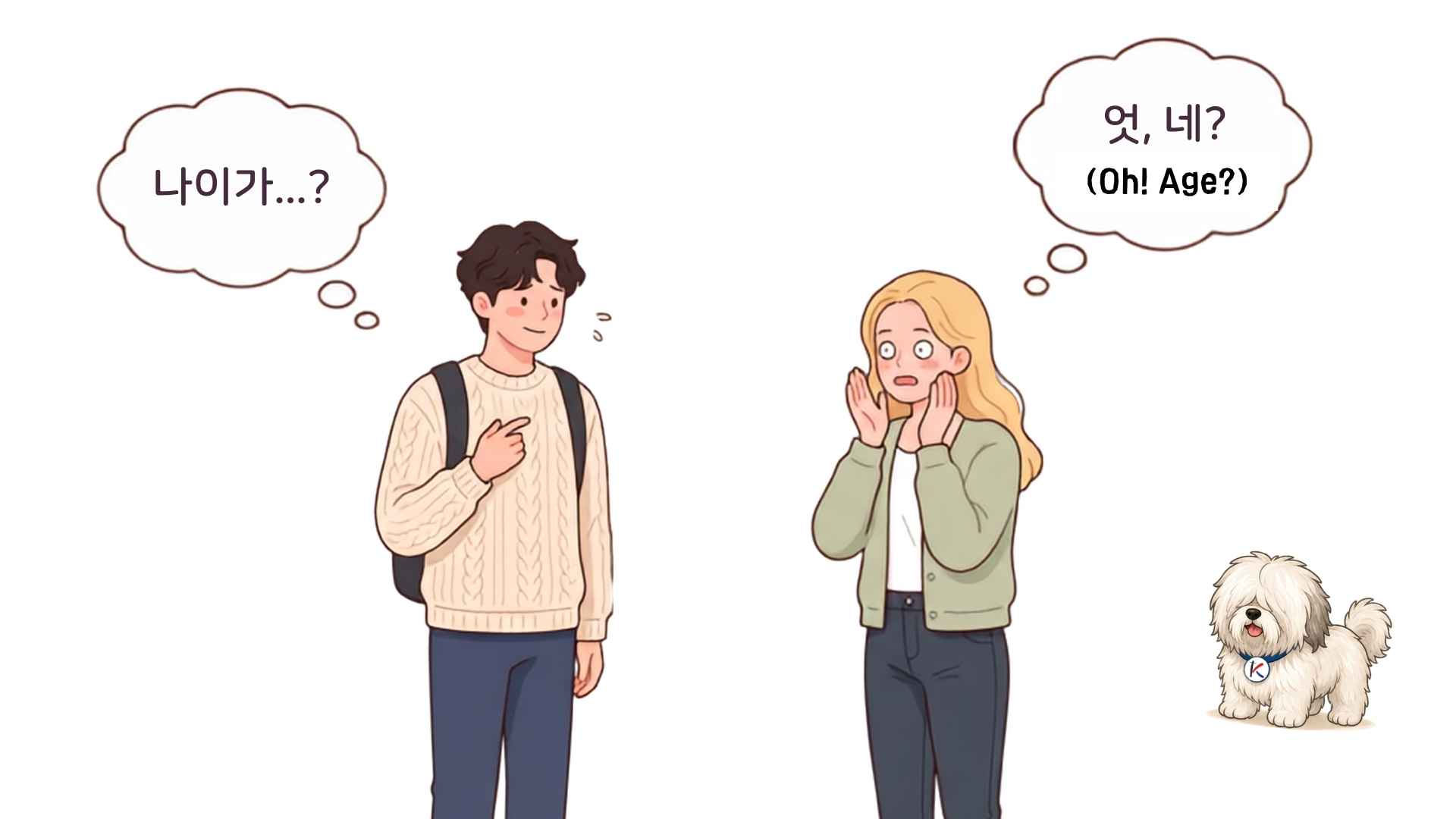
Let me ask a question first. If you watch Korean dramas, you have probably seen this. Two people meet for the first time. And right after saying hello, one of them asks:
“How old are you, if you don’t mind?”
Why do Koreans ask age when you first meet? For a Korean learner, this can feel a little strange.
“Why do they want to know my age already? Isn’t that rude?”
But there is an interesting secret behind ask age. Let me tell you the story.
Don’t worry — at first, you don’t need to know
Let’s start with the most reassuring part.
When you meet someone for the first time, you don’t need to know their age. Before you ask age, Remember the polite speech from our earlier stories, like “안녕하세요? (an-nyeong-ha-se-yo?)” With someone you just met — older or younger — you can simply use polite speech (존댓말, jon-daen-mal).
💡If you want to see the previous post, 👉 [ Click here ]
That is always safe.
- Someone who looks younger than you → polite speech
- Someone who looks about your age → polite speech
- Someone who looks older than you → polite speech
So you don’t have to worry, “I can’t talk to them because I don’t know their age.” Polite speech works for everyone at the start.
So when does age matter?
Then why do Korean people ask age so often? Age becomes important not at the first meeting, but a little later, once you get closer.
Think about English. The word “you“ stays the same whether the person is 5 or 80.
Korean is a little different. After you become close, the ending of your sentences and the way you call each other can change.
🙇♂️ Keep polite speech "어디 가세요?(eo-di ga-se-yo?)" — (Where are you going?)
🙋♂️Or switch to casual speech "어디 가?(eo-di ga?)"— (Where are you going?)
So age is not really about “I’m curious how old you are.” It helps answer, “Should we keep using polite speech, or can we speak casually now?” And even then, age is not the only thing that matters. It is just one of many.
If you want to know a title, ask this — not their age
Korean also has special words to call someone. Among close people, you might call someone a little older than you:
- 오빠 (oppa) — a woman calling an older man
- 형 (hyeong) — a man calling an older man
- 언니 (eonni) — a woman calling an older woman
- 누나 (nuna) — a man calling an older woman
But here’s the thing: you don’t call someone “오빠” or “언니” just because they’re older, right after meeting them. These words are for people you’ve already become close to.
So when you’re not sure how to address someone, there’s a better question than to ask age:
“제가 어떻게 불러 드리면 될까요? (je-ga eo-tteo-ke bul-leo deu-ri-myeon dwael-kka-yo?)”
— “What should I call you?”
This one sentence is very handy. It doesn’t ask the person to reveal their age, but it tells you exactly what you want to know. And if you’re still unsure, just saying “○○ 씨 (ssi)” with their name is always safe.
Same age? It’s easy to become friends
There’s a fun case, too — when you’re the same age. When two people learn they are the same age, it feels friendly. So they might say, “Oh, we’re the same age! Should we speak casually?” They stop using polite speech and start speaking comfortably.
This is called “말을 놓다(Mal-eul no-da)” or “말을 트다(Mal-eul teu-da)”
But remember one thing. Being the same age doesn’t mean you can just start using casual speech. Casual speech begins not because of age, but because both people agree to it.
So they ask:
“괜찮으면 우리 말 놓을까요? (gwaen-cha-neu-myeon u-ri mal no-eul-kka-yo?)”
— “If it’s okay, shall we speak casually?”
When both people say “yes”, that’s when the comfortable friendship begins.
🔎 Wait — what about Korean age?
The official age is your international age.
But to check if you’re the same age, people often ask
“몇 년생이에요? (myeot nyeon-saeng-i-e-yo?)”
— “What year were you born?”
You might be wondering why Koreans ask the year instead of the age. There’s an interesting reason.
In the past, Korea had its own way of counting age. A baby was already counted from the moment the mother became pregnant — so when the baby was born, they were already one year old. Because of this, Korean age was usually one or two years higher than international age.
But in 2023, this old system was officially dropped. Now everyone officially uses their international age. Still, the old Korean-age culture hasn’t fully disappeared from daily life. That’s why, to be more exact, many people ask what year you were born — “몇 년생이에요? (myeot nyeon-saeng-i-e-yo?)” — rather than age.
But is it okay to ask?
Here is something important to know. Don’t simply memorize, “In Korea, it’s fine to ask someone’s age.”
The truth is, not every Korean feels comfortable with the age question either. When it’s fairly natural
- After you’ve talked enough and become comfortable with each other
- When the other person brings up their age or birth year first
- In a group of peers, where age really matters for the group
When it’s better to be careful
- Asking it as your very first question, right after hello
- At work, or in a formal setting
- When the person avoids the answer or looks uncomfortable
So instead of treating “asking age” as a rule, it’s better to first check whether the other person feels okay with it.
That said, don’t be too surprised if an older person on the street asks your age as their very first question. Asking about age is one of Korea’s old traditions, and for many older Koreans, it feels completely natural. It’s not meant to be rude — it’s often just their way of figuring out how to talk to you.😉
If you don’t want to share your age
On the other hand, someone asks your age — but you’d rather not say. You can gently reply:
- “조금 더 친해지면 말씀드릴게요. (jo-geum deo chi-nae-ji-myeon mal-sseum-deu-ril-ge-yo.)“ — “I’ll tell you once we’re a bit closer.”
- “그냥 ○○ 씨라고 불러 주세요. (geu-nyang ○○ ssi-ra-go bul-leo ju-se-yo.)” — “Just call me by my name.”
Saying this is not rude at all. You also have the freedom not to share your age.
One last thing
In Korea, people ask age for many reasons. Sometimes to choose the right speech and title, sometimes to see if you’re the same age, and sometimes just out of curiosity. That feeling isn’t always a bad thing.
Often, there’s a warm wish behind it: “I’d like to get a little closer to you.” But it’s also good to remember that not everyone in Korea enjoys this question. So if you keep these three things in mind, you’ll be safe:
- At first, you don’t need their age — just use polite speech.
- If you want to know a title, ask “What should I call you?” instead of their age.
- Casual speech begins with agreement, not age.
Know these three, and the Korean habit of asking age will feel easy to understand.
In your country, is it rude or normal to ask someone’s age when you first meet? Tell me in the comments. I would love to know.🥰
📝 Just remember this
| Situation | The safe choice |
|---|---|
| Someone you just met | Polite speech first, no matter their age |
| Someone older than you | Usually polite speech |
| A close older friend | 오빠 / 형 / 언니 / 누나, depending on the relationship |
| Someone the same age | Casual speech, if you both agree |
| When you don’t know how to address them | “What should I call you?” |
| When you’d rather not share your age | “I’ll tell you once we’re closer” |
One-line takeaway: Age can shape speech and titles, but if you’ve just met, polite speech comes before age.
Okay! Well done! If you enjoyed this post, you’ll love my next one too! See you again soon!
Read more 👉 Why Does Korean "Hello" Have a Question Mark?
<Latest Posts>