Prefer to study in Korean? 한국어로 읽기 (Read in Korean)
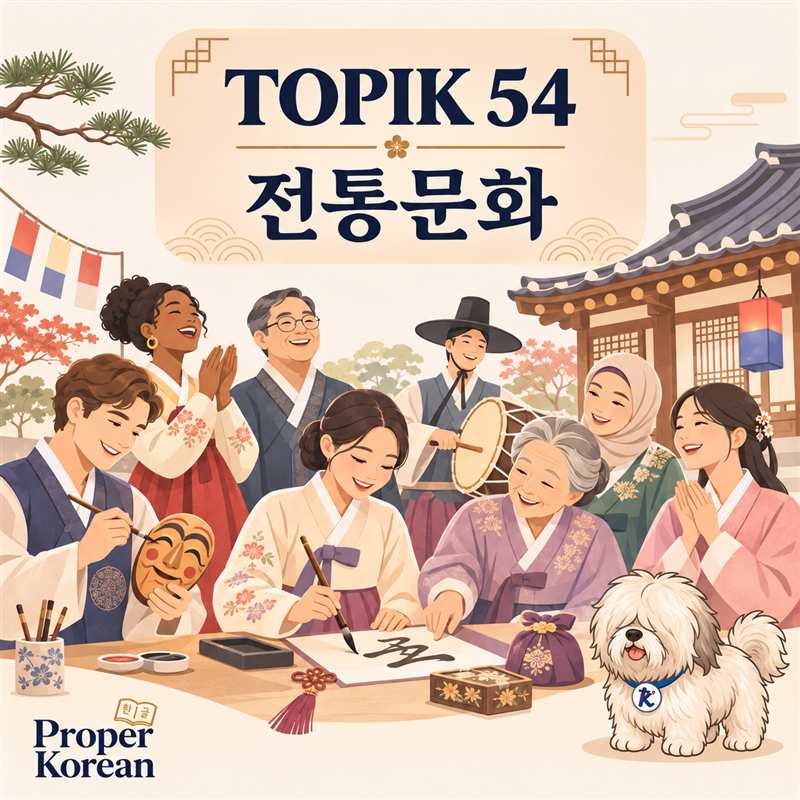
Welcome back. TOPIK 54 traditional culture is a classic essay topic on the TOPIK II writing test, and today we practice it step by step.
Culture is easy to feel but hard to write about. You know the word “tradition,” but you may not know what to write or how to organize it. That is okay.
In this lesson you will think, collect words, make sentences, and build four paragraphs into one essay. You will write your own answer, not a memorized one.
New here? Start with 👉 What Is TOPIK Writing? and 👉 Practice ② Aging Society.
Write in 문어체 (“-다”), not “-습니다” or “-어요”. Both spoken endings lose points. For the full style rules see TOPIK Writing Style “-다”, and for the 50-point scoring table see Practice ① Cooperation.
Remember just this: a TOPIK 54 traditional culture essay needs three things — (1) why tradition matters, (2) why it is disappearing, (3) how to preserve it. Prepare these three and your essay almost writes itself.
STEP 0. Open your mind before writing about traditional culture
Before memorizing the word “전통문화”, think about real life.
- What traditional food, clothes, music, or festival does your country have?
- Do young people still enjoy it, or do they prefer global pop culture?
- What is lost when a tradition disappears?
- How could a school or a city keep a tradition alive today?
생각 정리: 전통문화에는 한 사회의 역사와 정체성이 담겨 있다. 세계화 속에서 전통문화를 지키는 것은 과거를 그대로 두는 것이 아니라, 현재와 미래로 이어 가는 일이다.
Preserving culture is not freezing the past. It is carrying it into the present and future.
STEP 1. Understand the prompt
쓰기 문제 (practice prompt)
세계화와 디지털 기술의 발달로 세계 여러 나라의 문화가 빠르게 교류하고 있다. 사람들은 다른 나라의 음악, 음식, 의상 등을 쉽게 접하고 즐길 수 있게 되었다. 그러나 외국 문화에 대한 관심이 높아지면서 일부 지역에서는 고유한 전통문화가 점차 사라지고 있다는 우려도 커지고 있다. 아래의 내용을 중심으로 ‘전통문화의 보존과 계승’에 대한 자신의 생각을 쓰라. (600~700자)
- 전통문화를 보존하고 계승하는 것이 중요한 이유는 무엇인가?
- 전통문화가 점차 사라지는 원인은 무엇인가?
- 전통문화를 다음 세대에 전달하기 위해 어떤 노력이 필요한가?
(This is a practice prompt we made, not a real past exam question. Question 54 always gives you three questions like these.)
| The prompt asks | What you must write | Check |
|---|---|---|
| 중요성 Why it matters | 전통문화에 담긴 가치 | ☐ |
| 사라지는 이유 Why disappearing | 관심이 줄어드는 원인과 결과 | ☐ |
| 보존·계승 방법 How to preserve | 학교·지역·현대적 활용 | ☐ |
If you miss even one of the three, your content score drops.
STEP 2. Learn vocabulary by its job
A. Why tradition matters (본론 1 재료)
- 전통문화 — 전통문화를 보존하다
- 문화유산 — 문화유산을 보호하다
- 정체성 — 문화적 정체성을 형성하다
- 가치관 — 전통적인 가치관
- 세대 — 다음 세대에 전하다
- 자부심 — 문화적 자부심을 갖다
- 전달하다 — 지혜와 정신을 전달하다
B. Why it is disappearing (본론 2 재료)
- 세계화 — 세계화가 진행되다
- 문화 교류 — 문화 교류가 활발하다
- 생활 방식 — 생활 방식이 변화하다
- 관심 — 관심이 줄어들다
- 사라지다 — 점차 사라지다
C. How to preserve it (결론 재료)
- 보존하다 — 문화유산을 보존하다
- 계승하다 — 문화를 계승하다
- 체험하다 — 전통문화를 체험하다
- 교육하다 — 전통의 가치를 교육하다
- 현대화하다 — 전통문화를 현대화하다
- 활용하다 — 관광 자원으로 활용하다
- 지역사회 — 지역사회가 참여하다
Vocabulary practice (the answer is under each question)
Question 1
세계화가 진행되면서 외국 문화에 대한 ____이/가 높아지고 있다.
정답과 해설 보기 (See the answer)
A: 관심 (interest)
관심이 높아지다 / 관심이 줄어들다 are the standard pairs.
Tip: use 관심 for attention toward something, not 흥미.
Question 2
전통문화에는 한 사회의 역사와 ____이/가 담겨 있다.
정답과 해설 보기 (See the answer)
A: 정체성 (identity) — 가치 or 가치관 also works.
담겨 있다 = “is contained in”, a very natural verb for culture and values.
Tip: 문화적 정체성 is a strong level-4 phrase.
Question 3
학교에서 전통문화를 직접 ____ 교육을 늘릴 필요가 있다.
정답과 해설 보기 (See the answer)
A: 체험하는 (experience)
체험하다 means to try something yourself, not just to watch it.
Tip: 체험 중심 교육 is a useful solution phrase for the conclusion.
STEP 3. Put grammar into your sentences
| 문법 | Job | 예문 (문어체) |
|---|---|---|
| -(으)ㄹ 뿐만 아니라 | not only ~ but also | 전통문화는 역사를 알려 줄 뿐만 아니라 공동체 의식도 높여 준다. |
| -(으)면서 | at the same time | 전통의 가치를 지키면서 새로운 방식으로 발전시킬 수 있다. |
| -아/어 오다 | has continued until now | 전통문화는 오랜 시간 이어져 왔다. |
| -(으)ㄹ수록 | the more ~, the more ~ | 세계화가 진행될수록 고유한 문화를 지키는 일이 중요해진다. |
| -는 것이 바람직하다 | recommendation | 전통문화를 체험 중심으로 교육하는 것이 바람직하다. |
Level-4+ expressions (use one or two):
-는 데에 의의가 있다 : 전통을 다음 세대에 전하는 데에 큰 의의가 있다.
-기 위해서는 : 전통문화를 지키기 위해서는 모두의 관심이 필요하다.
STEP 4. Grow sentences into four paragraphs
1) 서론 Introduction — cultural exchange and change
Job: say how globalization brought cultures together, and why protecting tradition matters now.
Think: 세계화로 다른 나라 문화를 어떻게 접하게 됐나요? / 전통문화에 대한 관심은 어떻게 변했나요?
Frames: 세계화로 여러 나라의 문화를 쉽게 접할 수 있게 되었다. / 그러나 __________을/를 지키는 일도 중요해지고 있다.
Question 4 — Write your 서론
Write two sentences for the introduction in -다 style.
정답과 해설 보기 (See the answer)
Example
세계화로 여러 나라의 문화를 쉽게 접할 수 있게 되었다. 그러나 고유한 전통문화를 지키는 일도 점점 중요해지고 있다.
Tip: accept the good side of exchange first, then raise the concern.
2) 본론 1 — why tradition matters
Job: explain the value that tradition holds.
Think: 전통문화에는 어떤 역사·가치가 담겨 있나요? / 다음 세대에 어떤 도움이 되나요?
Frames: 전통문화에는 조상들의 __________이/가 담겨 있다. / 이를 통해 다음 세대는 __________을/를 이해할 수 있다.
Question 5 — Write your 본론 1
Write two or three sentences about the value of traditional culture.
정답과 해설 보기 (See the answer)
Example
전통문화에는 조상들의 생활 방식과 지혜가 담겨 있다. 이를 통해 다음 세대는 자신의 문화적 정체성을 이해할 수 있다.
Tip: value first, then the effect on the next generation.
3) 본론 2 — why it is disappearing
Job: show the cause and the result of losing tradition.
Think: 젊은 세대가 전통문화에 관심이 적은 이유는? / 전통이 멀어지면 어떤 문제가 생기나요?
Frames: 반면 생활 방식이 바뀌고 __________면서 관심이 낮아지고 있다. / 그 결과 __________이/가 사라질 수 있다.
Question 6 — Write your 본론 2
Write two or three sentences about why tradition is disappearing.
정답과 해설 보기 (See the answer)
Example
반면 생활 방식이 바뀌고 전통문화를 배울 기회가 줄어들면서 관심이 낮아지고 있다. 그 결과 오랜 기술과 문화유산이 사라질 수 있다.
Tip: cause (생활 방식 변화, 기회 감소) then result (기술·유산 소멸).
4) 결론 Conclusion — how to preserve and pass it down
Job: give school, community, and modern-use solutions, then your own idea.
Think: 학교·지역은 무엇을 할 수 있나요? / 전통을 현대적으로 활용하는 방법은?
Frames: 따라서 학교에서는 __________할 필요가 있다. / 또한 전통의 가치를 지키면서 __________하는 것이 바람직하다. / 결국 전통문화는 __________ 때 그 가치가 더욱 커진다고 생각한다.
Question 7 — Write your 결론
Write three sentences to finish your essay.
정답과 해설 보기 (See the answer)
Example
따라서 학교에서는 전통문화를 직접 체험하는 교육을 늘릴 필요가 있다. 또한 전통의 가치를 지키면서 현대적으로 발전시키는 것이 바람직하다. 결국 전통문화는 현재와 미래로 이어 갈 때 그 가치가 더욱 커진다고 생각한다.
Tip: finish with 생각한다 so the examiner sees your own opinion.
STEP 5. Connect the paragraphs
| Position | Linking words | Example |
|---|---|---|
| 서론 → 본론 1 | 먼저, 이러한 상황에서 | 이러한 상황에서 전통문화의 가치를 다시 생각할 필요가 있다. |
| 본론 1 → 본론 2 | 반면, 그러나 | 반면 전통문화에 대한 관심은 점점 줄어들고 있다. |
| 원인 → 결과 | 그 결과, 이로 인해 | 그 결과 오랜 기술과 지식이 사라질 수 있다. |
| 본론 → 결론 | 따라서, 이를 위해 | 따라서 학교와 지역사회가 함께 노력해야 한다. |
STEP 6. TOPIK 54 traditional culture model answer
Write your own answer first. Then open the model and study how it works.
모범 답안
모범 답안 + 예상 채점 펼쳐 보기 (약 660자 · 문어체)
세계화와 디지털 기술의 발달로 사람들은 다른 나라의 음식과 음악, 의상 등 다양한 문화를 쉽게 접할 수 있게 되었다. 이러한 문화 교류는 서로를 이해하는 데 도움이 되지만, 한편으로는 지역마다 이어져 온 전통문화가 점차 사라질 수 있다는 우려도 낳고 있다.
전통문화에는 한 사회의 역사와 조상들의 생활 방식, 지혜가 담겨 있다. 따라서 전통문화를 보존하는 것은 과거의 모습을 그대로 유지하는 것만을 의미하지 않는다. 자신의 문화적 정체성을 이해하고 다음 세대에 소중한 가치를 전달한다는 점에서 중요하다. 또한 전통문화는 지역의 자부심을 높이고 관광 자원으로 활용될 수도 있다.
그러나 생활 방식이 빠르게 바뀌고 외국 문화와 대중문화에 대한 관심이 커지면서 전통문화를 접할 기회가 줄어들고 있다. 특히 젊은 세대가 전통문화를 어렵거나 오래된 것으로 생각하면 관련 기술과 지식이 다음 세대에 전달되지 못하고 사라질 수 있다.
이를 막기 위해 학교에서는 전통문화를 직접 체험하는 교육을 늘릴 필요가 있다. 지역사회도 축제와 전시회 등을 열어 주민들이 자연스럽게 참여하도록 해야 한다. 또한 전통의 가치를 지키면서 디자인이나 콘텐츠에 현대적인 요소를 더해 젊은 세대가 관심을 갖도록 할 수 있다. 결국 전통문화는 과거에 머무는 것이 아니라 현재와 미래로 이어 갈 때 그 가치가 더욱 커진다고 생각한다.
How would this model answer score? (practice estimate)
This is a learning estimate based on the official TOPIK 54 criteria, not an official score.
| 항목 | 배점 | 예상 | 이유 |
|---|---|---|---|
| 내용 및 과제 수행 | 12 | 11 | 중요성, 사라지는 이유, 보존 방법을 모두 다루고 구체적인 방안까지 제시한다. |
| 글의 전개 구조 | 12 | 11 | 서론·본론1·본론2·결론이 분명하고 ‘따라서·그러나·결국’으로 잘 연결된다. |
| 언어 사용 | 26 | 24 | 문어체를 지키고 중급 이상 어휘와 문법이 다양하다. 정확성에 따라 달라질 수 있다. |
| 합계 | 50 | 46 | 자기 점검용 예상 점수 |
Analyze it: underline the vocabulary, circle the grammar, and star the main sentence of each paragraph. Then compare it with your own answer.
STEP 7. Write for real and self-check
Real mission: close the model answer. Using the three required questions, write 600–700 characters in -다 style.
- ☐ Answered all three questions (value, disappearing, preserving)?
- ☐ Four paragraphs?
- ☐ Connected cause and result in body 2?
- ☐ Gave concrete solutions (school, community, modern use)?
- ☐ Written in
-다style? - ☐ 600–700 characters?
STEP 8. 3-hour self-study plan
| Step | Time | What to do |
|---|---|---|
| HOUR 1 | 약 60분 | Understand the prompt, brainstorm (STEP 0–1), learn the vocabulary groups |
| HOUR 2 | 약 60분 | Practice the 5 grammar points, write the four paragraphs, compare with the model |
| HOUR 3 | 약 60분 | Write 600–700 characters without the model, then fix your errors |
You can finish in one sitting, but keep the order: think, then sentences, then paragraphs. Take a short break between each hour.
STEP 9. Use AI to self-correct
Copy this prompt
I am an intermediate Korean learner studying TOPIK II writing question 54 (traditional culture). Please correct my answer in this order: (1) check I answered all 3 questions; (2) check intro/body1/body2/conclusion are logical; (3) list grammar and word errors in a table (original / fixed / reason); (4) explain in easy words; (5) keep my ideas; (6) give an improved version; (7) tell me the character count. [My answer] (paste here)
AI is for practice. Past exams are the real answer key.
Summary of the TOPIK 54 traditional culture essay
- The essay grows from ideas, to grouped words, to sentences, to paragraphs, to one essay.
- Write in
-다. This protects your language score (26 of 50). - Answer all three questions: why it matters, why it disappears, how to preserve it.
- Preserving culture means carrying it into the present and future, not freezing the past.
Take it slowly, one step at a time. If you have a question, leave a comment.
You can check the official test format on the TOPIK official website.
FAQ
Q: Can I write in -습니다 or -어요?
A: No. Question 54 uses written style -다. Both lose points.
Q: How many characters should I write?
A: 600–700 characters including spaces. Our model answer is about 660.
Q: Is globalization only bad for tradition?
A: No. A strong essay shows that cultural exchange is positive and that protecting local tradition still matters, then gives solutions.
Q: Do I need hard words to pass level 4?
A: No. You need accurate words and correct grammar used in context, plus one or two challenge expressions.
Previous: Practice ② — Aging Society
- TOPIK Writing Style: Turn Speaking Into -다 Sentences — the 3 rules behind the 문어체 warning in this lesson
- What Is TOPIK Question 53? — the other writing question, worth 30 points
- Practice ① — Cooperation — start the series from the beginning
<Latest Posts>