

‘Sino-Korean Numbers (일, 이, 삼, 사…)‘ are essential for daily life in Korea and for visiting Korea’s charming traditional markets.
Korean has two ways to count numbers, so many learners find it a bit confusing at first. But don’t worry! Today’s lesson is on Sino-Korean numbers, which are very useful when talking about prices, dates, phone numbers, and floor levels.
Once you master this, you will be able to confidently ask and answer prices when you find an outfit or shoes you love in a traditional market! Let’s get started, shall we?
1. Meaning & Function of Sino-Korean Numbers
The Korean number system is largely divided into ‘Sino-Korean Numbers’ and ‘Native Korean Numbers’. The Sino-Korean numbers (일, 이, 삼, 사…) we are learning today are mainly used in the following situations:
| Type | Reading | Usage |
|---|---|---|
| 한자어 수 Sino-Korean Numbers | 일·이·삼·사·오… | Prices (Won), Dates (Month/Day), Floors, Phone numbers, Minutes (Time) |
| 고유어 수 Native Korean Numbers | 하나·둘·셋·넷·다섯… | Quantity (Items/Clothes/Pairs), Age, Hour (Time) |
🌟 Key Point for Shopping! 물건의 가격을 말할 때는 꼭 한자어 수(일, 이, 삼, 사)로 말하세요~! When you ask for the price of an item in a market, you must use ‘Sino-Korean Numbers’.
- ✅ 이만 오천 원이에요. (It is 25,000 won.)
- ❌ 두만 다섯천 원이에요. (This is incorrect.)
2. Number Table & Price Expressions of Sino-Korean Numbers
① Basic Sino-Korean Numbers (0 ~ 10)
| Number | Sino-Korean | Number | Sino-Korean |
|---|---|---|---|
| 0 | 영 / 공 | 6 | 육 |
| 1 | 일 | 7 | 칠 |
| 2 | 이 | 8 | 팔 |
| 3 | 삼 | 9 | 구 |
| 4 | 사 | 10 | 십 |
| 5 | 오 |
② Large Numbers and Units
| Unit | Sino-Korean | Example |
|---|---|---|
| 10 | 십 | 15 → 십오 (Sip-o) |
| 100 | 백 | 300 → 삼백 (Sam-baek) |
| 1,000 | 천 | 5,000 → 오천 (O-cheon) |
| 10,000 | 만 | 20,000 → 이만 (I-man) |
③ Price Reading Practice
Unlike English, Korean prices are counted in units of 10,000 (Man) rather than 1,000 (Thousand). This is very important! Read the numbers in order from left to right and add ‘원 (Won)’ at the end.
| Price | How to Read |
|---|---|
| 500원 | 오백 원 (O-baek won) |
| 1,000원 | 천 원 (Cheon won) (Note: Do not say ‘Il-cheon won’) |
| 3,500원 | 삼천오백 원 (Sam-cheon-o-baek won) |
| 10,000원 | 만 원 (Man won) (Note: Do not say ‘Il-man won’) |
| 15,000원 | 만 오천 원 (Man o-cheon won) |
| 23,000원 | 이만 삼천 원 (I-man sam-cheon won) |
| 100,000원 | 십만 원 (Sip-man won) |
④ Expanded Real-Life Examples
Here are 10 diverse, real-life example sentences showing how to use Sino-Korean numbers for prices, dates, floors, and phone numbers in everyday situations.
| Context | Korean Sentence | English Translation |
| Shopping (Asking Price) | 이 모자는 팔천 원이에요. | This hat is 8,000 won. |
| Shopping (Bargaining) | 이만 오천 원으로 깎아 주세요. | Please give me a discount of 25,000 won. |
| Shopping (Total Amount) | 오늘 시장에서 사만 원을 썼어요. | I spent 40,000 won at the market today. |
| Location (Floor) | 화장실은 삼 층에 있어요. | The restroom is on the 3rd floor. |
| Appointment (Date) | 제 생일은 오 월 십오 일이에요. | My birthday is May 15th (5th month, 15th day). |
| Contact (Phone Number) | 제 전화번호는 공일공-일이삼사-오육칠팔이에요. | My phone number is 010-1234-5678. |
| Time (Minutes) | 지금은 세 시 오십 분이에요. | It is 3:50 now. |
| Transportation (Bus Number) | 학교에 갈 때는 백사 번 버스를 타요. | I take bus number 104 when going to school. |
| Shopping (Change) | 거스름돈은 이천 원이에요. | The change is 2,000 won. |
For more official information about Korean culture, visit the King Sejong Institute.
3. Common Mistakes of Sino-Korean Numbers
What are the most common mistakes learners make when reading numbers? Check the table below to see the correct expressions!
| ❌ Incorrect | ✅ Correct | Reason |
|---|---|---|
| 23,000원 ➡️ 이십 삼천 원 (❌) | 23,000원 ➡️ 이만 삼천 원 | Koreans use the 10,000 (Man) unit, not the 1,000 (Cheon) unit. |
| 10,000 ➡️ 일만 원 (❌) 1,000 ➡️ 일천 원 (❌) | 10,000 ➡️만 원 1,000 ➡️ 천 원 | The number ‘1 (Il)’ at the beginning of a large number is usually omitted. |
| 8,000원 ➡️ 여덟천 원(❌) | 8,000원 ➡️ 팔천 원 | Do not mix Native Korean numbers with Sino-Korean numbers for prices. |
4. Real-Life Dialogue
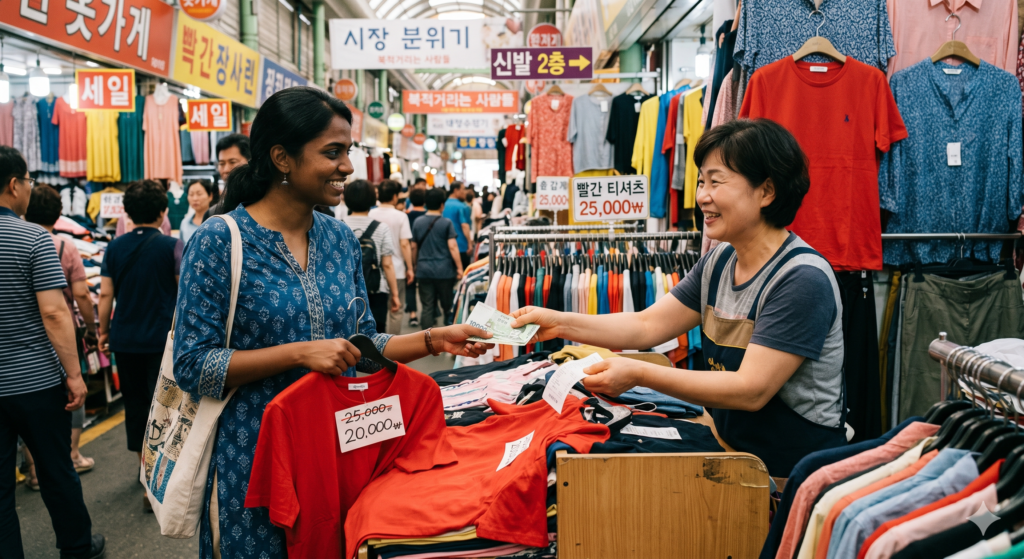
Aditi, an international student from India, is talking to a store owner at a traditional market. Let’s see how Sino-Korean numbers are used in the conversation!
① Listening Practice (듣기 연습)
Instructions: Listen first and answer the following questions.
1) 아디티 씨는 무엇을 샀습니까?
2) 아디티 씨는 영수증을 받았습니까?
- 아디티: 저 빨간 옷 얼마예요?
- 직 원: 이만 오천 원이에요.
- 아디티: 조금 비싸요. 깎아 주세요!
- 직 원: 그럼 이만 원에 드릴게요.
- 아디티: 감사해요! 여기 이만 원이요.
- 직 원: 네, 영수증 드릴까요?
- 아디티: 네, 주세요. 그런데 신발 가게는 몇 층이에요?
- 직 원: 이 층이에요.
👉 Click Dialogue Translation!
- 아디티: How much is that red shirt?
- 직 원: It is 25,000 won.
- 아디티: It’s a bit expensive. Please give me a discount!
- 직 원: Then I’ll give it to you for 20,000 won.
- 아디티: Thank you! Here is 20,000 won.
- 직 원: Okay, would you like a receipt?
- 아디티: Yes, please. By the way, which floor is the shoe store on?
- 직 원: It’s on the second floor.
② Comprehension Questions (내용 이해 질문)
1) 아디티 씨는 어떤 옷을 사고 싶어 해요?
2) 아디티 씨는 그것을 얼마에 샀어요?
3) 아디티 씨는 또 무엇을 사고 싶어 해요?
5. AI Tutor Practice
🤖 Digital Literacy Tip! You can practice price expressions with an AI Tutor (ChatGPT). Instead of just memorizing, try simulating a shopping scenario with AI. It will help you remember the numbers much faster!
[Copy and paste this prompt into AI: like ChatGPT ]
| “I am a beginner Korean student studying Sino-Korean numbers. Please act as a shop owner in a Korean traditional market. I will ask you for the price of different items, and you answer using Sino-Korean numbers (e.g., 15,000 won, 23,000 won). Please keep the conversation simple and correct my mistakes in Korean.” |
6. Today’s Quiz
Test your knowledge of the prices and numbers we learned today!
[Quiz 1] Read the following prices in Sino-Korean numbers.
- 3,000원 => ( ___________________ )
- 12,000원 => ( ___________________ )
- 25,000원 => ( ___________________ )
👉 Click here to see the [Quiz 1 Answers]
- 삼천 원
- 만 이천 원
- 이만 오천 원
[Quiz 2] Complete the dialogue.
- 가: 이 편한 신발은 얼마예요? (How much are these comfortable shoes?)
- 나: ___________________________이에요. (119,000원)
👉 Click here to see the [Quiz 2 Answers]
=> 십 일만 구천 원이에요.
7. Wrap-up
Today, we studied Sino-Korean numbers, which are essential for asking and answering prices at a market. Now, you won’t be confused when you see price tags or hear the vendor telling you the price, right? Don’t forget to review on your own!
Next Lesson Preview: In the next lesson, we will learn about ‘Counter Nouns’ (개, 벌, 켤레, etc.) used to count items such as apples, clothes, and shoes.
Next Lesson Preview: In the next lesson, we will learn about ‘Counter Nouns’. You can also review our previous lessons on the Proper Korean Home.
See you next time! 또 만나요~:)