
Prefer to study in Korean? 👉 [ 한국어로 읽기 ]
Welcome back! 😊
Understanding TOPIK Writing Scoring is key to a high score. In Part 3, we learned how to use the TOPIK writing paper (원고지). Haven’t seen it? Read it first 👉 [ Part 3 link ]
Today we learn something very important: how TOPIK writing is scored. Many students think like this.
“If I know a lot of grammar, I get a high score.”
“If I use difficult words, my score is good.”
“If I just write many characters, it’s fine.”
Grammar and vocabulary are important, of course. But graders don’t look only at those. They look at three big things.
💡 Remember just this:
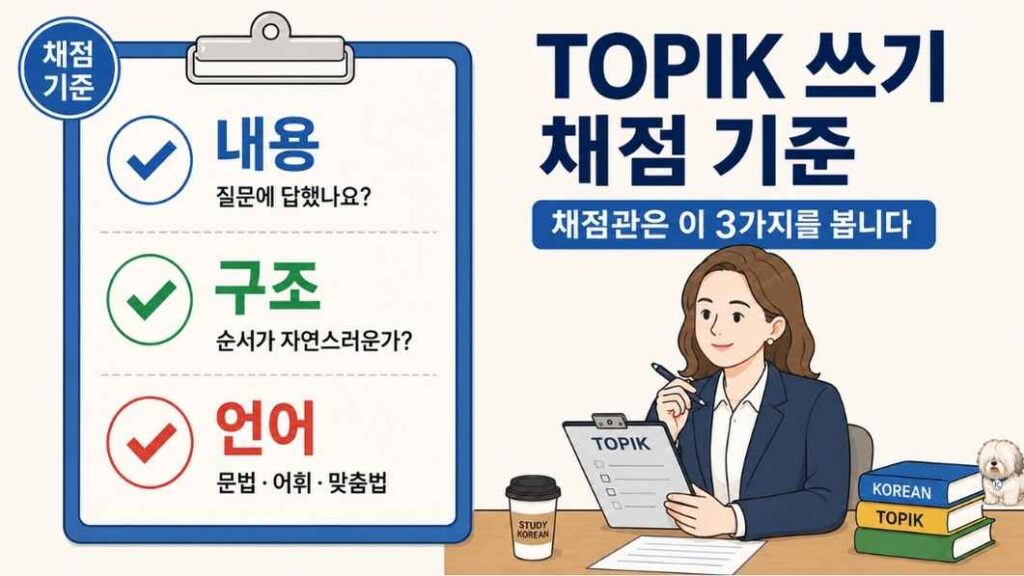
Graders check ① Content · ② Structure · ③ Language.
• Content = Did you answer the question?
• Structure = Does it flow in order?
• Language = Is it accurate and in written style?
1. Why should you know the scoring criteria?
TOPIK writing is not simply “write something in Korean.” It is a test where you read what the question asks, and write to match it. So even if you write many nice sentences, you won’t get a good score if you don’t answer the question.
For example, imagine the question asks:
Q: Write about your most memorable trip.
Where did you go? Why is it memorable? What did you do on the trip?
If a student only writes “I like travel. Travel is fun,” the sentences may be correct. But the student did not answer what the question asked. The important thing is not just writing Korean sentences — it’s writing an answer that fits the question.
2. What does Level 3 writing need?
Level 3 does not ask for perfect, advanced writing. The official Level 3 criteria say you should be able to write about familiar topics, write a simple text with the structure of an explanatory passage, and write using the written-style ending (문어체 종결형).
In simple words, a student aiming for Level 3 should be able to write:
an easy topic · in paragraphs · in written-style sentences · with connected content
You don’t need many difficult words from the start. First, writing on-topic, in order, and accurately is what matters.
3. How TOPIK Writing Scoring Works
Graders give points in three areas. The point breakdown shows you what matters most.
| Area | Q53 (30 pts) | Q54 (50 pts) |
|---|---|---|
| Content & task | 7 | 12 |
| Structure | 7 | 12 |
| Language use | 16 | 26 |
Look — language use is more than half in both questions. That’s exactly why the written style and accurate sentences we learned in Part 2 matter so much. (How each area splits into high/mid/low, we’ll see in detail later, when we study Questions 53 and 54.)
4. First, “Content” — did you answer the question?
The first thing graders check is content. In simple words: “Did you answer what the question asked?”
Question 53 gives you data (a graph or chart). So instead of writing many of your own opinions, you should accurately write what is in the data / what is high or low / what the differences are.
Question 54 asks for your own opinion on a topic. But you must answer all of the questions given in the prompt.
5. How to get content points
Before you write, first mark what the question is asking. For example, if Question 54 has three questions:
① What is the problem? ② Why does it happen? ③ How can it be solved?
Then answer each one with one sentence. Don’t try to write a long text at the start.
One question = one answer.
This is the first way to earn content points.
6. Second, “Structure” — does it flow in order?
The second thing is structure, the order of your writing. In a good text, sentences don’t appear randomly — ideas connect naturally.
Question 53 usually goes like this:
① Introduce what the data is → ② The most important point → ③ Compare / show differences → ④ Final summary
Question 54 goes like this:
① Introduce the topic → ② Your opinion → ③ Reasons / examples → ④ Conclusion
The official criteria also check whether the writing is logical, whether paragraphs are well divided, and whether you use linking expressions (담화 표지) well. These are words like:
먼저 (first) · 그리고 (and) · 그러나 (but) · 그래서 (so) · 따라서 (therefore) · 마지막으로 (finally)
7. Weak structure vs. good structure
Weak structure
저는 운동을 좋아한다. 건강이 중요하다. 친구도 운동을 한다. 요즘 사람들은 바쁘다. 운동은 좋다.
Every sentence is Korean. But it’s hard to see what the writer wants to say first, or why.
Good structure
건강을 위해 운동은 중요하다. 먼저 운동을 하면 몸이 건강해진다. 그리고 스트레스를 줄일 수 있다. 그래서 바쁜 사람들도 조금씩 운동하는 것이 좋다.
This is much more natural, because it has an order: topic → reason 1 → reason 2 → conclusion.
8. Third, “Language” — accurate and appropriate?
The third thing is language — vocabulary, grammar, spelling, and written style. In simple words:
Did you use the right words? Is the grammar correct? Are spelling and spacing okay? Did you use written style, not speaking style?
Here is a very important official rule. Using the endings “-ㅂ니다/습니다” or “-아/어요” loses points. So “-습니다” is not okay, and “-아/어요” is not okay either. The written style “-다 / -이다” is the correct one.
사람이 많아요. / 저는 그렇게 생각해요. (❌)
사람이 많다. / 나는 그렇게 생각한다. (✅)
This is why the “-다 / -이다” written style from Part 2 is so important.
9. Correct sentences come before hard words
A common student mistake: forcing in difficult words to get a higher score. But if you use a word you can’t use correctly yet, your writing becomes strange.
많은 사람은 운동이 필요하다. → (a little more natural) 많은 사람에게 운동이 필요하다.
Even with easy words, using the right particles and grammar matters. One correct sentence is often more valuable than one difficult word In TOPIK writing scoring.
10. Questions 51 and 52 also have criteria
Questions 51 and 52 are not long writing. You fill in the blank. But the rules here are clear too. You must look at the sentences before and after the blank and make the content connect naturally. If you use words or grammar that don’t fit the context, or add unnecessary content, you lose points.
Don’t write freely. · Read the sentence before and after. · Write one sentence. · Don’t add unnecessary words.
Also, even if your 51/52 answer is not perfect, points are given step by step, depending on how correctly you used the connecting and ending forms. So don’t leave it blank — always try.
11. Is a mistake always 0 points?
No. In TOPIK writing, you can get partial credit even if your answer is not perfect.
Even if it’s not perfect, you get points when you write.
So leaving a blank or skipping Question 54 because you’re afraid of small mistakes is not a good strategy. Write as much as you can, on topic.
But these two things are 0 points. Be careful!
⚠️ Copying the question (the test paper) word for word → 0 points.
⚠️ Writing on a completely different topic → 0 points.
12. What makes a good answer?
In official sample answers, high-scoring writing is not just good grammar. It writes what, why, and how clearly and specifically, has a beginning–middle–end, uses intermediate expressions accurately, and uses written style. So a good answer is good in all three:
Clear content. · Natural order. · Accurate Korean.
13. Five checks after you write
- Did you answer everything the question asked? (If there are 3 questions, answer all 3.)
- Did you avoid writing things unrelated to the topic?
- Is the order natural? (beginning, middle, end)
- Did you avoid listing only short sentences? (e.g., “운동은 좋다. 건강에 좋다.” → “운동은 건강에 좋기 때문에 많은 사람에게 필요하다.”)
- Are there sentences ending in “-아요/어요”? (좋아요 → 좋다 / 생각해요 → 생각한다)
Summary 🌱
In TOPIK writing scoring, graders check three big things: Content · Structure · Language.
| Area | Meaning |
|---|---|
| Content | Did you write to match the question? |
| Structure | Does the writing flow in order? |
| Language | Did you use vocabulary, grammar, spelling, and written style well? |
Don’t try to write a perfect text from the start. Just practicing these four steps makes writing much easier.
Find the questions → Answer each with one sentence → Connect the sentences in order → Change them to “-다 / -이다” written style.
Take it slowly, one step at a time, and you can reach the level you want. If you have a question, leave a comment.
From the next post, we finally study Question 53. We’ll look at what kind of question it is, and what to read and write.
See you in the next lesson!
🔎 Still finding levels 1–2 hard? Review the basics first 👉 [ TOPIK I study ]
❓ FAQ
Q: What do graders check in TOPIK writing?
A: Three things — content (did you answer the question), structure (does it flow in order), and language (accurate and in written style).
Q: Which area has the most points?
A: Language use. It’s 16 of 30 points in Q53 and 26 of 50 in Q54 — more than half. That’s why written style and accuracy matter.
Q: Is a small mistake always 0 points?
A: No. There is partial credit, so you get points even if it’s not perfect. But copying the question or writing on a completely different topic gives 0 points.
Q: Can I write with “-습니다”?
A: No. Both “-ㅂ니다/습니다” and “-아/어요” lose points. Use the written style “-다 / -이다.”
<Latest Posts>