
💡 한국어로 읽고 싶어요? 👉 [ 여기에서 쉬운 한국어로 읽어 보세요! ]
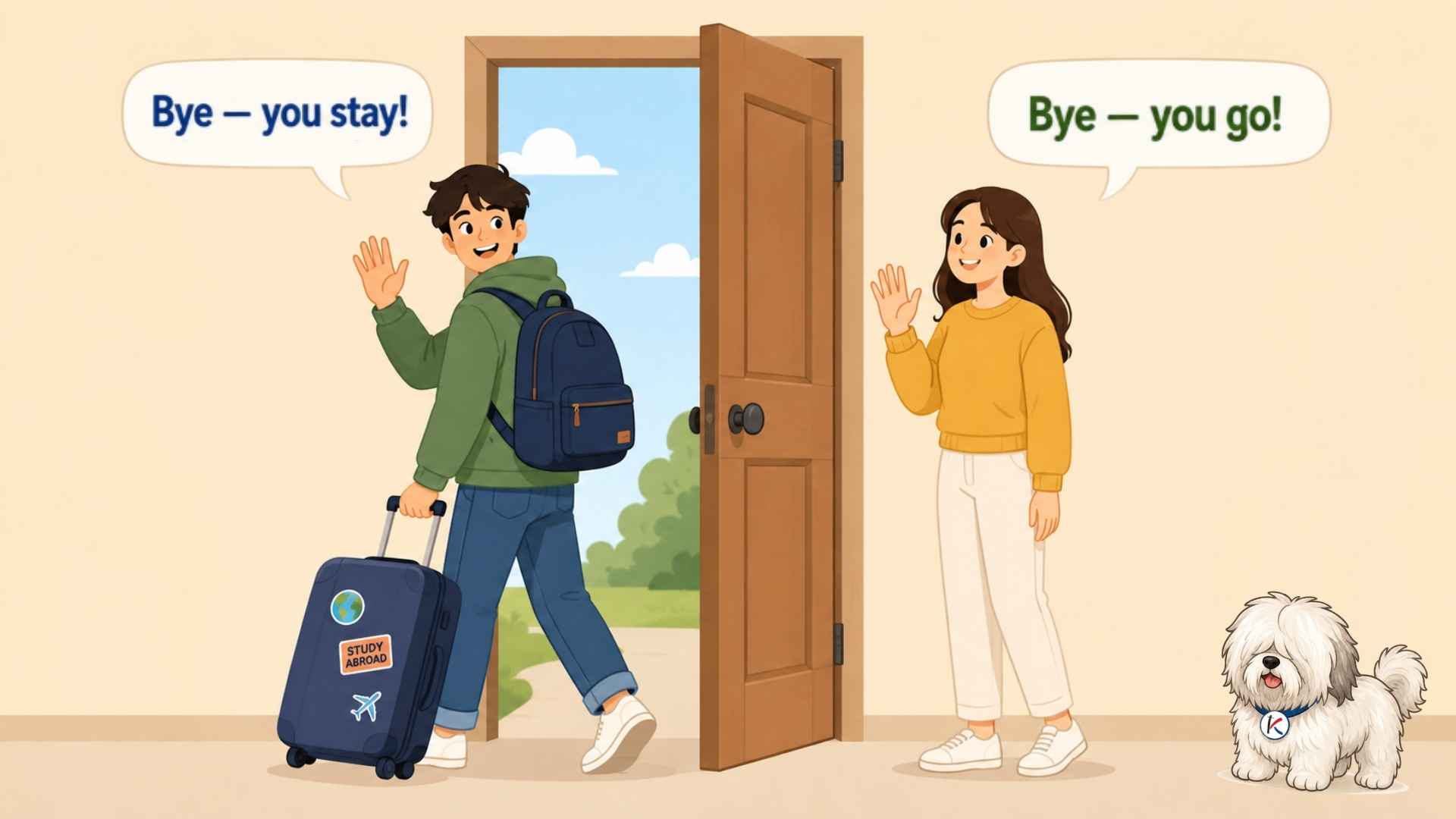
Hello! Have you ever heard a conversation like this in a Korean shop?
Customer: 안녕히 계세요. (an-nyeong-hi gye-se-yo) — Bye
Staff: 안녕히 가세요. (an-nyeong-hi ga-se-yo) — Bye
Two people are saying goodbye at the same moment
Why do they say different words as farewells?
In the last story, we learned that the “안녕(an-nyeong)i” inside “안녕하세요(An-nyeong-ha-se-yo)?” is a warm way to ask if someone is at peace.
💡If you want to see the previous post, 👉 [ Click here ]
When you meet someone, one “안녕하세요(An-nyeong-ha-se-yo)?” is enough. But when you say goodbye, this “안녕” splits into two. Let me tell you why.
What does “안녕히” mean?
To understand how to say goodbye in Korean, we said “안녕(An-nyeong) — 安寧” means “calm and safe, with nothing wrong.” When you add “-히(-hi)”, the word “안녕히(an-nyeong-hi)” means “calmly, safely.” In English, it is close to peacefully or safely.
So this goodbye is really a small wish:
“Please stay(or go) well and safe.”
When you meet, and when you leave, you hope the other person is at peace. But why two versions?
The secret is in the last verb
The answer is in two verbs: 가다(ga-da) and 계시다(gye-si-da).
가세요(ga-se-yo) ← 가다 (to go) — when the other person is leaving
계세요(gye-se-yo) ← 계시다 (to stay) — when the other person is staying
“계시다(gye-si-da)” may look new to you. “계시다(gye-si-da)” is the polite form of “있다(It-da)” (to be / to stay).
It is a respectful way to say that someone is in a place. So when you say “안녕히 계세요” to someone who stays, it means “please stay here comfortably.”
🔎 Mini Grammar
가다(ga-da) → 가세요(ga-se-yo).
있다(It-da) → 계시다(gye-si-da) → 계세요(gye-se-yo)
Once you know “계시다(gye-si-da)“, you can understand sentences like:
“선생님이 교실에 계세요(Sun-saeng-neem-ee gyo-sheel-eh gyeh-seh-yoh).” — The teacher is in the classroom.)
How to never mix them up
At the door, look at just one thing: the person you are greeting.
- The other person is leaving → 안녕히 가세요(An-nyeong-hi ga-se-yo).
- The other person is staying → 안녕히 계세요(An-nyeong-hi gye-se-yo).
Let’s go back to that shop.
You, the customer, are leaving. The staff stays in the shop.
So you say “안녕히 계세요(An-nyeong-hi gye-se-yo)” to the one who stays, and the staff says “안녕히 가세요(An-nyeong-hi ga-se-yo)” to you, the one who leaves.
This one little scene explains almost everything you need to know when you say goodbye in Korean.
💬 From my classroom When I teach this, students almost always ask the same question:
“Teacher, what if both people are leaving?”
It is a very good question. — and the answer is simple.
If you are both leaving, you are both “going,” so you both just say “안녕히 가세요(An-nyeong-hi ga-se-yo).” Easy!
Between friends
“안녕히 가세요 / 안녕히 계세요” is polite way to say goodbye in Korean.
With friends or close people, you can say it more casually.
- 잘 가(jal ga)! → I stay, and my friend leaves
- 잘 있어(Jal it-seo)! → I leave, and my friend stays
This is not simply the polite form turned casual, but you can think of it as the friendly goodbye used in the same situations.
The rule is still the same: “가(ga)” for the one who leaves, “있어(it-seo)” for the one who stays.
Wait — some tricky places
There are places where this rule does not work so well: taxis, buses, and elevators.
A taxi driver stays in the car, but the car moves. In an elevator, only one person gets off.
In these moments, it is not clear who is “leaving” and who is “staying.”
At times like this, don’t worry about the rule.
Just use another goodbye.
“조심히 가세요(jo-sim-hi ga-se-yo).” — go safely
“좋은 하루 보내세요(jo-eun ha-ru bo-nae-se-yo).” — have a good day
“먼저 갈게요(Meon-jeo gal-ge-yo).” — I’ll go first
“감사합니다(gam-sa-ham-ni-da).” — thank you.
All of these sound natural.
And when you hang up the phone
Here is something interesting.
When Korean people end a phone call, they very often say
“네, 들어가세요(ne, deu-leo-ga-se-yo).” — literally, “okay, go inside.”
In one survey, more than six out of ten people said they use this.
But here is the thing: “들어가세요(deu-leo-ga-se-yo)” is actually a command form (“go inside”), so standard Korean etiquette does not really recommend it.
To end a call politely, “안녕히 계세요(an-nyeong-hi gye-se-yo).”, “고맙습니다(go-map-seum-ni-da).”, or “이만 끊을게요(I-man kkeun-eul-ge-yo).” (I’ll hang up now) are the “correct” choices.
So this is a great example of when the textbook’s answer and real Korean are a little different.
Learn both, and you will have both the “proper” Korean and the “real” Korean that people actually use.
One last thing
Even for a simple say goodbye, Korean looks at whether the other person is leaving or staying.
It is not some grand cultural theory — think of it as a small habit of looking at the other person for a moment before you speak.
So next time you say goodbye in Korea, just check one thing: is the other person going, or staying?
If they go, say “안녕히 가세요(an-nyeong-hi ga-se-yo).” If they stay, say “안녕히 계세요(an-nyeong-hi gye-se-yo).”
Once you know this difference, your goodbyes will feel much more natural. 🥰
Does your language have different goodbyes for the person who leaves and the person who stays?
Tell me in the comments.
I would love to know.
🙋 FAQ
Q. The shop staff will go home soon too — so why “계세요(gye-se-yo)“?
A: Because at the moment you say goodbye, the staff is still in the shop. It doesn’t matter that they leave later. Just look at this moment.
Q. If we both leave the café, who is staying?
A: Neither of you. You both leave the place you were in and go your own ways — so you can both say “안녕히 가세요” to each other.
Q. What do I say in a taxi?
A: The driver stays in the car, but the car moves, so it feels unclear. Here, “감사합니다(Gam-sa-ham-ni-da).” (thank you) or “조심히 가세요(jo-sim-hi ga-se-yo)” (go safely) is easy and natural.
📝 Just remember this
| Situation | Say this |
|---|---|
| The other person leaves | 안녕히 가세요(an-nyeong-hi ga-se-yo) |
| The other person stays | 안녕히 계세요(an-nyeong-hi gye-se-yo) |
| To a friend (casual) | 잘 가(jal ga)! / 잘 있어(Jal it-seo)! |
| Ending a call politely | 안녕히 계세요(an-nyeong-hi gye-se-yo) / 고맙습니다(go-map-seum-ni-da) / 이만 끊을게요(I-man kkeun-eul-ge-yo) |
| What people really say on the phone | 들어가세요(deu-leo-ga-se-yo) / 다음에 연락할게요(da-eum-e yeon-rak-hal-ge-yo) |
One-line rule: if the other person goes, say “가세요(ga-se-yo).”; if they stay, say “계세요(gye-se-yo).”
well done! If you enjoyed this post, you’ll love my next one too! See you again soon!
Read more 👉 Why Does Korean "Hello" Have a Question Mark?
<Latest Posts>