
📌 한국말로 공부하고 싶어요? 👉 [한국어]
Do you keep mixing up 쉽다 (easy) and 어렵다 (hard) in TOPIK I reading? 😊
Don’t worry — the other sentence always tells you which one. Just read it first!
In questions 34–39, an adjective blank asks about a state — how something is (아프다, 바쁘다, 가깝다…). Each TOPIK I reading question is worth 2 points.
Try each one first, then open the answer to check.
① Remember just one thing
Read the other sentence — the reason or result — and choose the state that fits.
e.g. 약을 먹어요 (take medicine) → 아프다 (sick/hurt).
And learn opposite pairs (쉽다 ↔ 어렵다) to erase wrong choices fast.
② Adjective card
| When you see this situation… | Use this adjective |
|---|---|
| 약을 먹어요 / 병원에 가요 | 아프다 (sick / hurt) |
| 시간이 없어요 / 일이 많아요 | 바쁘다 (busy) |
| 늦게까지 일했어요 | 피곤하다 (tired) |
| 집 앞에 있어요 / 걸어가요 | 가깝다 (close / near) |
| 시험을 잘 봤어요 | 쉽다 (easy) |
| 점수가 나빴어요 | 어렵다 (difficult) |
| 발이 아파요 (신발) | 작다 (small) |
많다 ↔ 적다 (many ↔ few) · 크다 ↔ 작다 (big ↔ small) · 가깝다 ↔ 멀다 (near ↔ far) · 쉽다 ↔ 어렵다 (easy ↔ hard) · 싸다 ↔ 비싸다 (cheap ↔ expensive)
Practice: TOPIK I reading adjective blanks
Try each TOPIK I reading question first.
Read the two sentences, choose the adjective, then open the box to check.
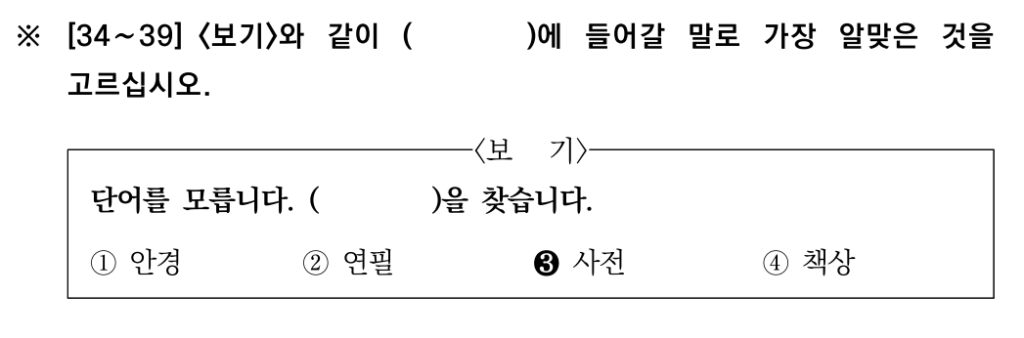
Question 1
이가 ( ). 그래서 치과에 갑니다.
① 아픕니다② 예쁩니다③ 짧습니다④ 좋습니다
🔽 See the answer (Question 1)
Q: 이가 ( ). 그래서 치과에 갑니다.
(My tooth ( ). So I go to the dentist.) 👉 The other sentence: “치과에 갑니다 (go to the dentist)”.
A: ✅① 아픕니다 (hurt) → If your tooth hurts, you go to the dentist!
② 예쁘다 = pretty.
③ 짧다 = short.
④ 좋다 = good / nice.
💡 Tip: go to a dentist/hospital / take medicine → 아프다 (hurt)!
Question 2
요즘 일이 많습니다. 그래서 아주 ( ).
① 조용합니다② 바쁩니다③ 가볍습니다④ 깨끗합니다
🔽 See the answer (Question 2)
Q: 요즘 일이 많습니다. 그래서 아주 ( ).
(These days I have a lot of work. So I am very ( ).) 👉 The other sentence: “일이 많습니다 (a lot of work)”.
A: ✅② 바쁩니다 (busy) → A lot of work makes you busy!
① 조용하다 = quiet.
③ 가볍다 = light (not heavy).
④ 깨끗하다 = clean.
💡 Tip: a lot of work / no time → 바쁘다 (busy)!
Question 3
학교가 집 앞에 있습니다. 그래서 아주 ( ).
① 큽니다② 비쌉니다③ 가깝습니다④ 깨끗합니다
🔽 See the answer (Question 3)
Q: 학교가 집 앞에 있습니다. 그래서 아주 ( ).
(The school is in front of my house. So it is very ( ).) 👉 The other sentence: “집 앞에 있습니다 (in front of the house)”.
A: ✅③ 가깝습니다 (close) → If it is in front of your house, it is close!
① 크다 = big.
② 비싸다 = expensive.
④ 깨끗하다 = clean.
💡 Tip: in front of the house / walk there → 가깝다 (near)! (opposite: 멀다 far)
Question 4
오늘 늦게까지 일했습니다. 그래서 조금 ( ).
① 작습니다② 무겁습니다③ 피곤합니다④ 비쌉니다
🔽 See the answer (Question 4)
Q: 오늘 늦게까지 일했습니다. 그래서 조금 ( ).
(Today I worked until late. So I am a little ( ).) 👉 The other sentence: “늦게까지 일했습니다 (worked until late)”.
A: ✅③ 피곤합니다 (tired) → Working late makes you tired!
① 작다 = small.
② 무겁다 = heavy.
④ 비싸다 = expensive.
💡 Tip: worked a lot / didn’t sleep → 피곤하다 (tired)!
Question 5
도서관에 갔습니다. 책이 아주 ( ).
① 넓습니다② 많습니다③ 쉽습니다④ 짧습니다
🔽 See the answer (Question 5)
Q: 도서관에 갔습니다. 책이 아주 ( ).
(I went to the library. There are very ( ) books.) 👉 The other sentence: “도서관 (library)”, “책 (books)”.
A: ✅② 많습니다 (many) → A library has many books!
① 넓다 = wide (a place is big).
③ 쉽다 = easy.
④ 짧다 = short.
💡 Tip: a big number of ~ → 많다 (many)! (opposite: 적다 few)
Question 6
시험 공부를 많이 했습니다. 그래서 시험이 ( ).
① 나빴습니다② 작았습니다③ 쉬웠습니다④ 재미없었습니다
🔽 See the answer (Question 6)
Q: 시험 공부를 많이 했습니다. 그래서 시험이 ( ).
(I studied a lot for the test. So the test was ( ).) 👉 The other sentence: “공부를 많이 했습니다 (studied a lot)”.
A: ✅③ 쉬웠습니다 (easy) → If you study a lot, the test feels easy!
① 나쁘다 = bad.
② 작다 = small.
④ 재미없다 = not fun.
💡 Tip: did well / studied a lot → 쉽다 (easy)! (opposite: 어렵다 hard)
Question 7
이 신발이 ( ). 그래서 발이 아픕니다.
① 큽니다② 작습니다③ 많습니다④ 좋습니다
🔽 See the answer (Question 7)
Q: 이 신발이 ( ). 그래서 발이 아픕니다.
(These shoes are ( ). So my feet hurt.) 👉 The other sentence: “발이 아픕니다 (feet hurt)”.
A: ✅② 작습니다 (small) → If shoes are small, your feet hurt!
① 크다 = big (big shoes don’t hurt your feet).
③ 많다 = many.
④ 좋다 = good / nice.
💡 Tip: shoes are small → feet hurt! (opposite: 크다 big)
Question 8
한국어 시험이 ( ). 그래서 점수가 나빴습니다.
① 쉬웠습니다② 어려웠습니다③ 짧았습니다④ 많았습니다
🔽 See the answer (Question 8)
Q: 한국어 시험이 ( ). 그래서 점수가 나빴습니다.
(The Korean test was ( ). So my score was bad.) 👉 The other sentence: “점수가 나빴습니다 (bad score)”.
A: ✅② 어려웠습니다 (difficult) → If the test is difficult, the score is bad!
① 쉽다 = easy (easy test → good score).
③ 짧다 = short.
④ 많다 = many.
💡 Tip: Q6 is 쉽다 (easy), Q8 is 어렵다 (hard).
Look at the RESULT (did well? / bad score?) to decide!
③ How to memorize the adjectives easily
Now you have practiced, here is the fastest way to grow your TOPIK I reading vocabulary.
- Learn situation ↔ adjective as a pair. (medicine → 아프다, a lot of work → 바쁘다)
- Learn opposite pairs together. (쉽다 ↔ 어렵다, 크다 ↔ 작다) You can erase the wrong choice fast.
- Read the OTHER sentence first — look at the reason or result. (feet hurt → shoes are small)
- Quiz yourself. See a situation, and say the adjective. (no time → ?)
🤖Practice with AI: a Korean opposite-word battle
You can practice TOPIK I reading alone with AI — and grow your Korean speaking too!
First, turn on the AI’s voice (read-aloud).
Then answer out loud in Korean. The game is played only in Korean.
🗣️”Let’s play a Korean opposite-word battle. Please speak only in Korean during the game — no English. You say an adjective in Korean (for example: 쉽다), and I say the opposite in Korean out loud (for example: 어렵다). Give me 10 quickly, then tell me my score in Korean. Use only beginner words.”
⚠️ AI can make mistakes.
Always check with real past exams at the end. AI is for practice; the past exams are the answer key.
Summary
- An adjective is a state. Read the other sentence (reason or result) and match it.
- Learn opposite pairs (쉽다 ↔ 어렵다) to erase wrong choices fast.
- Same words, different result? Decide by the result. (good score → easy / bad score → hard)
Well done! Keep practicing, and you can all pass TOPIK Level 2. 🎉
Have a question? Please leave a comment.
See you in the next lesson!
📢 want to practice TOPIKⅠ Listening next? 👉 [ TOPIKⅠ Listening ]
FAQ
Q: What are TOPIK I reading questions 34–39?
A: They ask you to fill a blank with the right word — a particle, noun, verb, adjective, or adverb. Each question is worth 2 points.
Q: How do I choose the right adjective for the blank?
A: Read the other sentence — the reason or the result — and pick the state that fits. (feet hurt → shoes are small)
Q: Why do opposite pairs help?
A: If you know 쉽다 ↔ 어렵다, you can quickly erase the wrong one and decide by the result (good score or bad score).