TOPIK I reading question [31-33] – choose the topic

TOPIK I reading question [34-39]

📌 Prefer to read in Korean? 한국어로 공부하고 싶어요? 👉 [한국말로 배워요!]

Welcome! 😊

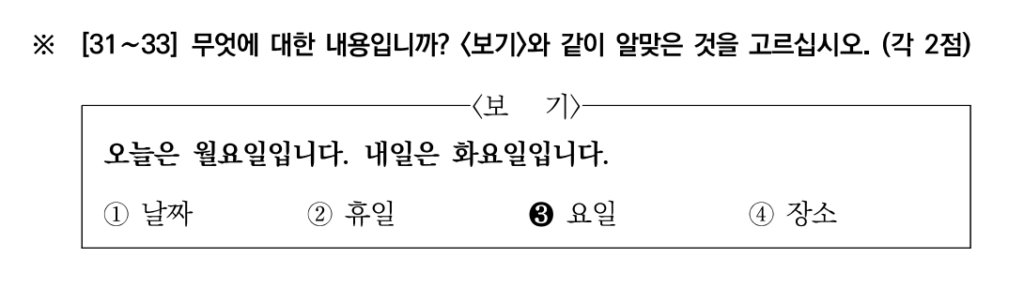
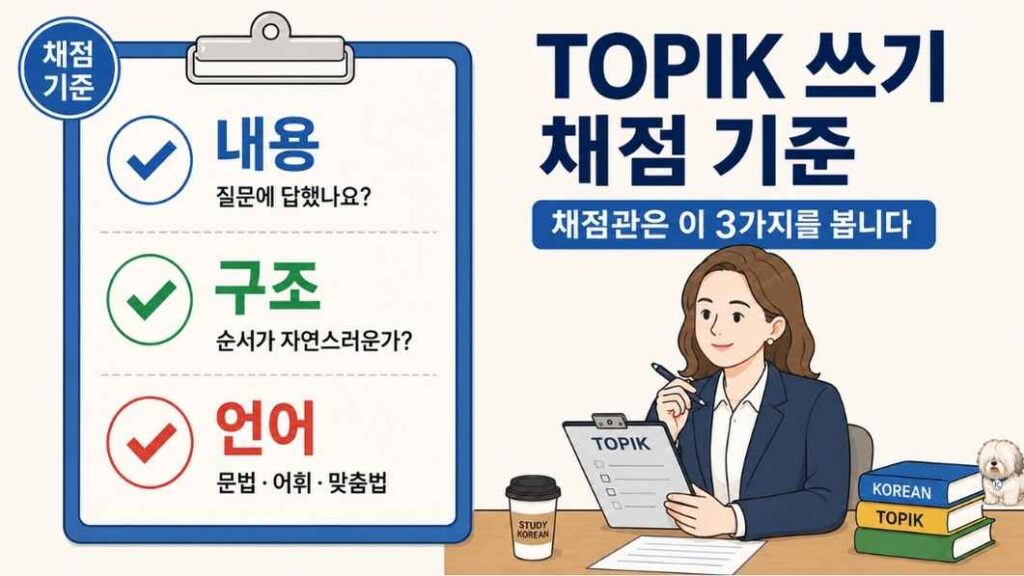
In TOPIK I reading, questions 31–33 ask one thing: “What is this text about?”

You read a short text and choose its topic from four choices. Each question is worth 2 points.

These TOPIK I reading questions are all about vocabulary. If you know the words, you can answer very fast.

Today you will learn a simple “category box” method, and then practice.
Try each question first, then open the answer to check.

① Remember just one thing

When you read, find which “box (category)” the words go into.
Two words share a box → that box is the answer!
e.g. 사과 (apple), 바나나 (banana) → both go in the “과일 (fruit)” box 👉 answer: fruit.

② Category card (quick reference)

3 signal units — see it, and you know the answer right away:
  • ~원 (won)값 (price) — eg. 오천 원 (5,000 won)
  • ~살 (years old)나이 (age) — eg. 스무 살 (20 years old)
  • ~시 (o’clock)시간 (time) — eg. 열두 시 (12 o’clock)

Box (the answer word)When you see these words…
음식 (food)김치, 라면, 불고기, 비빔밥
과일 (fruit)사과, 바나나, 수박, 포도
나라 (country)한국, 미국, 미얀마 (“~에서 왔습니다”)
직업 (job)선생님, 의사, 회사원, 요리사
날씨 (weather)비, 눈, 바람, 춥다, 덥다
취미 (hobby)운동, 등산, 그림 (“좋아합니다”, “자주 합니다”)

Practice: TOPIK I reading questions 31–33

Try each TOPIK I reading question first.

Read the short text, choose the topic, then open the box to check.

Question 1

김치가 맛있습니다. 라면도 맛있습니다.

① 요일② 나라③ 음식④ 값


🔽 See the answer (Question 1)

Q: 김치가 맛있습니다. 라면도 맛있습니다. (Kimchi is delicious. Ramyeon is delicious too.) 👉 “김치”, “라면” → things you eat.

A: ③ 음식 (food) → Both are food! ✅

① 요일 (day) = no words like Monday or Tuesday.

② 나라 (country) = no words like Korea or Japan.

④ 값 (price) = no words like “~원 (won)”.

💡 Tip: When you see food names → the “음식 (food)” box!

Question 2

저는 미국에서 왔습니다. 친구는 미얀마에서 왔습니다.

① 나라② 음식③ 요일④ 선물


🔽 See the answer (Question 2)

Q: 저는 미국에서 왔습니다. 친구는 미얀마에서 왔습니다. (I am from US. My friend is from Myanmar.) 👉 “미국”, “미얀마” → country names.

A: ① 나라 (country) → Both are countries! ✅

② 음식 / ③ 요일 / ④ 선물 = no such words here.

💡 Tip: “~에서 왔습니다 (I came from ~)” + a country name → the “나라 (country)” box!

Question 3

수미 씨는 요리를 합니다. 식당 요리사입니다.

① 가족② 직업③ 이름④ 나이


🔽 See the answer (Question 3)

Q: 수미 씨는 요리를 합니다. 식당 요리사입니다. (Sumi cooks. She is a restaurant cook.) 👉 “요리사 (cook)” → the work someone does.

A: ② 직업 (job) → “cook” is a job! ✅

① 가족 (family) = no words like father or sibling.

③ 이름 / ④ 나이 = no such words here.

💡 Tip: When you see a job name (cook, doctor, teacher) → the “직업 (job)” box!

Question 4

저는 열 살입니다. 동생은 여덟 살입니다.

① 날짜② 시간③ 나이④ 이름


🔽 See the answer (Question 4)

Q: 저는 열 살입니다. 동생은 여덟 살입니다. (I am ten years old. My younger sibling is eight years old.) 👉 “열 살”, “여덟 살” → “~살 (years old)”!

A: ③ 나이 (age) → “~살” means age! ✅

① 날짜 / ② 시간 / ④ 이름 = no such words here.

💡 Tip: ⭐ When you see “~살” → always the “나이 (age)” box!

Question 5

커피는 사천 원입니다. 우유는 이천 원입니다.

① 맛② 옷③ 값④ 일


🔽 See the answer (Question 5)

Q: 커피는 사천 원입니다. 우유는 이천 원입니다. (Coffee is 4,000 won. Milk is 2,000 won.) 👉 “사천 원”, “이천 원” → “~원 (won)”!

A: ③ 값 (price) → “~원” means price! ✅

① 맛 / ② 옷 / ④ 일 = no such words here.

💡 Tip: ⭐ When you see “~원 (won)” → always the “값 (price)” box!

Question 6

지금은 점심입니다. 열두 시입니다.

① 시간② 요일③ 직업④ 휴일


🔽 See the answer (Question 6)

Q: 지금은 점심입니다. 열두 시입니다. (It is lunchtime now. It is twelve o’clock.) 👉 “점심”, “열두 시” → a time (“~시”).

A: ① 시간 (time) → “twelve o’clock” is a time! ✅

② 요일 / ③ 직업 / ④ 휴일 = no such words here.

💡 Tip: ⭐ When you see “~시 (o’clock)” → always the “시간 (time)” box!

Question 7

오늘은 눈이 옵니다. 아주 춥습니다.

① 계획② 날씨③ 방학④ 계절


🔽 See the answer (Question 7)

Q: 오늘은 눈이 옵니다. 아주 춥습니다. (It is snowing today. It is very cold.) 👉 “눈 (snow)”, “춥다 (cold)” → about the weather.

A: ② 날씨 (weather) → snow and cold are weather! ✅

① 계획 / ③ 방학 = no such words here.

④ 계절 (season) = needs words like spring, summer, fall, winter. They are not here.

💡 Tip: rain, snow, wind, hot, cold → the “날씨 (weather)” box! (Do not confuse it with “season”.)

Question 8

저는 그림을 좋아합니다. 주말에 자주 그립니다.

① 쇼핑② 장소③ 취미④ 날씨


🔽 See the answer (Question 8)

Q: 저는 그림을 좋아합니다. 주말에 자주 그립니다. (I like drawing. I often draw on weekends.) 👉 “그림 (drawing)”, “자주 그립니다 (often draw)” → something you enjoy doing.

A: ③ 취미 (hobby) → drawing is a hobby! ✅

① 쇼핑 / ② 장소 / ④ 날씨 = no such words here.

💡 Tip: “좋아합니다 (like)” + “자주 합니다 (often do)” → the “취미 (hobby)” box!

③ How to memorize the words easily

Now you have practiced, here is the fastest way to build your TOPIK I reading vocabulary.

  1. Group by box. Don’t memorize words one by one. Put 김치, 라면, 불고기 together in the “food” box — about 3–5 words per box.
  2. Make pairs. One word + one box: doctor–job, snow–weather, apple–fruit.
  3. Learn the 3 signal units first: ~원 → 값, ~살 → 나이, ~시 → 시간. When you see them, you already know the answer!
  4. Quiz yourself. Cover the box name, look at a word, and say the box.

🤖Practice with AI: a listening game 🎧

Here is a new game — a listening game. The AI reads two short Korean sentences, and you say the topic in one Korean word. You only need one word, so it is easy — and you train your ears too!

First, turn on the AI’s voice (read-aloud). The AI reads in Korean; you answer with one Korean word out loud.

🗣️“Let’s play a topic listening game. Read TWO short, easy Korean sentences out loud (beginner level, slowly). I will listen and say the topic in ONE Korean word. Then tell me if I am right in English. For example, you read ‘사과가 맛있어요. 바나나도 맛있어요.’ and I should say ‘과일 (fruit)’. Pick topics from: food, fruit, country, job, family, weather, hobby, clothes, price, age, time. Give me 5 rounds and count my score.”

⚠️ AI can make mistakes. Always check with real past exams at the end. AI is for practice; the past exams are the answer key.th real past exams at the end. AI is for practice; the past exams are the answer key.

Summary

  • Find the “box (category)” of the words. Two words, one box = the answer!
  • Remember the 3 signal units: ~원 → 값, ~살 → 나이, ~시 → 시간.
  • Study a little TOPIK I reading every day. Learn one box each day — that is enough!

OK! You Work hard Today!

Don’t give up. Keep practicing, and you can all pass TOPIK Level 2. 🎉

If you have any questions, leave a comment.

See you in the next lesson! 🌱

📢 want to practice TOPIKⅠ Listening next? 👉 [ TOPIKⅠ Listening ] 

FAQ

Q: What are TOPIK I reading questions 31–33?

A: You read a short text and choose its topic (화제) from four choices. Each question is worth 2 points.

Q: How do I find the topic fast?

A: Find which “box (category)” the words go into. When two words share the same box, that box is the answer (사과, 바나나 → 과일 / fruit).

Q: Which words give the answer away instantly?

A: Signal units: ~원 → 값 (price), ~살 → 나이 (age), ~시 → 시간 (time). When you see them, you already know the answer.


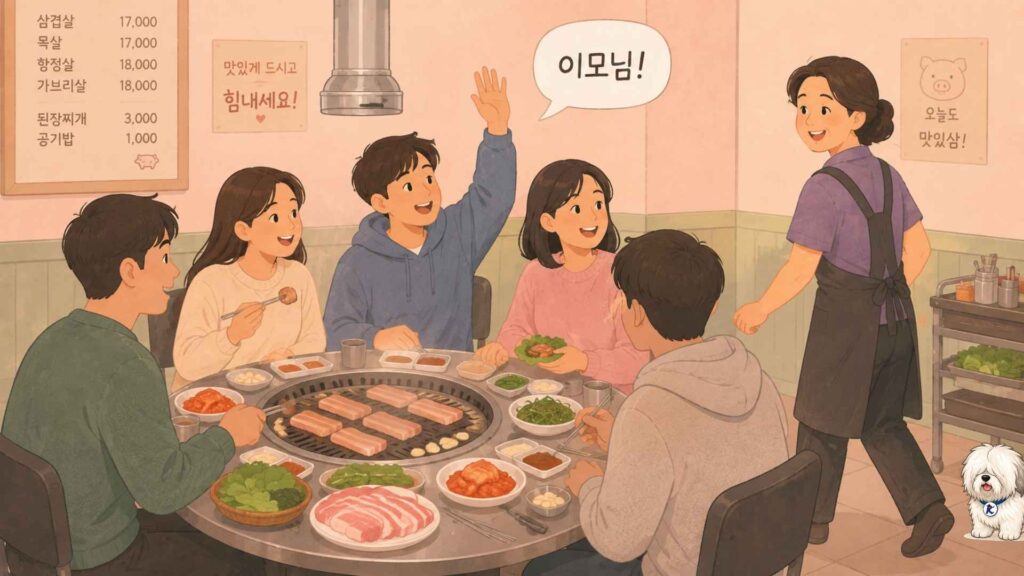
Why Do Koreans Ask your Age When You First Meet?

ask age
💡 한국어로 읽고 싶어요? 👉 [ 여기에서 쉬운 한국어로 읽어 보세요! ]

Welcome! 😃

Let me ask a question first. If you watch Korean dramas, you have probably seen this. Two people meet for the first time. And right after saying hello, one of them asks:

“How old are you, if you don’t mind?”

Why do Koreans ask age when you first meet? For a Korean learner, this can feel a little strange.

“Why do they want to know my age already? Isn’t that rude?”

But there is an interesting secret behind ask age. Let me tell you the story.

Don’t worry — at first, you don’t need to know

Let’s start with the most reassuring part.

When you meet someone for the first time, you don’t need to know their age. Before you ask age, Remember the polite speech from our earlier stories, like “안녕하세요? (an-nyeong-ha-se-yo?)” With someone you just met — older or younger — you can simply use polite speech (존댓말, jon-daen-mal).

💡If you want to see the previous post, 👉 [ Click here ] 

That is always safe.

  • Someone who looks younger than you → polite speech
  • Someone who looks about your age → polite speech
  • Someone who looks older than you → polite speech

So you don’t have to worry, “I can’t talk to them because I don’t know their age.” Polite speech works for everyone at the start.

So when does age matter?

Then why do Korean people ask age so often? Age becomes important not at the first meeting, but a little later, once you get closer.

Think about English. The word you stays the same whether the person is 5 or 80.

Korean is a little different. After you become close, the ending of your sentences and the way you call each other can change.

🙇‍♂️ Keep polite speech "어디 가세요?(eo-di ga-se-yo?)" — (Where are you going?)
🙋‍♂️Or switch to casual speech "어디 가?(eo-di ga?)"— (Where are you going?)

So age is not really about “I’m curious how old you are.” It helps answer, “Should we keep using polite speech, or can we speak casually now?” And even then, age is not the only thing that matters. It is just one of many.

If you want to know a title, ask this — not their age

Korean also has special words to call someone. Among close people, you might call someone a little older than you:

  • 오빠 (oppa) — a woman calling an older man
  • 형 (hyeong) — a man calling an older man
  • 언니 (eonni) — a woman calling an older woman
  • 누나 (nuna) — a man calling an older woman

But here’s the thing: you don’t call someone “오빠” or “언니” just because they’re older, right after meeting them. These words are for people you’ve already become close to.

So when you’re not sure how to address someone, there’s a better question than to ask age:

“제가 어떻게 불러 드리면 될까요? (je-ga eo-tteo-ke bul-leo deu-ri-myeon dwael-kka-yo?)”

“What should I call you?”

This one sentence is very handy. It doesn’t ask the person to reveal their age, but it tells you exactly what you want to know. And if you’re still unsure, just saying “○○ 씨 (ssi)” with their name is always safe.

Same age? It’s easy to become friends

There’s a fun case, too — when you’re the same age. When two people learn they are the same age, it feels friendly. So they might say, “Oh, we’re the same age! Should we speak casually?” They stop using polite speech and start speaking comfortably.

This is called “말을 놓다(Mal-eul no-da)” or “말을 트다(Mal-eul teu-da)”

But remember one thing. Being the same age doesn’t mean you can just start using casual speech. Casual speech begins not because of age, but because both people agree to it.

So they ask:

괜찮으면 우리 말 놓을까요? (gwaen-cha-neu-myeon u-ri mal no-eul-kka-yo?)”

“If it’s okay, shall we speak casually?”

When both people say “yes”, that’s when the comfortable friendship begins.

🔎 Wait — what about Korean age?

The official age is your international age.

But to check if you’re the same age, people often ask

몇 년생이에요? (myeot nyeon-saeng-i-e-yo?)”

— “What year were you born?”

You might be wondering why Koreans ask the year instead of the age. There’s an interesting reason.

In the past, Korea had its own way of counting age. A baby was already counted from the moment the mother became pregnant — so when the baby was born, they were already one year old. Because of this, Korean age was usually one or two years higher than international age.

But in 2023, this old system was officially dropped. Now everyone officially uses their international age. Still, the old Korean-age culture hasn’t fully disappeared from daily life. That’s why, to be more exact, many people ask what year you were born — “몇 년생이에요? (myeot nyeon-saeng-i-e-yo?)” — rather than age.

But is it okay to ask?

Here is something important to know. Don’t simply memorize, “In Korea, it’s fine to ask someone’s age.”

The truth is, not every Korean feels comfortable with the age question either. When it’s fairly natural

  • After you’ve talked enough and become comfortable with each other
  • When the other person brings up their age or birth year first
  • In a group of peers, where age really matters for the group

When it’s better to be careful

  • Asking it as your very first question, right after hello
  • At work, or in a formal setting
  • When the person avoids the answer or looks uncomfortable

So instead of treating “asking age” as a rule, it’s better to first check whether the other person feels okay with it.

That said, don’t be too surprised if an older person on the street asks your age as their very first question. Asking about age is one of Korea’s old traditions, and for many older Koreans, it feels completely natural. It’s not meant to be rude — it’s often just their way of figuring out how to talk to you.😉

If you don’t want to share your age

On the other hand, someone asks your age — but you’d rather not say. You can gently reply:

  • 조금 더 친해지면 말씀드릴게요. (jo-geum deo chi-nae-ji-myeon mal-sseum-deu-ril-ge-yo.) — “I’ll tell you once we’re a bit closer.”
  • 그냥 ○○ 씨라고 불러 주세요. (geu-nyang ○○ ssi-ra-go bul-leo ju-se-yo.)” — “Just call me by my name.”

Saying this is not rude at all. You also have the freedom not to share your age.

One last thing

In Korea, people ask age for many reasons. Sometimes to choose the right speech and title, sometimes to see if you’re the same age, and sometimes just out of curiosity. That feeling isn’t always a bad thing.

Often, there’s a warm wish behind it: “I’d like to get a little closer to you.” But it’s also good to remember that not everyone in Korea enjoys this question. So if you keep these three things in mind, you’ll be safe:

  1. At first, you don’t need their age — just use polite speech.
  2. If you want to know a title, ask “What should I call you?” instead of their age.
  3. Casual speech begins with agreement, not age.

Know these three, and the Korean habit of asking age will feel easy to understand.

In your country, is it rude or normal to ask someone’s age when you first meet? Tell me in the comments. I would love to know.🥰


📝 Just remember this

SituationThe safe choice
Someone you just metPolite speech first, no matter their age
Someone older than youUsually polite speech
A close older friend오빠 / 형 / 언니 / 누나, depending on the relationship
Someone the same ageCasual speech, if you both agree
When you don’t know how to address them“What should I call you?”
When you’d rather not share your age“I’ll tell you once we’re closer”

One-line takeaway: Age can shape speech and titles, but if you’ve just met, polite speech comes before age.


Okay! Well done! If you enjoyed this post, you’ll love my next one too! See you again soon!

Read more 👉 Why Does Korean "Hello" Have a Question Mark? 

<Latest Posts>

Why Does Korean “Hello” Have a Question Mark? (1 Secret)

Korean Hello
📌 한국어가 쉬워요? 여기를 보세요.👉 [한국어 blog]

Hello? Bonjour? Hola? 你好? السلام عليكم? नमस्ते? Здравствуйте?

Does the greeting in your language have a question in it? How do you say Hello in Korean?

You say “안녕하세요?” (an-nyeong-ha-se-yo?), right?

But look closely — there is a question mark (?) at the end. Open any Korean textbook, and it is always there.

Korean Hello

So why does the “Korean Hello” sound like a question? Let me tell you a little story.

What does Korean Hello “안녕?” really mean?

When learning Korean Hello “안녕(an-nyeong)?“, Most students never even notice this little question mark — but once you do, the first question is simple: what does “안녕” actually mean?

안녕 (安寧)” comes from Chinese characters. A long time ago, before King Sejong created Hangul, Korean people spoke Korean but wrote with Chinese characters. Even today, many Korean words still come from them. (We’ll talk more about this in another story.)

They mean a state of being calm and safe, with nothing wrong.” In English, it is close to “peace or well-being“.

So if we translate “안녕하세요?” word by word, it sounds like this:

“Are you at peace? Are you doing well, with nothing wrong?”

Is it the same as “How are you?” then? Almost.

In Korean, “How are you?” is usually “잘 지내세요?” (jal- ji-nae-se-yo?).

When you add a “question mark(?)” to the greeting “안녕하세요”, it becomes a soft way of asking about someone. If you really want to ask how they are, you write “안녕하세요?“. If it is just a light hello, you write “안녕하세요.

And honestly, when you speak, the sound matters more than the mark. Raise your voice a little at the end, and it feels like a question. Keep it flat, and it feels like a greeting.

Wait — Why do Korean keep asking about my life?

When you come to Korea, you will hear these too:

“밥 먹었어요?” (bap meo-geos-seo-yo?)Did you eat?

“어디 가세요?” (eo-di ga-se-yo?)Where are you going?

At first, this can feel strange.

Why do they want to know if I ate, or where I am going?”

But Korean people are not really trying to look into your private life. These are like cousins of “안녕하세요?”.

It is closer to a warm “You doing okay? Nothing wrong?”

Why do Koreans ask if you are okay?

Here comes the old story.

Long ago in Korea, neighbors lived close together and helped each other. They farmed together, and they got through hard times together.

Because of where Korea sits on the map, it was invaded by other countries many times through history. So there were many poor and hungry years. In times of war, or when people were dying of hunger, the first thing you wondered each morning was simple: Is my neighbor safe? Did anything bad happen in the night?

So when people met, they greeted each other like this:

“Are you at peace? Are you doing well?”
“You are not going hungry, are you?”

In years when many people were hungry, “밥 먹었어요? (Did you eat?)” really meant “Are you okay? Did you get enough to eat?” That caring feeling still lives inside today’s “안녕하세요?”.

Of course, this is not a proven history. But when you think of it this way, doesn’t a simple daily greeting start to feel a little warmer?

So remember just one thing: in Korean, a question-shaped greeting is not really asking for information. It is a way to start a conversation and to check in with each other.

How do I know what these greetings really mean?

It depends on the situation. Take “밥 먹었어? (Did you eat?)”:

  • From an adult or a friend you have not seen in a while → it means How have you been?”
  • Right before a meal time → it might mean “Want to eat together?”
  • After a meal time → it might really be asking if you ate

You can answer simply.

“네, 먹었어요. (Yes, I ate.)” or “아직요. ○○ 씨는요? (Not yet. How about you?)” is enough.

어디 가세요? (Where are you going?)” works the same way.

If you do not want to explain, you can just say “잠깐 볼일 보러 가요. (I’m just going out for a bit.)”

And “안녕하세요?” can feel like “How are you?”, but most of the time you do not need a long answer.

Just saying “안녕하세요?” back is perfect.

Who do I say it to?

When using Korean Hello in daily life, greetings have different levels of politeness.

They change a little depending on who you are talking to.

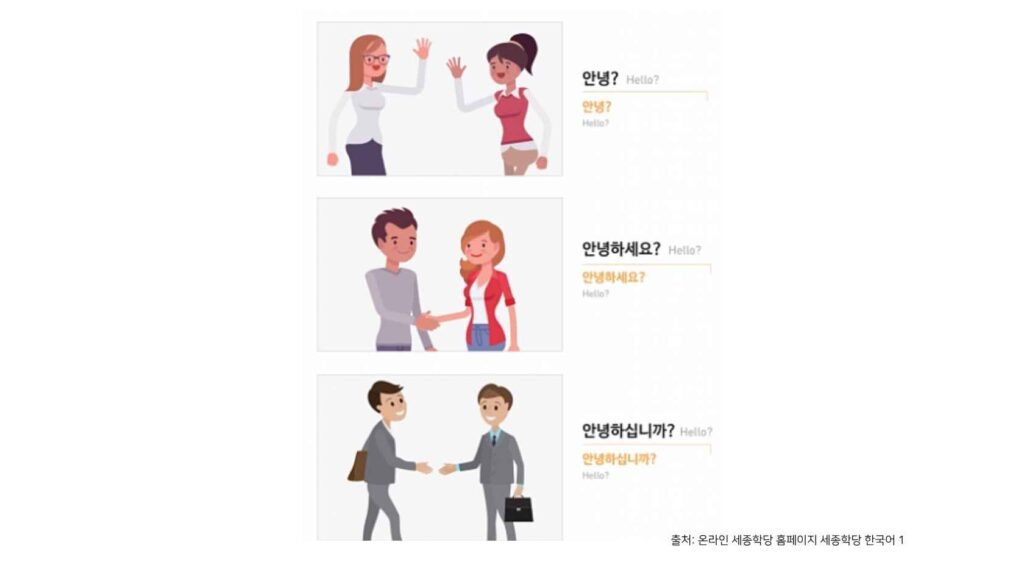
  • 안녕? (an-nyeong?) → a close friend, a child, or someone you already speak casually with
  • 안녕하세요? (an-nyeong-ha-se-yo?) → someone you just met, and most everyday situations (the safest choice)
  • 안녕하십니까? (an-nyeong-ha-sim-ni-kka?) → very formal places, like a presentation, an interview, or an official event

Remember one thing. With a child, “안녕?” feels natural.

But with an adult who looks a little younger than you, or with someone you just met, “안녕하세요?” is the safe choice — no matter their age.

The key is not age. It is your relationship.

One last thing

“안녕하세요?” is not just “Hello”. Inside it is an old, kind wish: I hope you are doing well.

So next time you greet someone with “안녕하세요?“, remember this little story. You are greeting them in a very old way, quietly saying:

“I hope you’re doing well today.”

Does “안녕하세요?” make a little more sense now?

So when you meet a Korean person on the street, let’s greet them properly — not just “안녕”, but “안녕하세요?

Does your language have a greeting that looks like a question? Tell me in the comments. I would love to know.🥰

See you again!

💡 Want to study more Korean expressions with detailed explanations? Check This 👉 [Korean culture!]


📝 Just remember this

SituationSay this
A close friend안녕? / 안녕! (annyeong)
Someone you just met, most situations안녕하세요? (annyeonghaseyo — safest)
Presentation, interview, formal event안녕하십니까? (annyeonghasimnikka)

Sino-Korean Numbers 101: Mastering Price Expressions

Sino-Korean Numbers

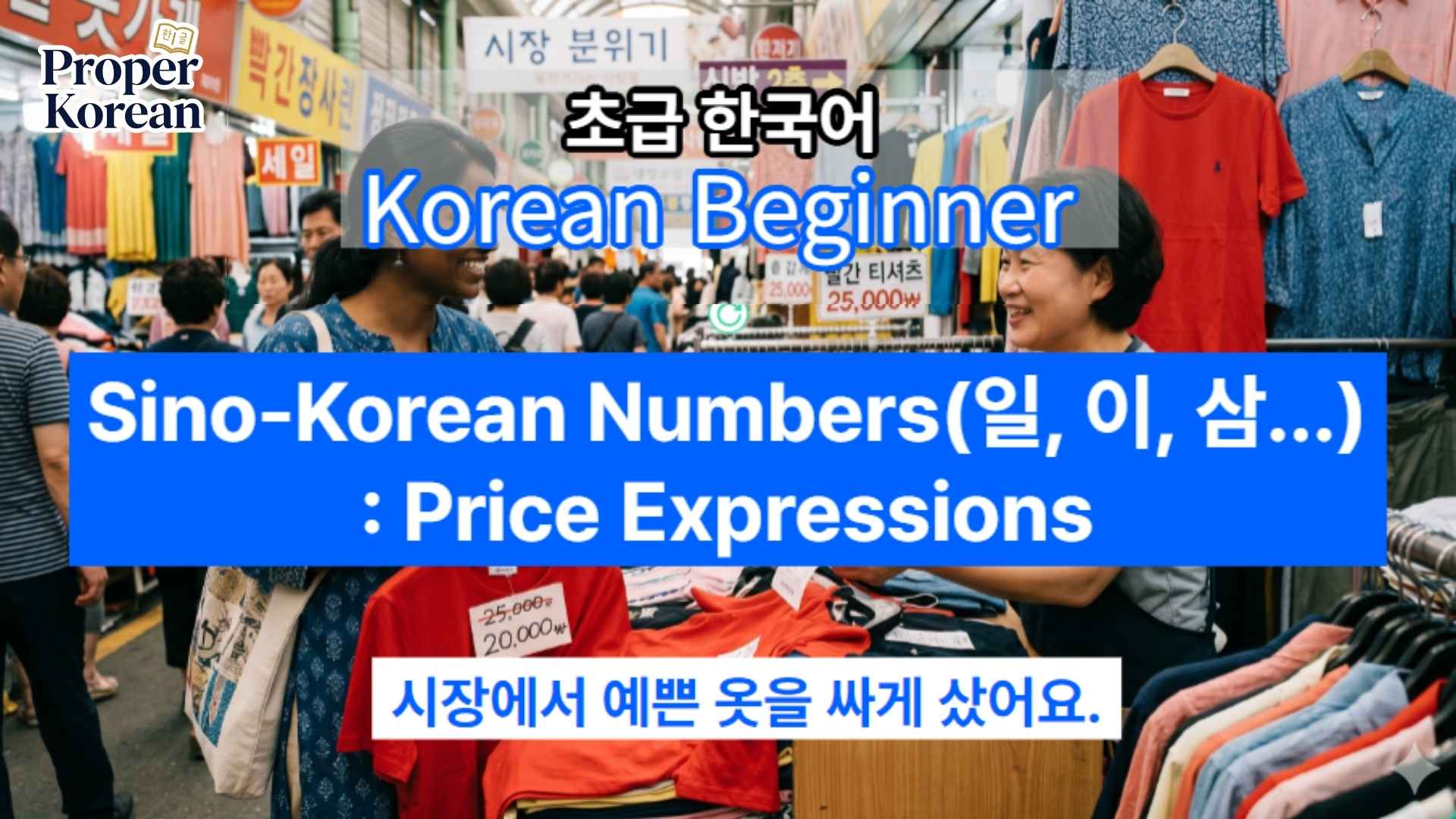
‘Sino-Korean Numbers (일, 이, 삼, 사…)‘ are essential for daily life in Korea and for visiting Korea’s charming traditional markets.

Korean has two ways to count numbers, so many learners find it a bit confusing at first. But don’t worry! Today’s lesson is on Sino-Korean numbers, which are very useful when talking about prices, dates, phone numbers, and floor levels.

Once you master this, you will be able to confidently ask and answer prices when you find an outfit or shoes you love in a traditional market! Let’s get started, shall we?

1. Meaning & Function of Sino-Korean Numbers

The Korean number system is largely divided into ‘Sino-Korean Numbers’ and ‘Native Korean Numbers’. The Sino-Korean numbers (일, 이, 삼, 사…) we are learning today are mainly used in the following situations:

TypeReadingUsage
한자어 수
Sino-Korean Numbers
일·이·삼·사·오…Prices (Won), Dates (Month/Day), Floors, Phone numbers, Minutes (Time)
고유어 수
Native Korean Numbers
하나·둘·셋·넷·다섯…Quantity (Items/Clothes/Pairs), Age, Hour (Time)

🌟 Key Point for Shopping! 물건의 가격을 말할 때는 꼭 한자어 수(일, 이, 삼, 사)로 말하세요~! When you ask for the price of an item in a market, you must use ‘Sino-Korean Numbers’.

  • ✅ 이만 오천 원이에요. (It is 25,000 won.)
  • ❌ 두만 다섯천 원이에요. (This is incorrect.)

2. Number Table & Price Expressions of Sino-Korean Numbers

① Basic Sino-Korean Numbers (0 ~ 10)

NumberSino-KoreanNumberSino-Korean
0영 / 공6
17
28
39
410
5

② Large Numbers and Units

UnitSino-Korean Example
1015 → 십오 (Sip-o)
100300 → 삼백 (Sam-baek)
1,0005,000 → 오천 (O-cheon)
10,00020,000 → 이만 (I-man)

③ Price Reading Practice

Unlike English, Korean prices are counted in units of 10,000 (Man) rather than 1,000 (Thousand). This is very important! Read the numbers in order from left to right and add ‘원 (Won)’ at the end.

PriceHow to Read
500원오백 원 (O-baek won)
1,000원천 원 (Cheon won) (Note: Do not say ‘Il-cheon won’)
3,500원삼천오백 원 (Sam-cheon-o-baek won)
10,000원만 원 (Man won) (Note: Do not say ‘Il-man won’)
15,000원만 오천 원 (Man o-cheon won)
23,000원이만 삼천 원 (I-man sam-cheon won)
100,000원십만 원 (Sip-man won)

④ Expanded Real-Life Examples

Here are 10 diverse, real-life example sentences showing how to use Sino-Korean numbers for prices, dates, floors, and phone numbers in everyday situations.

ContextKorean SentenceEnglish Translation
Shopping (Asking Price)이 모자는 팔천 원이에요.This hat is 8,000 won.
Shopping (Bargaining)이만 오천 원으로 깎아 주세요.Please give me a discount of 25,000 won.
Shopping (Total Amount)오늘 시장에서 사만 원을 썼어요.I spent 40,000 won at the market today.
Location (Floor)화장실은 층에 있어요.The restroom is on the 3rd floor.
Appointment (Date)제 생일은 십오 일이에요.My birthday is May 15th (5th month, 15th day).
Contact (Phone Number)제 전화번호는 공일공-일이삼사-오육칠팔이에요.My phone number is 010-1234-5678.
Time (Minutes)지금은 세 시 오십 분이에요.It is 3:50 now.
Transportation (Bus Number)학교에 갈 때는 백사 번 버스를 타요.I take bus number 104 when going to school.
Shopping (Change)거스름돈은 이천 원이에요.The change is 2,000 won.

For more official information about Korean culture, visit the King Sejong Institute.

3. Common Mistakes of Sino-Korean Numbers

What are the most common mistakes learners make when reading numbers? Check the table below to see the correct expressions!

❌ Incorrect✅ CorrectReason
23,000원
➡️ 이십 삼천 원 (❌)
23,000원
➡️ 이만 삼천
Koreans use the 10,000 (Man) unit, not the 1,000 (Cheon) unit.
10,000 ➡️ 일만 원 (❌)
1,000 ➡️ 일천 원 (❌)
10,000 ➡️
1,000 ➡️
The number ‘1 (Il)’ at the beginning of a large number is usually omitted.
8,000원 ➡️ 여덟천 원(❌)8,000원 ➡️ 팔천Do not mix Native Korean numbers with Sino-Korean numbers for prices.

4. Real-Life Dialogue

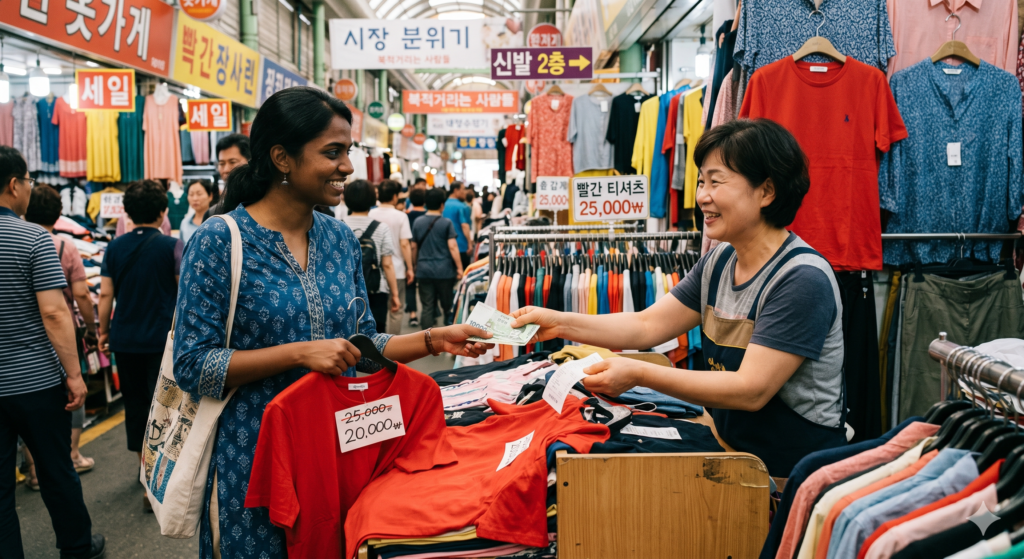
Aditi, an international student from India, is talking to a store owner at a traditional market. Let’s see how Sino-Korean numbers are used in the conversation!

Sino-Korean Numbers lesson for beginners

① Listening Practice (듣기 연습)

Instructions: Listen first and answer the following questions.

1) 아디티 씨는 무엇을 샀습니까?

2) 아디티 씨는 영수증을 받았습니까?

  • 아디티: 저 빨간 옷 얼마예요?
  • 직 원: 이만 오천 원이에요.
  • 아디티: 조금 비싸요. 깎아 주세요!
  • 직 원: 그럼 이만 원에 드릴게요.
  • 아디티: 감사해요! 여기 이만 원이요.
  • 직 원: 네, 영수증 드릴까요?
  • 아디티: 네, 주세요. 그런데 신발 가게는 몇 층이에요?
  • 직 원: 이 층이에요.

② Comprehension Questions (내용 이해 질문)

1) 아디티 씨는 어떤 옷을 사고 싶어 해요?

2) 아디티 씨는 그것을 얼마에 샀어요?

3) 아디티 씨는 또 무엇을 사고 싶어 해요?

5. AI Tutor Practice

🤖 Digital Literacy Tip! You can practice price expressions with an AI Tutor (ChatGPT). Instead of just memorizing, try simulating a shopping scenario with AI. It will help you remember the numbers much faster!

[Copy and paste this prompt into AI: like ChatGPT ]

“I am a beginner Korean student studying Sino-Korean numbers. Please act as a shop owner in a Korean traditional market. I will ask you for the price of different items, and you answer using Sino-Korean numbers (e.g., 15,000 won, 23,000 won). Please keep the conversation simple and correct my mistakes in Korean.”

6. Today’s Quiz

Test your knowledge of the prices and numbers we learned today!

[Quiz 1] Read the following prices in Sino-Korean numbers.

  1. 3,000원 => ( ___________________ )
  2. 12,000원 => ( ___________________ )
  3. 25,000원 => ( ___________________ )

[Quiz 2] Complete the dialogue.

  • 가: 이 편한 신발은 얼마예요? (How much are these comfortable shoes?)
  • 나: ___________________________이에요. (119,000원)

7. Wrap-up

Today, we studied Sino-Korean numbers, which are essential for asking and answering prices at a market. Now, you won’t be confused when you see price tags or hear the vendor telling you the price, right? Don’t forget to review on your own!

Next Lesson Preview: In the next lesson, we will learn about ‘Counter Nouns’ (개, 벌, 켤레, etc.) used to count items such as apples, clothes, and shoes.

Next Lesson Preview: In the next lesson, we will learn about ‘Counter Nouns’. You can also review our previous lessons on the Proper Korean Home.

See you next time! 또 만나요~:)

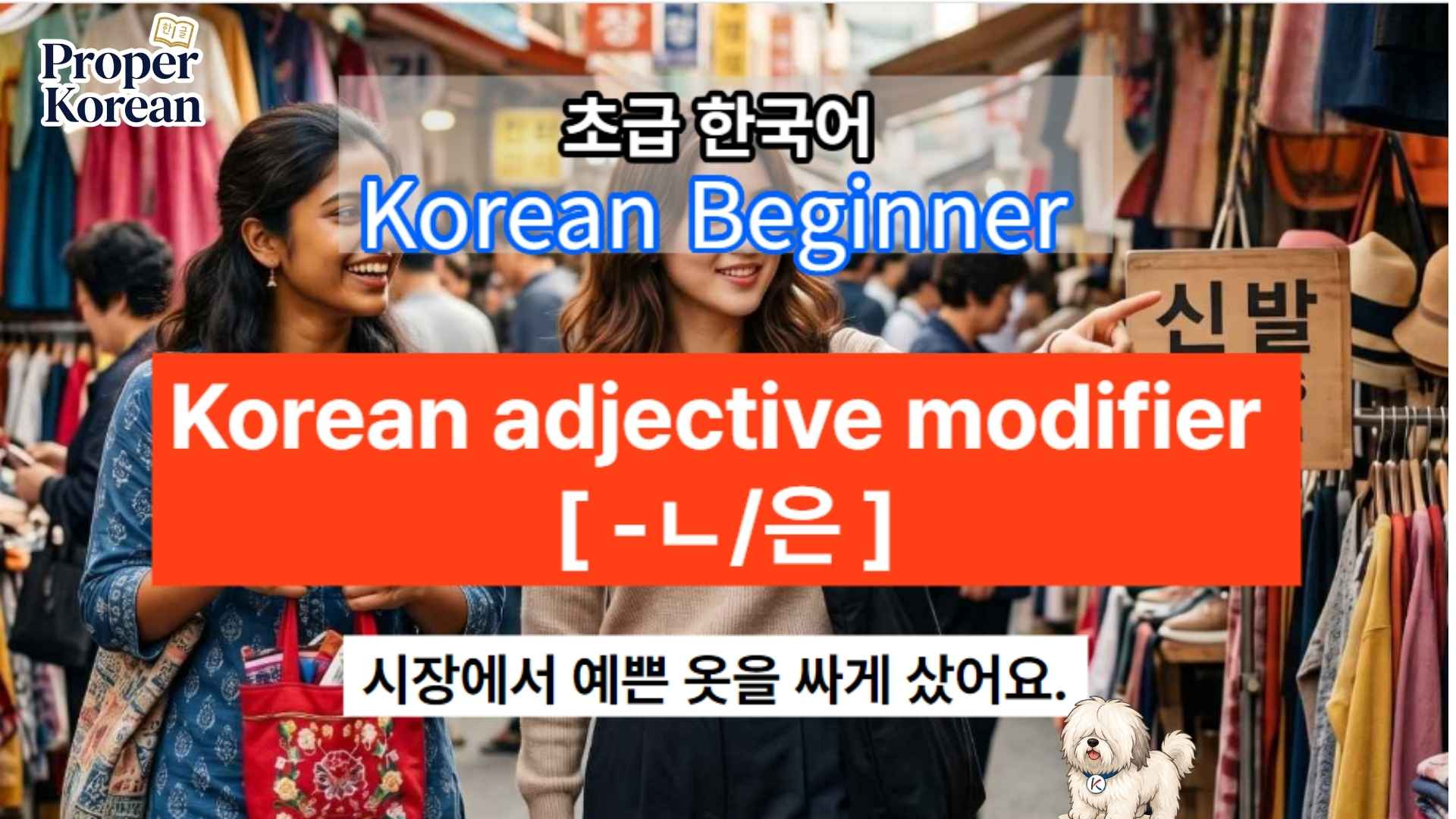
Korean adjective modifier ‘-ㄴ/은’

Korean adjective modifier

Have you ever visited a traditional Korean market? When you walk through the market(전통시장), you will see many pretty clothes and delicious foods everywhere!

But have you ever struggled to explain exactly what you want to buy?

For example, instead of just saying “I want to buy a bag (가방을 사고 싶어요),” wouldn’t it be much better if you could say, “I want to buy a cheap bag (싼 가방을 사고 싶어요)” or “I am looking for a small bag (작은 가방을 찾고 있어요)”?

After reading this blog post, you will be able to describe the characteristics of any object or person beautifully and accurately, just like a native speaker! Are you ready to find out how this grammar works? Let’s explore together!

1. Meaning & Function Korean adjective modifier

In English, when you want to describe a noun, you simply place the adjective before it (e.g., pretty clothes, cheap bag). In Korean, however, you cannot put a basic adjective form (like 예쁘다 or 싸다) directly in front of a noun.

To make an adjective describe a noun, you must drop the dictionary ending -다 and attach -ㄴ or -은 to the adjective stem. This form is called the determiner form (관형사형).

  • 예쁘다 (to be pretty) + (clothes)예쁜 옷 (pretty clothes)
  • 싸다 (to be cheap) + 가방 (bag)싼 가방 (a cheap bag)

Using this grammar allows you to vividly explain the unique features of objects, places, or people around you!

2. Conjugation Rules & Table of Korean adjective modifier

The form changes depending on whether the adjective stem ends in a vowel or a final consonant (받침). Let’s look at the three simple rules.

Rule 1: No Final Consonant (Ends in a Vowel) ➡️ Add ‘-ㄴ’

If the adjective stem does not have a final consonant, simply attach -ㄴ to the bottom of the stem.

Dictionary FormStemChangeFinal FormExample Sentence
싸다
(to be cheap)
싸-+ ㄴ시장에서 옷을 많이 사요.
(I buy a lot of cheap clothes at the market.)
크다
(to be big)
크-+ ㄴ 가방을 사고 싶어요.
(I want to buy a big bag.)
예쁘다
(to be pretty)
예쁘-+ ㄴ예쁜저기 예쁜 모자가 있어요.
(There is a pretty hat over there.)
편하다
(to be comfortable)
편하-+ ㄴ편한저는 편한 신발을 찾고 있어요.
(I am looking for comfortable shoes.)

Rule 2: Has a Final Consonant (받침) ➡️ Add ‘-은’

If the adjective stem ends in a final consonant, add -은 right after the stem.

Dictionary FormStemChangeFinal FormExample Sentence
작다
(to be small)
작-+ 은작은아디티 씨는 작은 가방을 찾아요.
(Aditi is looking for a small bag.)
좋다
(to be good)
좋-+ 은좋은여기 정말 좋은 시장이 있어요.
(There is a really good market here.)
많다
(to be many/a lot)
많-+ 은많은주말에 시장에 많은 사람이 왔어요.
(A lot of people came to the market on the weekend.)

Rule 3: ‘ㄹ’ Final Consonant ➡️ Drop ‘ㄹ’ and Add ‘-ㄴ’

If the adjective stem ends in the consonant , you must remove the first, and then attach -ㄴ underneath.

Dictionary FormStemChangeFinal FormExample Sentence
길다
(to be long)
길-Drop ㄹ + ㄴ수엔 씨는 치마를 입었어요.
(Xuyen wore a long skirt.)
멀다
(to be far)
멀-Drop ㄹ + ㄴ저는 학교에서 곳에 살아요.
(I live in a place far from the school.)

💡 Teacher’s Note: Watch out for Color Adjectives! (ㅎ Irregular)

Color words like 빨갛다 (to be red), 파랗다 (to be blue), 하얗다 (to be white), and 까맣다 (to be black) drop the and change their forms uniquely before a noun:

  • 빨갛다 + 옷 → 빨간 옷 (Red clothes)
  • 파랗다 + 가방 → 파란 가방 (Blue bag)
  • 하얗다 + 신발 → 하얀 신발 (White shoes)
  • 까맣다 + 모자 → 까만 모자 (Black hat)

3. Common Learner Mistakes of Korean adjective modifier

As a beginner, it is very natural to make mistakes. Let’s look at what foreign students frequently mix up so you can avoid these common traps! Understanding these traps will make you a master of the Korean adjective modifier rules.

❌ Incorrect✅ CorrectWhy is it wrong? DOCX
빨갛다빨간You cannot use the base dictionary form directly before a noun. You must conjugate it to match the noun-modifying rule!
작다 가방작은 가방Since the stem 작- has a final consonant, you must append -은 instead of leaving it plain.
먹는 음식Warning! The formula -ㄴ/은 is strictly used for Adjectives. For Verbs (like 먹다 – to eat, 사다 – to buy), a completely different modifier form (-는) is used. We will learn that in a later chapter!

4. Real-Life Dialogue (At a Local Market)

Let’s read a conversation between two international students: Xuyen (from Vietnam) and Aditi (from India). They are enjoying a weekend shopping trip at a traditional Korean market near their university. Pay close attention to how they use today’s grammar-Korean adjective modifier point!

korean adjective modifier

① Listening Practice (듣기 연습)

Instructions: Listen to the dialogue and answer the following questions.

1) 여기는 어디입니까?

2) 누가 가방을 샀습니까?

  • 수 엔 : 네, 이 시장은 물건이 많아서 자주 와요. 아디티 씨는 뭘 사고 싶어요?
  • 아디티 : 저는 작은 가방을 찾고 있어요. 어! 저기 빨간 가방이 있어요!
  • 수 엔 : 정말 예쁜 가방이네요.
  • 아디티 :빨간 가방은 얼마예요?
  • 판매원 : 이만 원이에요.
  • 아디티 : 와, 정말 가격이에요! 살게요. 수엔 씨는요?
  • 수 엔 : 저는 편한 하얀 신발을 사고 싶어요. 저쪽에 신발 가게가 있으니까 같이 가요!

② Comprehension Questions (내용 이해 질문)

1) 아디티 씨는 어떤 가방을 샀습니까?

2) 가방은 얼마입니까?

3) 수엔 씨는 어떤 물건을 사고 싶어 합니까?

5. AI Tutor Practice

🤖 Digital Literacy Tip! The best way to master a new language is to practice using it actively. We want you to use AI as your personal conversation partner! Copy the prompt box below and paste it into ChatGPT (or any AI tool) to start practicing your real-life shopping dialogue with Korean adjective modifier right now.

[Copy and paste this prompt into AI ]

Act as a kind and encouraging Korean language teacher. I am a beginner-level student practicing the grammar "-ㄴ/은 [명사]" (Korean adjective modifying a noun) based on a shopping/market context.

Please follow these steps:
1. Greet me warmly in easy Korean and ask me what kind of item I want to buy at the traditional market today.
2. When I reply in Korean, check if I correctly used the "-ㄴ/은" adjective modifier grammar form. 
3. If I make a mistake with grammar, spelling, or vocabulary, gently point out the error, explain why, and provide the corrected sentence.
4. Keep the conversation going for 3-4 turns by asking simple follow-up questions (such as asking about the color, size, or price of the item).
5. Please use simple Korean suitable for an elementary/TOPIK Level 2 learner, and include English translations in parentheses for your responses so I can follow along easily.

6. Today’s Quiz

Test your understanding of Korean adjective modifier with these practice exercises based on today’s lesson!

[Quiz 1] Conjugate the adjective in the brackets to complete the phrase.

  1. ( 예쁘다: to be pretty ) + → __________
  2. ( 작다: to be small ) + 가방 → __________ 가방
  3. ( 편하다: to be comfortable ) + 신발 → __________ 신발
  4. ( 비싸다: to be expensive ) + → __________

[Quiz 2] Combine the two short sentences into one fluid sentence using today’s grammar, following the example.

Example (보기): 가방이 있어요. 그 가방은 커요. => 큰 가방이 있어요. (There is a big bag.)

  1. 옷이 있어요. 그 옷은 싸요. => _____________________
  2. 신발이 있어요. 그 신발은 편해요.=> _____________________

7. Wrap-up & Next Lesson

Fantastic job today! Today, we completely conquered the korean adjective modifier form!

You have learned how to use the adjective modifier -ㄴ/은 to vividly describe people and objects around you. Now you don’t have to just point at an object and say “this” or “that”—you can proudly say “예쁜 옷 (pretty clothes)” or “작은 가방 (small bag)”!

In our next lesson (Day 2), we will explore how to talk about money and costs at the market using [Korean Numbers: Sino-Korean Numbers (일·이·삼·사…)]. You will learn exactly how to ask for prices and understand numbers up to tens of thousands in Korean!

Keep up the incredible work, stay curious, and see you!

If you have any questions, please leave a comment~!

여러분, 다음에 또 만나요!

<Latest Posts>

error: Content is protected !!